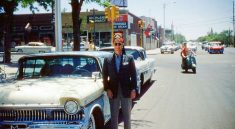
In the vibrant world of classic cars, two names resonate with palpable nostalgia: the 1957 Ford Thunderbird, a symbol of elegance, and the Budd XT-Bird, a prototype that would never see the light of day. Imagine for a moment that the former was a movie star, while the latter is just an abandoned script in a studio’s drawers. Let’s dive into this automotive saga, between dazzling success and unfulfilled dreams.
An iconic legacy: the 1957 Ford Thunderbird
The 1957 Thunderbird is a true masterpiece of design. Its look is both bold and timeless, like a love song from the 50s that continues to haunt the minds. This car, which marked the end of the production of the “Baby Birds,” was the last of its lineage to roll off the assembly line on December 13, 1957. With its E-Code 312 engine producing 270 horsepower and its two Holley carburetors, it is not only beautiful but also knows how to pack a punch.

This automotive beauty stands out with its striking “Thunderbird Bronze” color and its meticulously restored interior. The last example has been cherished at the Gilmore Car Museum, where it testifies to the craftsmanship of a bygone era. Imagine the factory workers placing a sign on its flank: “Bye bye, baby.” It’s a farewell worthy of a Hollywood diva.
The aborted dream: the Budd XT-Bird
But while the Thunderbird celebrated its greatness, creative minds at Ford were brainstorming what would become the Mustang. Among the ideas emerged the Budd XT-Bird, a tempting yet unrealistic proposal. In collaboration with the Budd Company, which had already designed the bodies of previous Thunderbirds, Lee Iacocca hoped to rekindle the magic of the original model with a modernized design. Everything seemed to be on track, but it would have been like trying to turn an old vinyl into an MP3 without altering its soul.

The prototype was based on a Falcon whose chassis had been carefully modified to accommodate a body inspired by the 1957 T-Bird. The rounded wings and the absence of those famous 50s fins highlighted an attempt to adapt to a 60s aesthetic. But in truth, it resembled more of a haphazard combination than a natural evolution. The magic of the T-Bird was in its bold curves, and here, everything seemed a bit too… conventional.
A complex transformation
The design of the XT-Bird perfectly illustrates the challenges of the time: creating an attractive car while controlling costs. The Budd Company had the brilliant idea of cutting the body of a Falcon to fit the chassis of a Thunderbird. With this clever trick, they hoped to sell the body of the XT-Bird to Ford for a song, between $350 and $400. A real gamble! But in the automotive world, creativity isn’t always enough.

With a wheelbase of 109.5 inches — 7.5 inches longer than the original Thunderbird — the silhouette of the XT-Bird lacked harmony. One wondered if it was a car or a poorly executed joke. Even though the dashboard of the original model was reused for the prototype, it could not mask the growing disappointment of purists who saw their icon transform into a caricature.
A critical look at the past
The story of the XT-Bird leaves us with a bitter taste: that of an idea that could have been brilliant but lacked vision. Lee Iacocca ultimately chose to turn the page to focus on the Mustang, a decision that would change the American automotive landscape. The numbers speak for themselves: while the production of the T-Bird reached about 21,380 units in 1957, the Mustang would quickly surpass those figures in the following years.

The XT-Bird project never made it past the prototype stage, and for good reason. The modernized version lacked the sparkle and charisma that had made the original T-Bird famous. Its lines quickly became outdated, to the point that it resembled an elephant dressed as a bird: a clumsy mix that failed to capture the very essence of what a Thunderbird was.
A contrasting legacy
Today, the XT-Bird is preserved at the Henry Ford Museum, where it symbolizes what could have been but never happened. The fact that its engine is a 170 cubic inch Falcon six-cylinder with a supercharger remains vague, yet intriguing. The hypothesis that this engine could have offered additional power seems appealing; however, it would have been too modest compared to the performance demanded by car enthusiasts of the 60s.

And therein lies the tragedy: despite the initial enthusiasm and the considerable efforts made by Ford and Budd to bring the XT-Bird to life, it never managed to compete with the icons surrounding it. The success of the Mustang proves that sometimes, it’s better to let certain legends live without unnecessary alterations.
Official sources: