

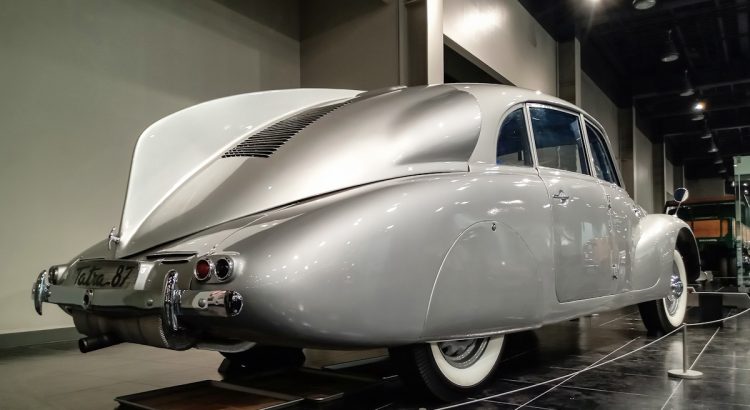
Who would have thought that the Tatra 87, a true monument of automotive engineering, would one day find itself thousands of kilometers away from its homeland? Yet it was in the Toyota automobile museum in Japan that I had the incredible chance to encounter this timeless beauty. In a dark corner of the museum, the T87 awaited, displaying a majestic presence despite unfavorable lighting conditions. The joy of admiring such a masterpiece cannot be dimmed by a few shadows.
The Origins of Tatra
The saga of Tatra begins in 1850, in a small town named Nesseldorf, then located in the Austro-Hungarian Empire. Originally, this company was dedicated to carriages and wagons. It was not until 1897 that Tatra ventured into automobile production. In 1920, the town became Kopřivnice, and the cars and trucks produced took the name Tatra, in homage to the Slovak mountain range. This evolution reflects a commitment to innovation that continues to this day.
An Heritage of Innovation
Tatra quickly became synonymous with manufacturing quality and technical innovation, thanks to the influence of Hans Ledwinka, who joined the company just as it was opening its automotive department. From 1906 to 1945, he shaped Tatra, often remaining on the ground, among the machines. This passion for innovation allowed Tatra to offer avant-garde vehicles, such as the V570 prototype, designed to be a popular car, but which paved the way for much bolder models.
The Birth of the Tatra 87
The Tatra 87 was born in 1937, but it was in 1938 that it truly began to captivate the public. This model represents a major advancement over its predecessors, with a steel monocoque structure and a modernized V8 engine. With its 75 horsepower, this sedan can reach 160 km/h, an achievement for its time. The combination of its fluid lines and aerodynamics makes it a true work of art on wheels, a real gem that could make many contemporary supercars envious.
Design and Performance
In terms of design, the T87 managed to stand out with its sleek appearance and exemplary aerodynamics, boasting a drag coefficient of 0.36 – a figure that would make even some modern cars blush with jealousy. Engineers developed a steel body that improved rigidity while maintaining a touch of classicism with wooden elements for the doors. The front and rear suspensions, although innovative for their time, gave it a reputation for delicate handling, especially at high speeds. Driving this sedan would undoubtedly be an experience as exhilarating as it is anxiety-inducing.
A History Marked by War
Despite the growing tensions in Europe, the production of the T87 continued until 1944. This model, prized by German officers, was even equipped with an anti-intrusion headlight during the war. After the German defeat, Tatra resumed production under a new regime, but without Hans Ledwinka, who had been imprisoned for collaborating with the Nazis. The post-war period was marked by strong demand for this iconic model, which found its way to distant countries like Brazil and Egypt. A journey fraught with challenges that did not tarnish its image.
A Mythical Model
The Tatra 87 is not just a car; it is a symbol of a bygone era. With around 3,000 units produced, most of which were made after the war, this sedan has managed to win the hearts of many motorists. Yet, I can’t help but wonder how many of these wonders are still in circulation today. My last memory of a T87 dates back to my youth, probably during a visit to the Schlumpf museum. This model remains etched in my memory as a masterpiece of automotive history.
The Magic of a Meeting
Meeting an automotive hero like the Tatra 87 is an unforgettable experience. It evokes a time when automotive engineering reached peaks of audacity and elegance. Although I dream of seeing it in motion, slipping into its cabin would already be a privilege. Driving such a car would undoubtedly be an adventure as exhilarating as it is anxiety-inducing. But after all, who hasn’t wanted to meet their heroes? It’s worth a few thrills.


