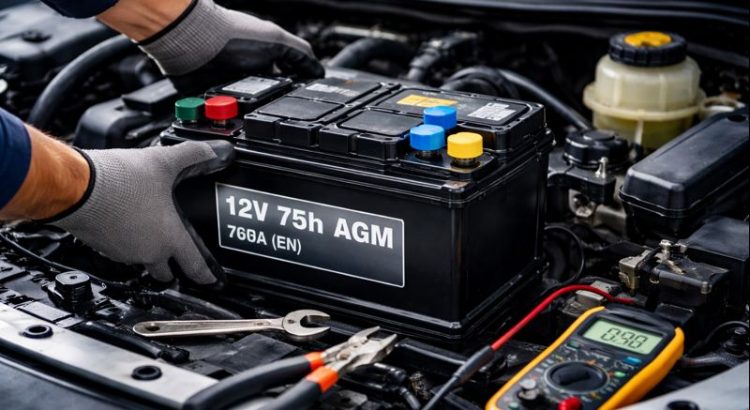
Changing a 12V battery seems simple… until the moment the engine refuses to start, the Start & Stop begins to fail, or error messages pop up on the dashboard. In modern cars, choosing the right battery — technology, capacity, cold cranking amps — and how to replace it — connection order, coding — are crucial. This practical guide explains how to choose and replace a 12V battery correctly while avoiding common mistakes.
1) Information to read on a battery: Ah, CCA, and technology
Capacity (Ah): endurance
The capacity, expressed in Ah (amp-hours), represents the “reserve” of energy in your battery. The higher the Ah, the more it can power your equipment while stationary and handle short trips without issue. However, be careful: this is not a “free bonus”; if your vehicle is not designed for it, it is imperative to respect the dimensions and mounting.
Cold Cranking Amps (CCA): the real criterion in winter
The CCA (Cold Cranking Amps), often measured according to the EN standard, indicates the ability to provide a high current at startup, especially during cold winter mornings. If you live in a region with harsh climates, prioritize a CCA equivalent to or slightly higher than the original, without going overboard.
Technology: conventional lead, EFB, or AGM
- Conventional lead: ideal for cars without Stop & Start systems or with very basic equipment.
- EFB: often used in “simple” Stop & Start systems, it supports more cycles than a conventional battery.
- AGM: more robust, this technology is frequently installed in demanding Stop & Start vehicles or those with extensive electronics.
Golden rule: if your car is equipped with an EFB or AGM, avoid reverting to a conventional battery. This could lead to recurring failures and a very limited lifespan.
2) How to be sure of the right battery for your vehicle
Most reliable option: stick to the original specs
Note the values of the old battery: Ah, CCA, technology (AGM/EFB), and sometimes the format. This is the safest starting point to avoid unpleasant surprises.
Check the format and “trivial” (but blocking) details
- Dimensions: length, width, height (otherwise the battery won’t fit or secure).
- Terminal type: often standard EU auto, but not always.
- Polarity: location of the positive terminal (+) (on the right or left). Reversing it could make the cables too short.
- Mounting: some batteries require a specific base for lower securing.
Can you “upgrade” an EFB to AGM?
Generally, yes (AGM being more robust), but it’s preferable to follow the manufacturer’s recommendations. If your car finely manages the charge, it may be necessary to declare the technology (AGM/EFB) via diagnostics after replacement.
3) When to replace: unmistakable signs
- Slow starting, especially in the morning.
- Rapid discharge after a few days of inactivity.
- Start & Stop unavailable without an obvious reason.
- “Phantom” electronic error messages.
- Aging battery (often between 4 and 7 years, depending on use and climate).
If you have to recharge very often to keep the system alive, you are only buying time. The underlying cause may be that the battery is at the end of its life, the vehicle is not charging it properly, or there is a parasitic drain.
4) Replacing a 12V battery: the clean method (step by step)
Useful materials
- Appropriate wrench(es) (often 10 mm).
- Gloves and goggles (especially if there is oxidation).
- Wire brush/fine sandpaper (to clean the terminals).
- Terminal grease (optional).
- Multimeter (optional but handy).
Before starting
- Turn off the ignition, remove the key, open the hood.
- Wait 2 to 5 minutes: on some cars, modules remain active for a moment.
- If your battery is in the trunk or cabin, ensure you have access to tools and lighting.
Step 1: disconnect in the correct order
1) Disconnect the negative terminal (–) first. This is the safest rule: it reduces the risk of accidental short-circuiting if your tool touches the bodywork.
2) Then disconnect the positive terminal (+).
Step 2: remove the battery
- Unscrew the bracket or securing strap.
- Remove the battery (it’s heavy), keeping it upright.
- Clean the tray and check for significant oxidation.
Step 3: install the new battery
- Position it correctly (polarity +).
- Re-secure the strap (a poorly secured battery deteriorates quickly).
Step 4: reconnect in reverse order
1) Reconnect the positive terminal (+) first, then tighten properly.
2) Reconnect the negative terminal (–), then tighten.
Step 5: quick check
- Start: the engine should