Fernando Alonso, a veteran of Formula 1, does not hesitate to voice his opinions on the evolution of the discipline. Between a nostalgia for the cars of yesteryear and the current technological challenges, the Spaniard speaks of a driving reality that has become more complex and, in his view, less exciting.
A New Generation on the Grid
As the grid of Formula 1 gradually gets younger, with eight of the current 22 drivers under the age of 25, several competitors, such as Valtteri Bottas, Sergio Pérez, Nico Hülkenberg, and especially Lewis Hamilton and Fernando Alonso, stand out as true veterans of the discipline. Their valuable experiences contrast with the ambitions of the young talents who are launching onto the asphalt.
Today, these drivers are about to experience a new era in F1. The change is expected to be a bit more abrupt than anticipated. Even though the chassis and engine have not been completely overhauled, the introduction of a larger share of electricity in the power unit and its management during races and qualifying represents a major challenge for the 2026 season.
The Complexity of Modern Driving
When asked about this new way of driving, which requires increased skills in battery management and active aerodynamics, Fernando Alonso does not hide his concern. He expresses a certain regret regarding the use of energy, which he believes is too “regulated.”
“I think it’s a bit more complex, so it requires a bit of thought before getting into the car or preparing for an overtaking maneuver, for example,” said the two-time world champion during the launch of the 2026 Aston Martin livery. “But at the same time, the teams are now very well prepared; everything is simulated in advance. We already have this information by Thursday, so by Sunday, I think there are not many surprises or many mistakes possible for the driver.”
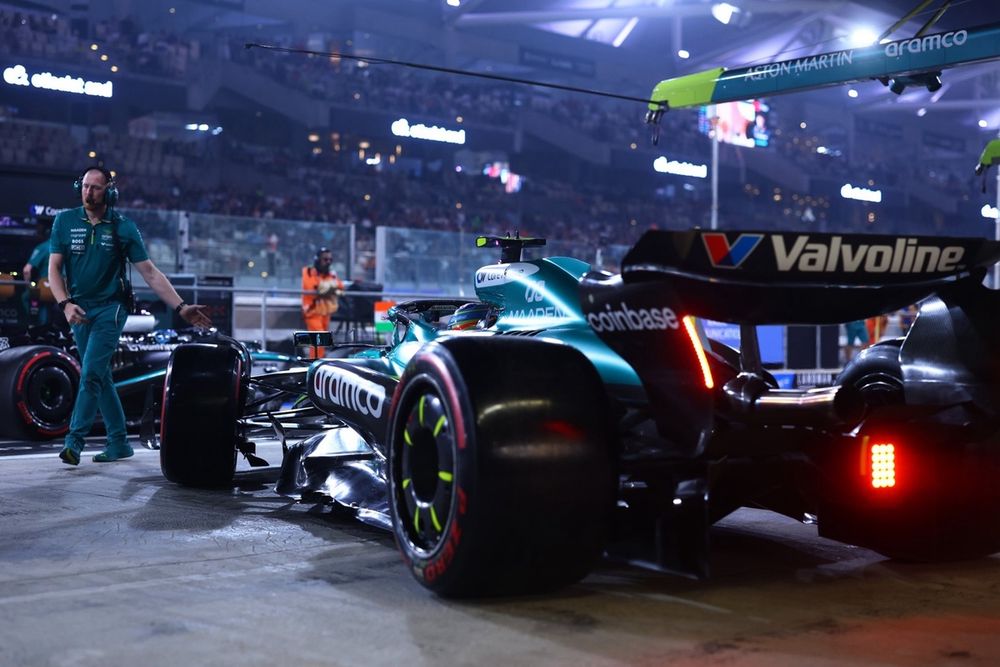
Fernando Alonso in the AMR25.
For him, this rigor has its downsides. “Let’s say there isn’t much freedom regarding what you can do in the cockpit or the amount of energy you can use, which is very limited by the FIA,” he adds. According to Alonso, the reduction of energy must occur at a certain pace, which limits the drivers’ ability to unleash their full potential.
“So there are a few points that are probably too regulated. In terms of freedom or how to use this energy intelligently, the differences will be minimal, as unfortunately, there is not much room for maneuver.”
A Golden Era Gone?
When asked if this strict regulation can stifle the natural driving of the drivers, Alonso replies: “Probably, yes.” Indeed, present in Formula 1 since 2001, the Spaniard has experienced several generations of single-seaters, particularly those from the early 2000s, where driving seemed more accessible and instinctive.
At that time, the cars and engines were very different, and the sensations behind the wheel were purer. Alonso believes that the current reality is somewhat diluted to appeal to younger generations and maintain interest in this premier category of motorsport. “I think it was more interesting before, but it has to be ‘sold’ to the new generation,” he admits with a hint of melancholy.
“You can’t say that the cars are worse today, but no one will say that driving before was worse than now. There was undoubtedly more adrenaline with the old cars, a real feeling of driving at the limit.”
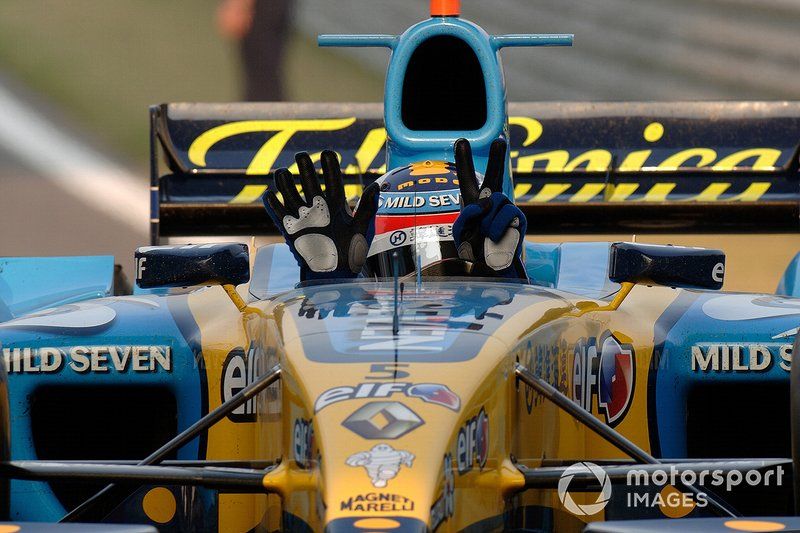
Fernando Alonso in the Renault R25, the single-seater with which he won his first world championship title in 2005.
The Quest for Authentic Sensations
For Alonso, modern single-seaters lack authenticity. “Even when you get into a kart, it’s probably the purest type of racing you can have. It’s enjoyable to drive cars at the limit of physics, and not in an ‘efficient’ or robotic style,” he declares passionately. In his eyes, it is essential to regain that spirit of challenge and unpredictability that characterized racing in the past.
“Everything is more or less organized this way, and I’m sure it can be found in many other sports, football, basketball, the NBA, no matter,” he explains. According to him, the evolution towards a rigid structure has taken away some improvisation and adrenaline from competitions. “Before, 20 years ago, maybe a player had a magical evening and won the match. Today, everything is more structured, and precise mechanisms are needed to really perform in a basketball game. The pure inspiration of someone is somewhat forgotten in this generation.”
A Necessary but Delicate Transition
Alonso does not question the interest in technical innovations, but he advocates for a balance between modernity and authenticity. Formula 1 must continue to evolve while preserving what makes it rich: the emotion of driving and the thrill of racing. The challenges that await drivers in the coming years will undoubtedly be exciting to experience, but it is essential to keep in mind that competition must remain a field of expression for the talents of the drivers.
As F1 embarks on this challenging path, it will be fascinating to observe how these changes will influence not only the spectacle on the track but also the way drivers feel about their profession. Alonso’s nostalgia may resonate with other drivers who experienced that era when each race was a unique adventure.