


Haas F1 has taken the lead by presenting its 2026 car, the VF-26, well ahead of other teams. However, don’t be fooled by the initial images, as the reality on the track could be quite different. As the new regulations come into play, the development battle intensifies, and changes may be as frequent as a tire change during a race.
Promising but Uncertain Beginnings
While we have already seen Audi and Cadillac in action, as well as Red Bull and Racing Bulls reveal their colors, Haas F1 is the first team to present its car for 2026. Yet, Ayao Komatsu, the director of the American team, warns that the images of the VF-26 are just the tip of the iceberg. “The car everyone will see in Barcelona will not be the one racing in Australia. I think this will be the case for the entire grid, as it is simply too early.” This observation reminds us that the road to perfection is long and fraught with obstacles.
What makes this period even more delicate is the busy schedule. Komatsu explains: “The situation may be different when there is only one test two weeks before the first race, but with more than a month before the season opener, teams are not going to stop wind tunnel development.” In short, the cars that will run in Barcelona and at the first test in Bahrain will be prototypes still in the testing phase, far from their final version. This is not a sprint, but a true marathon.
Constant Development Under Pressure
Between the tests in Barcelona and those in Bahrain, we will witness notable evolutions across all cars, particularly regarding the aerodynamic package. “On the power unit side, the material is almost fixed. The big question is how we will use this power unit.” Clearly, optimizing energy will be crucial to make the most of each lap. The pressure is therefore at its peak for the teams, which must juggle between innovation and reliability.
A Marathon Without a Finish Line
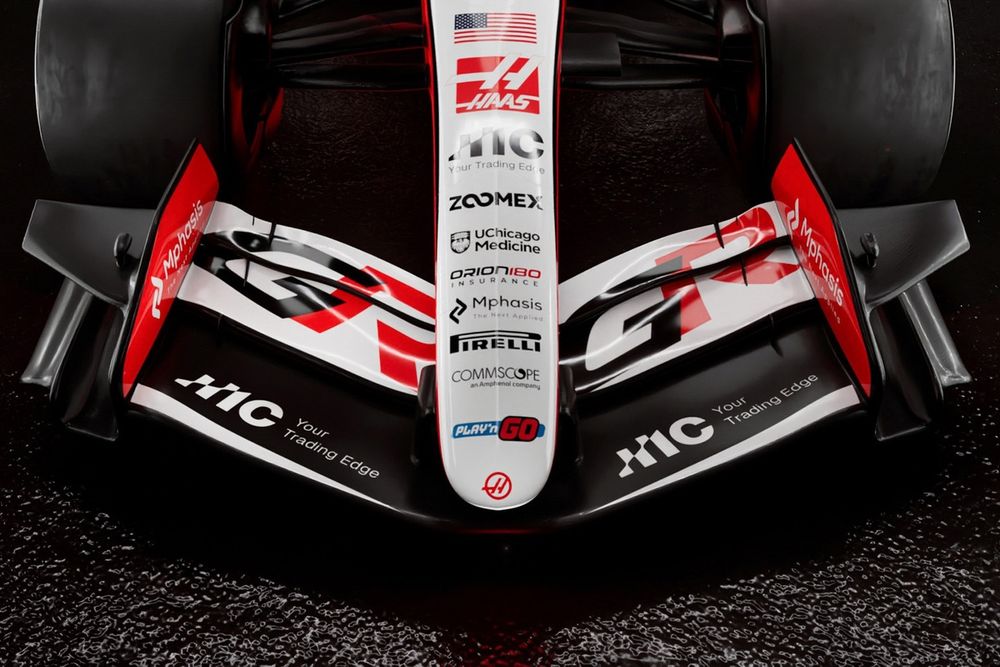
The front wing of the Haas VF-26
With a major overhaul of chassis and engine regulations for 2026, the Haas team had to anticipate the advent of this new era. Andrea de Zordo, the technical director, highlights the unique challenges the team faces: “Everything actually started during the second half of 2024, with a small group working on the concept of the new car.” This group then evolved until the launch of the VF-25, with a gradual reallocation of resources towards the 2026 program.
Interestingly, a small group continued to work on the VF-25 quite late, as every point in the championship was crucial. “It was about deciding the main work axes for 2025 and 2026, without losing too much time on what we knew would be a major season.” This duality between the development of two cars demonstrates the complexity of the strategy implemented by Haas.
Milestones of a Complex Process
The official presentation of the VF-26 marks an important milestone in this long process, but it only represents part of the journey ahead. “The process has been a marathon, and when we think we see the end, I suspect it is actually just the beginning.” Andrea de Zordo thus mentions the crucial milestones: “The first milestone was the testing of the dummy chassis and the homologation of the final chassis.”
Teams must work quickly to avoid falling too far behind in development. “If something needed to be corrected, it would represent an enormous additional workload. Fortunately, everything went well.” This is a relief for a team that knows every detail counts in this race for innovation.
A Promising Future Despite Uncertainties
The homologation of the front wing was also a key moment for Haas. “We had to define its mechanism and test it in the lab to validate our hypotheses.” Upon arriving at the simulator, engineers were able to start visualizing potential performances for the upcoming season: “It was the first concrete assessment of our work.”
The challenges are numerous, but Haas seems ready to rise to the occasion. With a united team and a clear vision, they are preparing to enter a new era that could redefine their place in the pack. It remains to be seen whether the promises of innovation will translate into tangible results on the track. One thing is certain: with the recent regulatory changes, the game is far from over.


