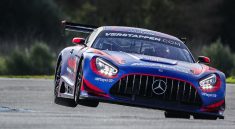
Lewis Hamilton, in third place during the qualifying session for the Chinese Grand Prix, has shown revealing caution regarding Mercedes’ performance. This questioning raises crucial strategic stakes for the team and its competitors, especially in a context where every millisecond counts.
A Mixed Podium for Hamilton: Between Satisfaction and Skepticism
Lewis Hamilton recorded the third-best time in qualifying in Shanghai, positioning himself as a direct competitor to the Mercedes. However, this result is tinged with a certain ambiguity. In a sport where performance often equates to dominance, Hamilton seems to doubt the authenticity of the strength displayed by his former team. “Maybe they didn’t activate their [engine] mode,” he remarked with a hint of irony. This comment suggests that the team may have strategic reserves, a chess game where every piece is moved with caution.
Discrepancies to Consider: The True Pace of Mercedes?

Lewis Hamilton congratulates Kimi Antonelli after his first pole position in F1.
The gap of 351 milliseconds with poleman Kimi Antonelli is revealing, but it must be interpreted with caution. Hamilton himself admits that the race pace of the Mercedes could be four to six tenths faster. This analysis fuels the debate on race strategy and the real potential of the W17s. In practice, this could influence the tactical choices of rival teams, which will need to adjust their approaches based on the performances displayed in qualifying.
The Qualifying Dynamics: An Opportunity to Seize
The start of the season seems more competitive for Hamilton than the end of the previous year. The changes made to the car have evidently allowed for progress, but the former champion remains clear-eyed. “I think we have gotten a bit closer,” he emphasizes, while indicating that the true measure of their progress will only be evident after the upcoming races. This dynamic could prompt other teams to rethink their development and performance optimization strategies.
A Competition More Intense Than Ever
The rivalry between Hamilton and his former teammate George Russell highlights an internal competition that could become an asset for Mercedes. Russell, with his second-best time, shows that the team not only has a fast car but also two drivers capable of maximizing that performance. This could turn qualifying into a true strategic duel within the team, but also against other competitors like Ferrari or Red Bull.
Upcoming Races: A Constant Challenge
Hamilton is aware that the road to victory is fraught with obstacles. “It is very unlikely that we can beat them in the race,” he admits candidly. This clarity is essential in a sport where optimism can quickly clash with the reality of the track. Teams must therefore anticipate race strategies, taking into account not only qualifying performances but also tire management and tactical choices during the race.
In Summary
- Hamilton questions the transparency of Mercedes’ performances.
- A gap of 351 milliseconds that requires cautious interpretation.
- The changes made to the car seem to be paying off.
- Internal competition at Mercedes could boost overall performance.
- Upcoming challenges force each team to rethink its strategy.
Who are these reflections relevant for? For fans of Formula 1, of course, but also for teams looking to understand performance dynamics in such a competitive environment. In terms of alternatives, brands like Ferrari and Red Bull could leverage the doubts raised by Hamilton to refine their own strategies. The strengths of this season seem to lie in uncertainty and the need for rapid adaptation in the face of rivals who may be hiding their true game.