

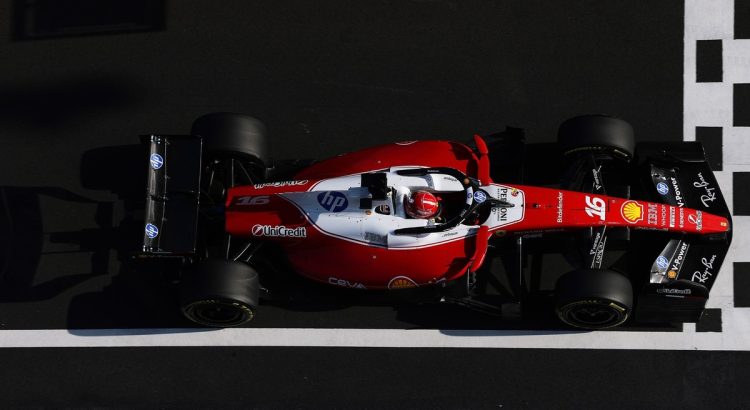
The Chinese Grand Prix revealed the flaws of a Scuderia Ferrari still in search of performance. Charles Leclerc, despite undeniable talent, suffered the consequences of an energy problem that prevented him from shining during qualifying. This setback raises crucial questions about the reliability and competitiveness of the SF-26 against rivals like Mercedes.

A tense qualifying
The sprint qualifying of the Chinese Grand Prix was dominated by George Russell and Kimi Antonelli, but the Scuderia Ferrari seemed capable of competing, at least at the beginning. Charles Leclerc finished the session with a modest sixth time, far from the expected performances. Far from being a mere anecdote, this situation highlights a recurring problem: Ferrari’s ability to maintain a consistent level of performance under pressure.
Leclerc expressed his frustration after the session, mentioning issues with his steering wheel and an unexplained loss of power on his last lap. This statement is not trivial, as it reveals a concerning technical instability. Indeed, this inability to maximize the vehicle’s potential in qualifying could have repercussions throughout the season, especially against competitors like Mercedes, who display impressive consistency.
A failing energy deployment
Frédéric Vasseur, Ferrari’s director, confirmed that the problem encountered by Leclerc was related to energy deployment. This type of technical issue may seem minor, but in the ultra-competitive world of Formula 1, every tenth of a second counts. Leclerc lost about three tenths in the last straight, a significant handicap that not only affected his qualifying time but also his confidence in the car.
In fact, this situation questions Ferrari’s development strategy. While other teams, like Mercedes, seem to have found the recipe to maximize performance in qualifying, Ferrari faces technical obstacles that could compromise its ambitions. This strategic turnaround is all the more concerning as the season progresses and points begin to become scarce.
Leclerc remains optimistic, but at what cost?
Despite the difficulties encountered, Leclerc has shown a certain optimism regarding the performance of the SF-26 in the race. He believes the car should be more competitive when the lights go out. However, this optimism could be a double-edged sword. Indeed, hoping for better performance in the race without resolving the technical issues in qualifying could lead to a frustrating season.
The question then arises: how far can one afford to be optimistic? Competing teams, particularly Mercedes, are not standing still. Their advantage in qualifying could allow them to gain a lead in the championship, making every race crucial for Ferrari. This last stand could very well turn into a fierce struggle to catch up with an already significant deficit.
A formidable competition
The fight for the title has never been fiercer. Charles Leclerc is not only competing with Mercedes; he must also be wary of Lando Norris and Oscar Piastri’s McLarens, who are dangerously close. During qualifying, Norris showed he was capable of competing with the best cars, further complicating Ferrari’s task.
In practice, this increased competition pushes each team to refine its technical strategy and performance. Therefore, Ferrari must not only resolve its internal problems but also anticipate the moves of its rivals. Leclerc’s ability to get the best out of his car will be essential to face this growing pressure.
A strategy to rethink
It is clear that Ferrari needs to reassess its short- and medium-term strategy. The technical problems encountered by Leclerc are not isolated and reflect an urgent need for improvement in the energy management of the SF-26. If the team fails to find solutions quickly, it risks tarnishing its image and compromising its podium ambitions.
In short, it is imperative for Ferrari to adopt a proactive approach, both technically and in terms of communication. Leclerc, as the leader on the track, must also be supported by a team that understands the importance of every technical detail. Otherwise, hopes for victory will gradually fade as the season progresses.
In summary
- Leclerc faced an energy problem during qualifying at the Chinese Grand Prix.
- Frustration and technical instability highlight Ferrari’s flaws.
- The performances of Mercedes and McLaren complicate the situation for Ferrari.
- Leclerc’s optimism must be tempered by concrete results in the race.
- Ferrari needs to rethink its strategy to remain competitive over time.
In conclusion, the road remains fraught with obstacles for Charles Leclerc and Scuderia Ferrari. The optimism displayed by the Monegasque driver is commendable, but it must be accompanied by a deep reassessment of technical strategies and qualifying performances. If Ferrari fails to correct its course quickly, it risks being outpaced not only by Mercedes but also by rising teams like McLaren. In the medium term, the image of the Scuderia could suffer, along with its ambitions for a title that seems to be drifting away.


