


The regulatory changes in Formula 1 for 2026 are not mere adjustments. They mark a decisive turning point that disrupts everything from engines to brakes, including aerodynamics. Get ready for an unprecedented spectacle where thermal and electric power balance out, and where engineers will need to demonstrate unprecedented creativity.
A Major Technical Overhaul
The 2026 season promises to be a true technical challenge for Formula 1 teams. With a shift in engine power distribution from 80/20 between thermal and electric to a perfect balance of 50/50, brake design becomes crucial. Currently, the cars use a 120-kilowatt (161 horsepower) MGU-K, but soon this power will rise to around 350 kW (469 horsepower) with the removal of the MGU-H. This will not only boost the speed of the cars but will also transform their behavior in terms of braking.
Andrea Algeri, F1 customer manager at Brembo, emphasizes the importance of these developments: “This is my 15th season in Formula 1, and I can tell you that this change is one of the most complex we have ever had to manage.” The increased demands for energy recovery via the MGU-K require teams to completely rethink their approach to braking, which will benefit from significantly increased regenerative power.
A New Regulatory Framework
The FIA has revised its regulations regarding brake discs, allowing front diameters to range between 325 and 345 mm and rear diameters between 260 and 280 mm, all with a maximum thickness of 34 mm. This flexibility allows engineers to opt for larger front configurations and smaller rears. Algeri specifies: “This is the most significant change to the calipers in 20 years, thus offering more freedom to engineers.”
The operating principle remains similar to that of 2014, with hydraulic front brakes and electronically controlled rear brakes. The driver’s brake pedal translates a torque request that is distributed between friction braking and regenerative braking, but innovation will still be needed to take advantage of these new specifications.
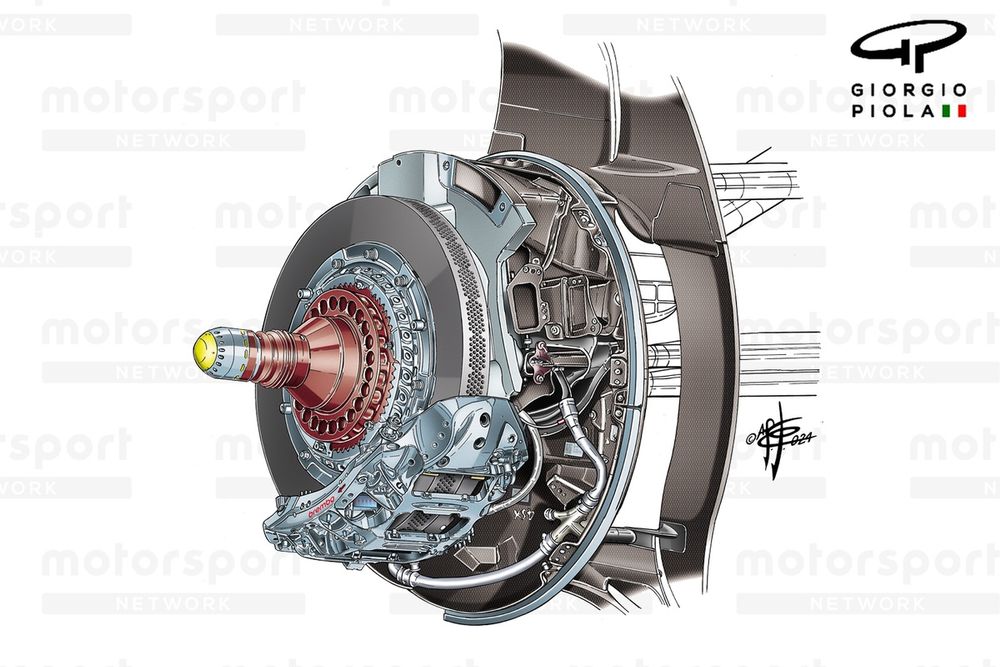
Brembo brake caliper of the Ferrari SF-24.
The Crucial Weight Battle
While engine performance and aerodynamics are at the heart of concerns, another significant issue looms: weight. The new regulations impose a strict limit of 768 kg, even as batteries gain weight. Few teams, if any, are expected to reach this limit by the start of the season, making the quest for weight reduction more crucial than ever.
Algeri explains: “Teams are looking for the best compromise. They do not want to go too far beyond the maximum allowed dimensions, as this could add weight to the vehicle.” Some opt for larger front brakes without reaching the maximum size, while others take calculated risks by reducing the weight of their components.

Comparison of the front brakes of the Mercedes W15.
The FIA also imposes a braking torque requirement for the rear axle of at least 2500 Nm to ensure safety. Indeed, the rear brakes cannot be too small, as they must be capable of stopping the car even without the aid of the energy recovery system. “We must avoid catastrophic scenarios,” warns Algeri.
Rethinking Circuit Classification
As braking dynamics evolve with the increase in regenerative power, the circuits themselves will need to be reevaluated. For example, Monza, known for its speed, may see different brake demands compared to more winding circuits like Monaco. Algeri notes: “We need to rethink the assessment of braking load, as it is now more linked to energy recovery.”
Low-torque circuits will paradoxically become very demanding on brakes, as cars will have time to recover energy before needing to slow down. This means that cooling requirements will vary significantly from one circuit to another.

Brake demands are expected to change on fast circuits like Monza.
Teams will need to adapt their braking strategies to make the most of the new technologies. With increased use of regenerative braking, every decision will count on the track, making the 2026 season exciting to follow.
Conclusion: The Future of Braking in F1
Formula 1 in 2026 promises to be both a race of hardware and a battle of software. Managing braking systems will become a crucial key to the performance of the single-seaters. Teams will have to juggle technical requirements and regulatory limits while seeking to maximize their efficiency on the track. An exciting adventure lies ahead, and we look forward to seeing how these innovations translate into concrete performances in the upcoming races.


