Eventful Testing in Malaysia
Yamaha recently encountered significant challenges during its testing sessions at Sepang, with engine issues overshadowing performance. The chaotic shakedown and limited timed laps turned the tests into a headache for engineers and riders alike. The Iwata-based manufacturer must double down on efforts to remain competitive this season.
Engine Problems Halt Progress
Malaysia, known for its winter testing, welcomed Yamaha under tense circumstances. An engine failure on the penultimate day brought all bike activity to a standstill. Engineers quickly shifted into investigation mode, racing against time to diagnose the problem before riders could return to the track. Each minute off the bike felt like a step closer to a challenging season.
When they finally returned, the directive was clear: ride “calmly.” Álex Rins confirmed this instruction, which limited not only their riding style but also their testing capabilities. Massimo Meregalli, sporting director of Yamaha Motor Racing, acknowledged the situation: “As you can imagine, everything is new and we don’t have many parts,” he stated. The strategy of managing both the Sepang shakedown and the upcoming Buriram test with the same equipment appears risky at this stage.
Struggles with Engine Performance
The lap times reveal the stark reality: Rins’ best performance clocked in at 1’57″580, placing Yamaha at the bottom among five competing brands, sharing this unfortunate distinction with KTM, and failing to approach the 1’56 mark. In terms of top speed, the M1s lag even further behind with a maximum speed of 335.4 km/h, while competitors easily surpassed the 340 km/h threshold—a considerable blow to Yamaha’s reputation.
Meregalli did not shy away from addressing the engine’s current shortcomings: “The area where we need to improve the most is power.” While the bike’s handling and balance seem satisfactory, raw performance clearly needs significant enhancement. Gino Borsoi, team manager at Pramac Racing, echoed these sentiments: “From a chassis perspective, the bike is quite competitive and it works very well. It is clear that we still lack top speed.” This highlights the considerable challenges ahead for Yamaha.
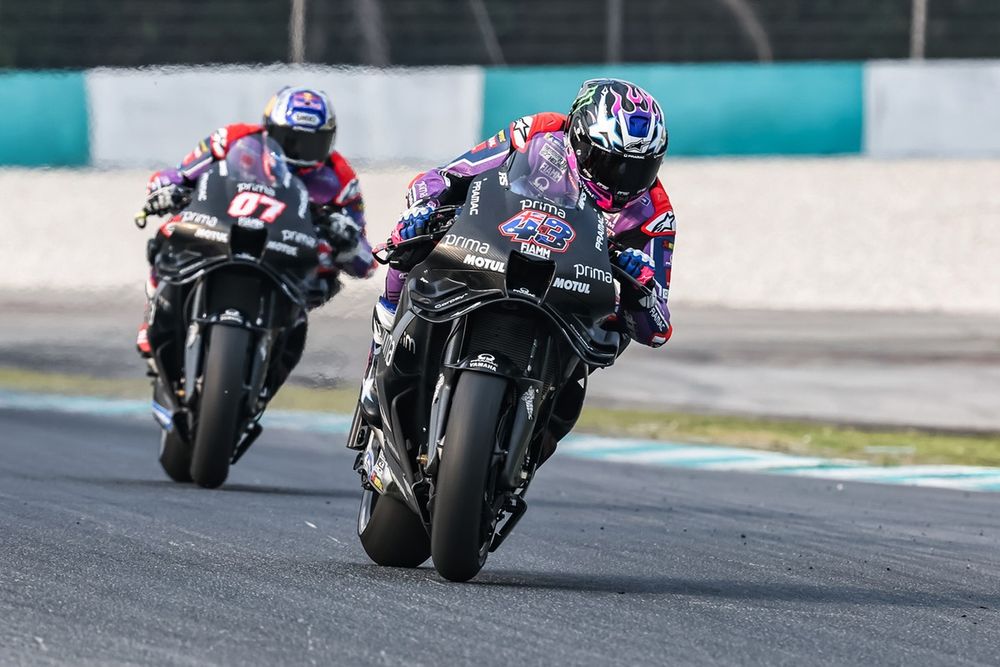
” alt=”Jack Miller and Toprak Razgatlioglu (Pramac Racing)”>
Crisis Management Efforts
Despite the technical hurdles, the Yamaha team is actively working to address the issues. Rins remained optimistic: “Fortunately, all the important things we needed to test, we tested on the first day of the shakedown and the first day [of this test].” This provides a glimmer of hope amid a challenging context.
Meregalli described the tests as “productive,” noting that they managed to evaluate most components on the agenda, including the chassis, swingarm, and aerodynamics. However, fine-tuning settings will have to wait until the Buriram test.
The situation worsened when Rins disclosed that two engines failed during testing: “They told us we couldn’t ride because Fabio and Toprak broke an engine.” This emphasizes how critical every detail is in competition. Rins hopes the new engines expected for the next test will alleviate constraints: “The engines won’t break now that Yamaha has shed light on the origin of the problem.”
Looking Ahead
The next testing session is scheduled for February 21 and 22, just days before the season’s first Grand Prix. This deadline looms large over the shoulders of both riders and engineers. With a balance between caution and performance, Yamaha must hope these tests have laid the groundwork for a successful season. The road ahead remains long, but every lap counts. Expectations are high, and doubts linger regarding the M1’s true capabilities against an increasingly competitive field.
In the meantime, MotoGP fans can stay updated with all the latest news on this thrilling sport at the dedicated MotoGP site, a must-visit for speed and adrenaline enthusiasts.