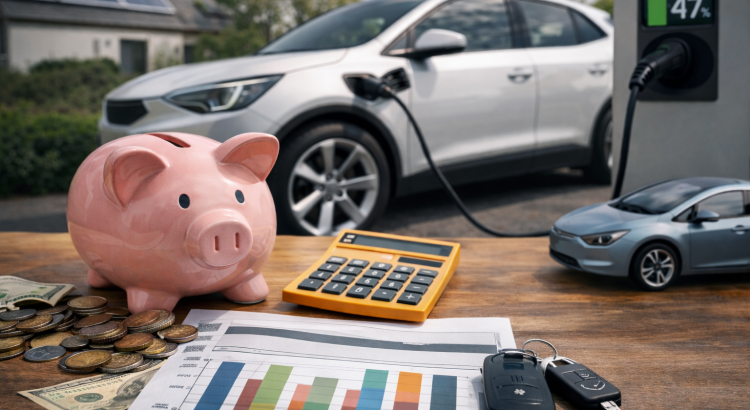
People talk a lot about the “catalog price,” and far less about what really matters: the true cost of an electric vehicle over 3, 5, or 7 years. Because once you factor in incentives, discounts, home charging, resale value, insurance, and maintenance, two models with the same sticker price can end up costing… very different amounts.
This article is intentionally evergreen: not today’s news, but a simple, durable method to choose an EV that’s genuinely cost-effective, avoid the common traps, and understand why some EVs become “affordable”… and others never do.
Forget the displayed price: the only question is the total cost
The most common (and misleading) reflex is to compare EVs solely on the purchase price. However, electric vehicles are judged on the TCO (Total Cost of Ownership), which means the total cost over time: purchase or monthly payments, energy, maintenance, tires, insurance, taxes, and resale.
To remember: an EV can be “expensive” to buy yet economical to use… or the opposite, if you misjudge the charging scenario, range, or financing option.
The 7 levers that make an EV truly “affordable”
- Home charging (this is cheat code #1).
- The right battery size (neither too small nor too large).
- High efficiency (consuming little means paying little).
- Reasonable insurance (often underestimated).
- Correct resale value (or a well-negotiated lease).
- Controlled tire costs (heavy EVs wear out tires).
- Strong battery warranty (and a clear history for used vehicles).
Charging: the difference between “good deal” and “soft scam”
The promise “electricity costs less” is true… if you mostly charge at home. At home, you control your price per kWh (and you can optimize with off-peak hours). On fast chargers, the cost rises and can bring the EV closer to a combustion vehicle in cost per kilometer, especially on repeated long trips.
Simple rule:
- If you can charge at home (house, condo with solution, professional parking), you have a structural advantage.
- If you depend 80% on fast chargers, the EV may remain enjoyable… but not necessarily “economic”.
Evergreen tip: calculate your energy cost over a typical month (trips + one long trip), not on an ideal “perfectly optimized” case.
Range: a battery that’s too large is a luxury, not a savings
Many people buy a large battery “just in case.” The result: they pay more, carry more weight, consume more, and tie up budget for rare use.
The right reasoning:
- Calculate your daily trip + weather margin (cold, rain, heating).
- Add a comfort margin (detours, unforeseen events, aging).
- Then choose the battery that meets this need without overpaying for the exception.
In general, the most “affordable” EV is not the one that promises the greatest range, but the one that has the best efficiency and a “just right” battery for your use.
Don’t get hypnotized by horsepower: efficiency pays, weight costs
Electric vehicles love torque and acceleration. Your wallet, however, loves efficiency. Two EVs may display similar ranges, but one consumes much more (heavy SUV, large wheels, wide tires) and costs you more daily.
Evergreen checklist:
- Prefer an EV known for low consumption in real use.
- Beware of large wheels (consumption + tires + comfort).
- A heavy SUV may be great to live with… but rarely “affordable” over time.
Purchase, lease, long-term lease: the “smart” strategy depends on your profile
There is no magic formula. There is a formula that fits.
- Cash purchase / loan: interesting if you keep it for a long time, charge often at home, and choose a model with good resale.
- Lease: useful if you want to protect yourself against the uncertainty of resale value. But watch out for mileage, return fees, and final buyout price.
- Long-term lease: comfortable if you want to “smooth everything out” (predictability), especially for professional use or high mileage… but compare the total cost.
Evergreen reflex: always compare total cost over time, not just the displayed monthly payment.
Used: the “affordable” EV already exists… if you check 5 points
The used market is often the real ground for good deals. But you need to check the right elements, because the EV doesn’t have the same weaknesses as a combustion vehicle.
- Battery health status (SOH/diagnostic, range consistency).
- Charging history (lots of fast charging isn’t automatically “bad,” but it matters).
- Battery warranty: remaining duration, conditions, transferable.
- Onboard charger and compatibilities (AC, DC, power).
- Thermal equipment (heat pump, preconditioning) that affects comfort and consumption.
Tip: a “simple, efficient, well-regarded” EV in the used market is often more profitable than a spectacular but heavy and costly model.
Maintenance: less mechanics, but not “zero costs”
Yes, maintenance is often lighter than on a combustion vehicle (no oil changes, fewer moving parts). But it still includes:
- Tires (often wear out faster, especially on heavy EVs).
- Brakes (sometimes little used, so risk of seizing if urban use + strong regeneration).
- Brake fluid, cabin filters, wipers, air conditioning, and periodic checks.
Evergreen: the “affordable” EV is often the one that doesn’t explode the tire/insurance bill.
Insurance: the surprise item that can ruin the “good deal”
On some models, insurance can rise quickly (high value, costly repairs, specific parts, electronics). Before signing, do a simulation.
Simple advice: if the annual insurance gap is significant, it can sometimes be the equivalent of “several thousand euros” over the ownership period. The cheapest EV to buy isn’t necessarily the cheapest to insure.
The simple method to decide in 15 minutes
Take your actual usage and fill out this mini-calculation:
- Km/year (and type of roads: city, mixed, highway).
- % home charging vs public/fast chargers.
- Cost kWh at home (off-peak hours if possible) and average charger cost (if you use them).
- Realistic consumption (not the homologation, a cautious value).
- Insurance (simulation).
- Tires (estimated annual budget based on size/weight).
- Resale value or cost of lease/long-term lease over time.
If, after that, the EV is a winner, it is “affordable” for you. Otherwise, it remains a pleasure choice… or an accounting error.
The classic mistakes that make you think an EV is “affordable” when it’s not
- Choosing a large battery “for once a year”.
- Depending too often on fast chargers (energy cost that rises).
- Getting large wheels and a heavy SUV (tires + consumption).
- Comparing only the monthly payment instead of the total cost.
- Forgetting insurance (and discovering it later).
Conclusion: the affordable EV is not a model, it’s a scenario
The “affordable electric car” is not a universal promise. It’s a combination: controlled charging, efficiency, appropriate battery, reasonable insurance, and good financing choice. If you check these boxes, the EV can become an excellent deal, today and tomorrow.
And if you don’t check these boxes? No problem: it’s better to have a good hybrid well chosen than an EV bought on a slogan.