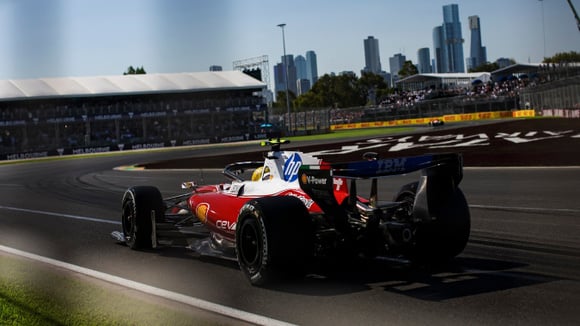
The 2026 Australian Grand Prix kicked off a season that promises to be thrilling, with qualifying marked by Mercedes’ dominance and the emergence of a new talent at Red Bull. In a context where the new technical regulations impose radical changes, the performances observed on the Albert Park circuit suggest a fierce battle for victory.
A new regulation, a new era
The 2026 season signifies upheaval. With the introduction of a new technical regulation, teams have had to double their efforts to adapt their cars. This change is not just a simple redesign; it is a complete overhaul of the performance philosophy. Teams must now juggle aerodynamic and mechanical constraints that could well reshuffle the championship deck. Mercedes, with George Russell on pole, seems to have managed to navigate this well, but the competition remains fierce.
Mercedes in the lead, but vigilance is required
George Russell clocked an impressive time of 1’18″518, placing Mercedes on the front row. Kimi Antonelli, his teammate, follows closely. This initial dominance might suggest a smooth season for the German team, but Scuderia Ferrari and McLaren have not said their last word. Russell’s performance is certainly impressive, but it should not overshadow the progress made by other teams. Indeed, Ferrari has shown signs of competitiveness with Charles Leclerc, while McLaren, with Oscar Piastri and Lando Norris, remains in the mix.
Isack Hadjar, the rising star of Red Bull
The real highlight of qualifying is undoubtedly the explosive entry of Isack Hadjar, who managed to secure third place in his F1 debut. This not only confirms his status as a promising driver; it also raises questions about Red Bull’s future. If Hadjar continues on this trajectory, he could become a major asset for the team, especially in a context where Max Verstappen, the reigning champion, faced difficulties during qualifying. This turnaround could create internal tensions but also energize the competition within the team.
Surprises and disappointments
Qualifying was also marked by surprises, notably the elimination of several expected drivers in Q1. Max Verstappen, Sergio Pérez, and Carlos Sainz failed to qualify for Q2, a tough blow for their respective teams. These results highlight the crucial importance of free practice and setups before qualifying. A strategic error or a lack of performance can quickly prove costly in this sport where every millisecond counts. Teams will need to double their efforts to avoid such setbacks in the future.
The Albert Park circuit: a technical challenge
The Albert Park layout has always been a tricky playground for drivers. With its 15 corners over 5.278 km, this semi-urban circuit demands perfect chassis control and optimal engine management. Drivers must navigate between speed and precision, making qualifying even more intense. The probability of a Safety Car, estimated at 50%, adds a layer of uncertainty that could influence race strategy. Teams will need to anticipate every scenario to maximize their chances of success.
In summary
- Mercedes starts strong with George Russell in pole position.
- Isack Hadjar impresses by finishing third in his debut.
- Max Verstappen and Carlos Sainz eliminated in Q1, a surprise that questions their strategies.
- The new technical regulation redefines the performance of the cars.
- The Albert Park circuit proves to be a major technical challenge for drivers.
The 2026 season promises to be thrilling with a tight battle between Mercedes, Ferrari, and Red Bull. The performances observed during qualifying in Melbourne are just a taste of the battles to come. In the medium term, we can expect an intensification of rivalries, especially with the emergence of young talents like Isack Hadjar. Teams will need to adapt quickly to the new dynamics imposed by the regulations and the surprises that each race may hold. The Australian Grand Prix is just the beginning of a season that could well redefine the hierarchy in Formula 1.