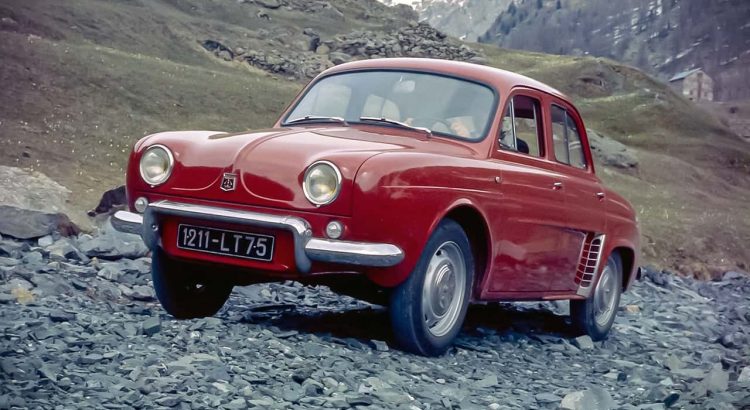
The Renault Dauphine, launched in 1956, marked a turning point in automotive history both in France and internationally. With over two million units produced, it established itself in diverse markets across Europe, America, and even Africa. Its legacy is still felt today as the automotive industry faces new challenges.

A Bold American Ambition
In the 1950s, Renault stood at a crossroads. The small 4CV, the flagship model of the time, enjoyed tremendous success in France. However, the brand’s leaders, led by Pierre Lefaucheux, felt the need to conquer larger markets. Their target? The United States. The challenge was significant: they needed a model capable of competing with American giants. The answer was the Dauphine, grandly unveiled at the Palais de Chaillot in Paris before 20,000 guests.

With its rear engine and rear-wheel drive, the Dauphine promised optimal traction, ideal for the often-degraded roads of the time. Its modern, spacious body, designed by Pietro Frua, was a major asset in a market where comfort and space were decisive factors.
Bold and Colorful Design
The Dauphine was not just practical; it also stood out for its aesthetics. At a time when most cars were painted in dark, austere shades, Renault introduced vibrant colors like “Montijo Red” and “Bahamas Yellow.” This boldness attracted a clientele eager to stand out. In addition to its meticulous finishes, it offered sporty variants and an automatic version that broadened its appeal.

The Birth of a Legend: Project 109
The Dauphine project, known by the codename “Project 109,” was launched in 1951. Visionary Pierre Lefaucheux aimed to create a more spacious and better-engineered car than the 4CV. Unfortunately, he would never see his masterpiece come to fruition, as he tragically died in an accident in 1955. His successor, Pierre Dreyfus, took up the mantle with the same ambition. The name “Dauphine,” inspired by a declaration at a banquet, gave it an aristocratic aura that would charm buyers.

A Bold Commercial Offensive
The launch of the Dauphine was accompanied by an audacious export strategy. In 1957, the first cars were shipped to the United States to entice dealers. The success was immediate: sales skyrocketed, reaching over 100,000 units by 1959. However, this rapid expansion soon faced the reality of the American market, where local competition was intensifying.

In Europe, the situation was quite different. The Dauphine quickly became a bestseller and a symbol of French export. Production was relocated to several European countries and even South America, showcasing Renault’s ambition to establish itself as a global manufacturer.
Challenges in the American Market
Despite a promising start, conquering the American market became increasingly complicated. Starting in 1960, local manufacturers responded with their own compact models, making Renault’s task more challenging. Additionally, internal issues related to poorly managed expansion and an excess stock of unsold vehicles tarnished the brand’s image. Ultimately, the American adventure ended prematurely, forcing Renault to reevaluate its export strategy.

A Lasting Success in Europe and Competition
In contrast, the Dauphine remained a true pillar for Renault in Europe. Production peaked with over 1.5 million units manufactured by 1961. Sporty and high-end versions like the Ondine and the Dauphine 1093, equipped with increased power, further enhanced its appeal. In competition, it also made a mark, achieving prestigious victories in events like the Monte Carlo Rally.

This competitive success went beyond mere marketing: it positioned Renault as a serious player in the automotive market, capable of competing with the best.
A Gentle Farewell
Despite its undeniable success, the Dauphine began to lose its luster against the rise of more modern models like the Renault 8. Production gradually wound down: the last Dauphine rolled off the assembly line in December 1967 after surpassing the two million mark. This end marked a transition to a new era for Renault, but the Dauphine left behind an indelible legacy.

In Summary
- The Renault Dauphine revolutionized the French and international automotive market.
- Its bold design and vibrant colors appealed to a wide audience.
- Despite initial success in the United States, internal challenges hindered its expansion.
- In Europe, it solidified Renault’s position as a major manufacturer.
- The end of Dauphine production marked the beginning of a new strategy for Renault.
Conclusion: The Renault Dauphine is more than just a car; it embodies an era where boldness and innovation were at the heart of the automotive industry. For those interested in automotive history, it represents a model worth studying for both its successes and failures. As Renault pivots towards electrification and new mobility solutions, the legacy of the Dauphine serves as a reminder that every vehicle has its story and that each strategic decision can have long-term consequences on a brand’s image and position in the global market.