Renault finds itself at the center of a legal storm that could capsize its ship. Indeed, the diamond brand is being sued by the American company Broadcom over patent issues. The verdict could lead to a sales ban on its flagship models, the Mégane and Clio, in Germany. A delicate situation that highlights the challenges automakers face in the face of modern connectivity issues.

The patent battle: a crucial issue
Broadcom, an American specialist in semiconductors and network systems, has decided to take Renault to German court. The reason? An alleged patent infringement concerning essential technologies used in the Mégane and Clio models. These vehicles, emblematic of the brand, now find themselves in the dock in a trial that could have disastrous repercussions for the French manufacturer.

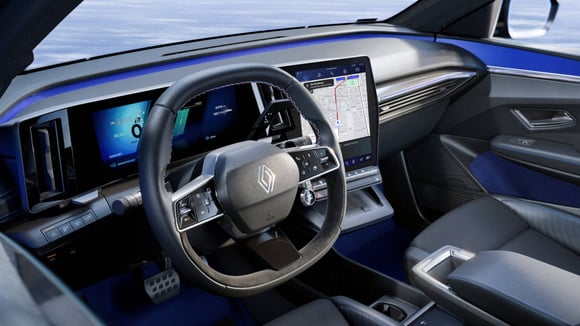
The object of the dispute: the network systems used in Renault Mégane and Clio © Renault
This is not the first time a legal case has disturbed the sleep of automotive giants. Let us remember Ford, which, in 2022, saw several of its models banned from sale due to patent violations. These stories illustrate the ongoing struggle between innovation and the protection of intellectual property rights. Connectivity, an essential pillar of modern vehicles, becomes a risky playground where protected technologies can quickly lead to legal complications.
Broadcom vs. Renault: a merciless battle
The accusations made by Broadcom focus on the use of the Ethernet 802.33bw standard, specific to networks integrated into cars. A domain where the diamond brand must navigate carefully. Indeed, as connectivity becomes essential in all vehicles, even the most affordable, it is often built on technologies protected by patents.

The American giant, known for its wide range of network-related products, intends to protect its innovations at all costs. This legal battle could well be a way for it to remind the automotive industry that it will not tolerate abuses in intellectual property. On one side, we have Renault, trying to justify the use of these technologies without having to shell out a fortune. On the other, Broadcom, which seems ready to do anything to enforce its rights.
The potential consequences of an unfavorable ruling
The situation is quite concerning for Renault. If the court rules in favor of Broadcom, it could mean a complete ban on the sales of the Mégane and Clio in Germany. But that’s not all: the consequences could extend to the destruction of all affected vehicles or even a complete buyback of those already in circulation. One could say that the sword of Damocles hangs over the manufacturer’s head.

For now, the sentence is not enforceable, as it depends on the payment of a bond by Broadcom. Renault breathes a little easier but remains in uncertainty. “We have initiated two nullity actions regarding the patent in question, which we believe will be successful,” declared the French manufacturer. However, waiting for an amicable agreement remains a plausible option, as both parties could end up finding common ground without having to fight to the bitter end.
A questionable patent system
The dispute between Broadcom and Renault also raises questions about the very functioning of the patent system in the automotive sector. Originally designed to protect intellectual creations, these patents can sometimes be misused to stifle innovation. This is where the notion of FRAND (Fair, Reasonable And Non-Discriminatory) comes into play, which aims to regulate the publication and access to patents to avoid abuses.
The patents in question are indeed signed under this FRAND standard. The Munich court has thus accused Renault of not sufficiently compensating Broadcom for the use of its technologies. In short, this case reminds us that the road to innovation is paved with obstacles, where every advance can be contested by those who hold the rights.
What will the future look like for Renault?
In this troubled context, Renault will have to double its efforts to navigate these turbulent waters. The stakes are considerable, not only in financial terms but also for brand image. Renault’s reputation is at stake, and every move must be calculated carefully. If a compromise is found, it could pave the way for a more fruitful collaboration between technology giants and automakers.
In the meantime, the automotive community is watching this case closely, which could well reshape the contours of relationships between manufacturers and technology suppliers. Connectivity is here to stay, but at what price? The upcoming decisions will be closely scrutinized by all industry players.