


After years of being the underdog against Google Maps and Apple Maps, Waze is finally waking up and adding a long-awaited feature: the display of traffic lights. Currently in testing phase in Israel, this update promises to simplify navigation and make driving more serene, like a GPS that remembers your little road whims.
A Long-Awaited Addition
For years, it was one of the great oddities of Waze: an app capable of reporting an accident or a speed camera from miles away, but leaving the user completely in the dark when it came to a simple traffic light. Imagine a chef who forgets to add salt to their dish: it was just as disconcerting. This absence often complicated voice instructions, making it difficult to anticipate stops. But that is about to change, as Waze is now testing the display of traffic lights on its map.
Traffic Lights, but Sparingly
Spotted by the Israeli media Geektime, this new feature is currently being tested in Israel via a beta version of the app. Waze is taking a cautious approach, as the interface is already loaded with icons representing police, hazards, traffic jams, speed bumps, and construction. The last thing the developer wants is to turn the map into a Christmas tree! In navigation mode, the app will only display the next three traffic lights on your route as simple icons. This will provide a useful visual reference for aligning voice instructions (“at the next light, turn right”) and better anticipating slow zones.
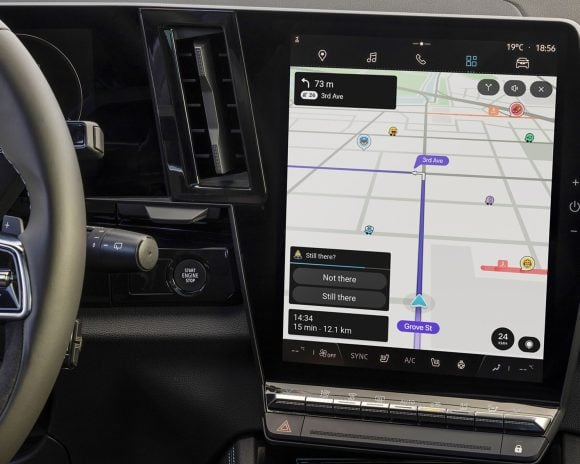
The Waze app displayed in full-screen mode on the 12-inch touchscreen of the Renault Austral. © Renault
However, if you are not in navigation mode and are simply exploring the map, all traffic lights near your location will be visible, providing a more complete view of surrounding intersections. This way, you can navigate without needing an overly excited GPS.
A Community-Driven Approach
Technically, Waze could very well retrieve the data already used by Google Maps, where traffic light displays have existed since 2022 in many countries. However, true to its community-driven DNA, Waze primarily relies on its users. Unlike other apps where mapping is maintained by professionals, Waze depends on volunteer editors who continuously add and correct roads. This means that deployment will be gradual and variable depending on the countries, and even from one city to another. Traffic lights will need to be added manually to the map by these local editors, illustrating the strength of the Waze community.
Beyond Display: Towards More Refined Guidance
In the short term, this update should mainly bring an improvement in readability and instructions. Voice instructions will become more precise, avoiding ambiguities in dense areas where intersections follow one another like notes in a symphony. Visualizing the number of lights on a stretch will also help anticipate potential stops, something that Google Maps and Apple Maps already offer. In the long term, this data collection could allow Waze to refine its travel time calculations by favoring routes with fewer traffic lights to smooth out certain trips. For now, no official announcement has been made regarding a global deployment timeline.

Currently in the testing phase, Waze will display traffic lights, which will facilitate navigation clarity. © Waze
For those living around the globe, it will still take some time before this innovation appears on our screens. In the meantime, Waze continues to evolve and adapt to the needs of drivers. It goes to show that even an app can need a little push to update in a world where technology evolves at breakneck speed.
To stay informed about the latest news on Waze and other technological innovations, feel free to check out our articles on automotive news.


