
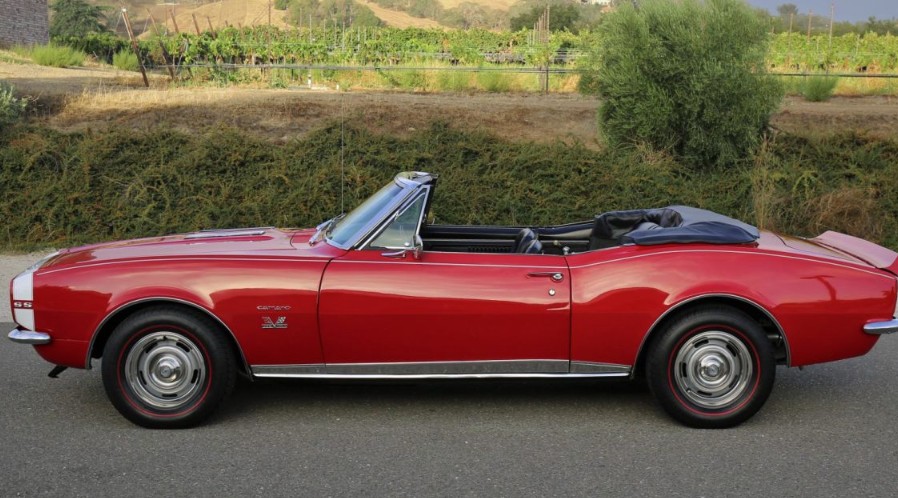
If you think that convertibles are just toys for summer vacationers, think again! The 1967 Chevrolet Camaro is living proof that beauty and technology can come together to offer a memorable driving experience. Here’s one of the most juicy anecdotes, where ingenious engineers found an original solution to chase away unwanted vibrations.
The Golden Age of the Camaro
It is undeniable that the first generation of the Camaro and Firebird is part of the masterpieces of automotive design. Imagine an elegant coupe, full of character, and for a few extra dollars, you can acquire a convertible, the ultimate symbol of freedom on the road. However, these beautiful bodies had a little hidden flaw. Buyers may not have known it, but four “cocktail shakers” were included in the price, and believe me, it was for a very good reason.
Unwanted Shakes
During a test at General Motors’ test track, engineers quickly realized that the prototypes of the convertible Camaro suffered from a “cowl shake” problem. In other words, the overly flexible body of the roofless model would vibrate like a drum during acceleration. If you’ve ever seen jelly wobble on a table, you can imagine what the ride was like. At that moment, it was clear that action needed to be taken to prevent this beautiful car from becoming a nightmare on wheels.

An Unexpected Solution
The engineers could have reinforced the side panels and stiffened the floor, but that would have added weight and cost a lot. That’s when they remembered the second-generation Corvair convertible, which had also encountered this problem. The solution found back then? Dampers added to each corner of the vehicle. These steel devices, filled with heavy weights mounted on springs, were designed to counteract the harmonic vibrations of an overly soft body. A brilliant idea that would give birth to the famous “cocktail shakers”.

The Ingenuity of Mechanics
Chevrolet engineers decided to attach these four dampeners to the Camaro prototype. And surprise! It worked wonderfully. These “cocktail shakers,” filled with automatic transmission fluid, proved to be reliable allies over the years. Of course, over time, their only weakness lay in rust or the weakening of the springs. There is even a market for these used parts, with specific references for each model, each production year, and each side of the vehicle.

A Slight Additional Weight
Chevrolet’s CEO, Pete Estes, had been alarmed by the vibrations of a convertible Camaro during an initial test. When he discovered the improvement made by his engineers on the next prototype, he was thrilled – until he learned that adding the shakers had increased the weight of each car by about forty-five kilograms. Not exactly what you’d call a bonus! But it was too late to consider another solution.
The Legacy of Convertibles
In total, about 110,000 Camaro and Firebird convertibles were produced between 1967 and 1969. In contrast, the 1970 models did not benefit from the “cocktail shakers,” as General Motors did not manufacture convertible versions for this second generation. It wasn’t until 1994 that Chevrolet reintroduced the convertible Camaro, along with a twin model for the Firebird. Unfortunately, these new versions did not have shakers; they relied instead on a reinforced chassis to reduce those unwanted vibrations.

So what can we say? The “cocktail shakers” have become a little legend in the automotive world, testament to the creativity and ingenuity that allowed the Chevrolet Camaro to shine beyond mere appearances. These technical innovations are an integral part of the timeless charm of the classic models that we continue to admire today.


