
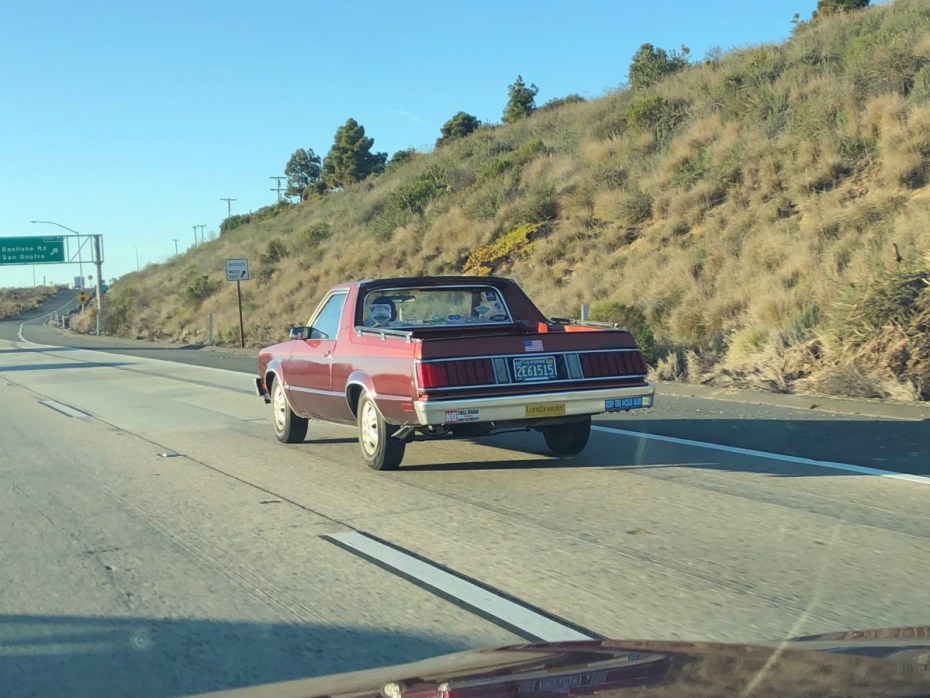
In the world of classic cars, some gems emerge like shooting stars, bright but ephemeral. The 1981 Ford Durango is one of those finds that reminds us never to underestimate the surprises that the automotive past holds. Imagine an unexpected encounter on the road, a mix of nostalgia and astonishment, that’s what this car represents.
An Unexpected Encounter on the Road
There’s a theory circulating in Southern California: if you spend enough time in this sunny region, you will eventually cross paths with any vehicle that has ever existed. After the Christmas festivities, I was able to check a new box off my list. As I was driving north from Oceanside, a flash of vintage color caught my attention. As I approached, I realized it was some sort of Fairmont Futura Ranchero—a configuration that never saw the light of day in Ford factories but was brought to life through a bold project.
A Vehicle with a Unique History
This model appears to be an original vehicle, and several clues confirm it: an elderly owner, nostalgic bumper stickers, original license plates, and non-conforming hubcaps. All of this contributes to the authentic aura of the vehicle, whose impeccable condition speaks to meticulous care. Indeed, such attention is not often observed on a recently restored car or one resold to a collector.
The Ford and National Coach Products Project
Ford tasked National Coach Products, based in Gardena, California, with transforming a handful of Fairmont Futuras into a sort of successor to the Ranchero in the early 1980s. The process involved sending complete cars, which were then modified at the rear with an addition to convert the tailgate. The taillights fold with the panel, leading to a warning label regarding driving with the tailgate down. A curiosity that adds a playful aspect to this model.
Intriguing Technical Specifications
Surprisingly, all these vehicles were equipped with a 200 cubic inch six-cylinder engine paired with a three-speed automatic transmission. While some have since been modified with different engines—which is not a difficult task for Fox series vehicles—the production numbers remain vague. It is generally estimated that between 1979 and 1982, around 100 units were produced as 1981 models, with potentially 100 to 250 more models from subsequent years. A total figure of 212 is often cited, but it is generally accompanied by a warning about its inaccuracy.
A Two-Tone Example and a Devoted Owner
The model I encountered features a beautiful color combination and is in remarkable condition. I identify it as a 1981 model, as that is how it is listed in the California emissions control database. Interestingly, it seems to fail the emissions test on average three times before passing, a pattern that has repeated for several years, evidence that the owner is particularly attached to it.
A Product to Compete with the El Camino
The promotional advertising from National Coach Products for the Durango highlights the small extension panel between the rear fender and the tailgate. By removing the rear window and part of the roof, then reshaping the hood and producing the bed in fiberglass, this model presents itself as an obvious alternative to the downsizing of the famous El Camino. One might wonder if Ford had considered in-house production for this model, given that the Futura body style was already considered atypical compared to the Fairmont lineup.
Conclusion: A Rarity to Cherish
The 1981 Ford Durango is more than just a vehicle; it is a testament to the past, a piece of automotive history that few lucky ones may cross paths with. For enthusiasts and collectors, it represents a unique opportunity to own a piece of Ford creativity, embodying the spirit of an era when boldness reigned supreme. If you wish to explore more fascinating stories behind these classic vehicles, feel free to check out our dedicated section on automotive passion and collections.


