

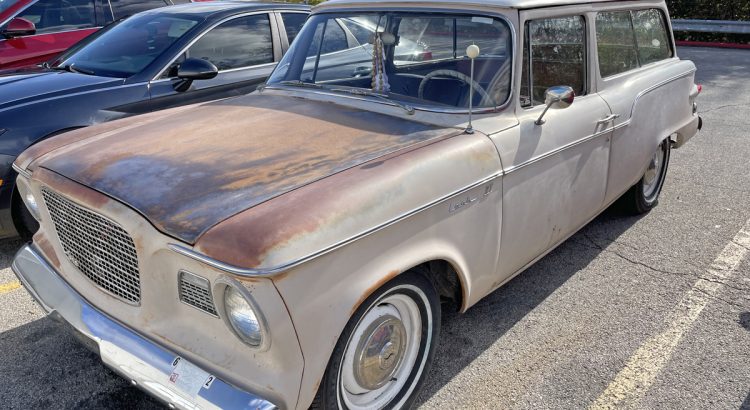
Imagine shopping at Walmart and stumbling upon a rolling treasure: a two-door Studebaker Lark VI wagon. This example, with its intriguing history, is much more than just a vehicle. It’s a piece of automotive history that spans the ages, making its way from Arizona to Missouri, like a modern cowboy on his faithful steed.
A bit of history: the birth of the Studebaker Lark
The Studebaker Lark made its debut in 1959, as the compact car market exploded. Designed to appeal to consumers looking for affordable and practical transportation, the Lark enjoyed great success with over 130,000 units sold in its first year. An impressive performance for a brand that hadn’t seen such numbers in nearly a decade. Upon closer inspection, this “new” model is actually just a refreshed face of the standard Studebaker, already presented in 1953. However, its sufficiently renewed look allows it to capture the attention of buyers.

For its launch year, the Lark offers four body styles: a four-door sedan, a two-door hardtop, a two-door sedan, and, icing on the cake, a rather atypical two-door wagon. Rarity has its charm, doesn’t it? Despite its original design, the latter still accounted for one-fifth of total Lark sales in 1959.
1960: the year of evolution
In 1960, Studebaker did not rest on its laurels. The brand introduced two new models to the Lark lineup: a convertible and a four-door wagon. Competition intensified with the arrival of GM, Ford, and Chrysler in the compact car market. Nevertheless, the Lark maintained a solid momentum with around 122,000 sales that year. Wagons continued to attract customers, but they primarily turned to the new four-door model. Only 5,231 two-door wagons would leave the South Bend factory that year. A paltry number compared to nearly 19,000 four-door wagons sold.

What’s fascinating about this model is its ability to defy the design conventions of the 1950s. Equipped with only two headlights at the front (an aberration for the time), the Lark is a symbol of automotive pragmatism in times of economic crisis. A small touch of boldness that could almost be likened to a well-placed guitar solo in a rock ballad.
A journey through time: our Studebaker Lark
This brings us to our example of the day. Photographed by my brother-in-law in Jefferson City, Missouri, this Lark certainly has a fascinating story to tell. Discovered with an Arizona license plate, it has undertaken an impressive road trip, accumulating delightful anecdotes along the way.

With its simple and stripped-down lines, this wagon evokes the simplicity and authenticity of a bygone era. Its ingenious design conceals the fact that it rests on a platform that has proven itself for a decade, while still managing to capture the attention of customers in a saturated market.
A rarity to appreciate
The two-door version of the Lark would not be a smooth ride. With only 3,497 of the 5,231 two-door wagons built equipped with a six-cylinder engine for that year, it quickly became a rare piece. Production ceased as early as 1961, leaving this body style as a vestige of a time when style and functionality coexisted without compromise.

Our example also stands out with a rather charming accessory: a roof rack, an option sold for about $40 in the 1960s. A small practical touch for weekend getaways without worrying too much about space in the cabin.
A vehicle full of stories
Every detail of the Lark tells a story. The stickers on the body, remnants of a glorious past, add to the charm of this example. Its VI badge on the front fender reminds us that it belongs to a time when every little detail mattered. Seeing these outdated emblems, one can’t help but dream of the journeys it may have taken.

And then there’s this license plate “Live the Golden Rule,” a call for kindness that contrasts with our sometimes tumultuous modern world. Such a message could prompt reflection on our own journey through life.
Conclusion: an icon to rediscover
The production of the Studebaker Lark continued until 1966, but the magic of the years 1959-60 would never be recaptured. Through this unique example encountered in a Walmart, we rediscover that every car has a soul and a story to tell. The Lark VI has become a rarity that embodies the passage of time and the memories that a vehicle can carry within it.
Photographed in Jefferson City, Missouri, in November 2025.


