
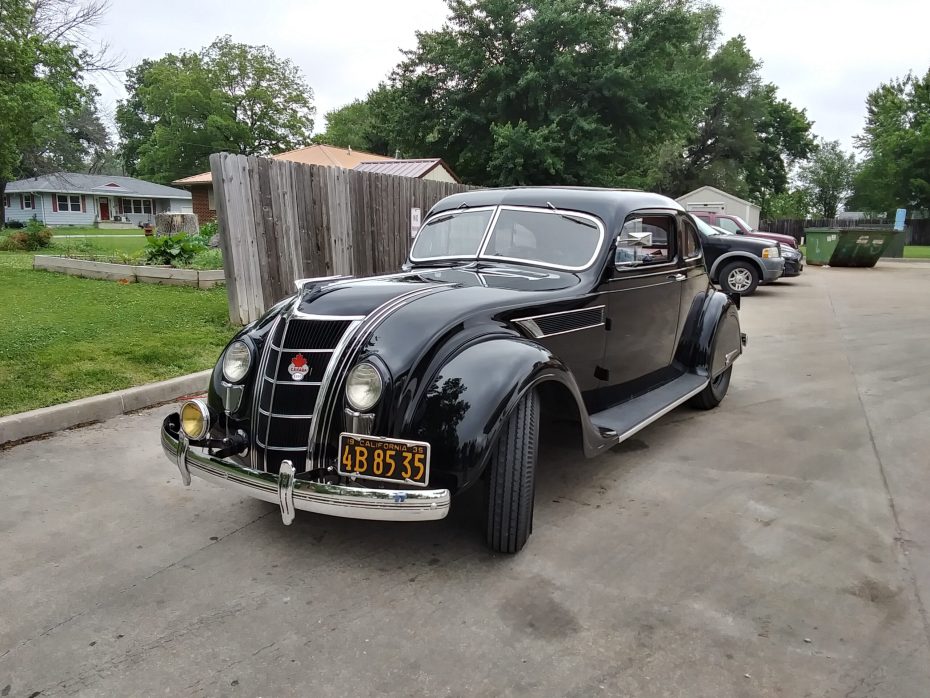
Traveling long distances in an antique car is a unique blend of exhilaration, hyper-vigilance, and stress. Imagine the adrenaline coursing through your veins as you cover thousands of miles in a vehicle that has traversed the ages. This is precisely what Peter experienced with his 1935 Chrysler Airflow, a rarity that allowed him to cross at least nine states and two countries, a true feat in itself.


An Unforgettable Journey
Peter does not do things halfway. Indeed, his journey far exceeds the trips I have taken in my 1963 Ford Galaxie, where I managed to cover six states with a single incident. But while my Galaxie was only 28 years old at the time, Peter’s Airflow is an antique that requires special attention for parts sourcing. His 2,100-mile journey to the San Francisco Bay is an adventure worth telling.


The Origin of the Airflow
When Walter P. Chrysler founded his company in 1925, he hired pioneers of the automotive industry, such as Carl Breer, Owen Skelton, and Fred Zeder, who would redefine the very concept of the automobile. Breer, fascinated by aerodynamics, began studying how cars could better cut through the air. At that time, many prejudices remained about the ideal shape of cars, but his research would challenge these accepted ideas.


The result of their work was the 1934 Airflow, a car whose bold design shifted the cabin and engine forward, allowing passengers to sit inside the chassis rather than on top. This innovative model was not well received by the market, but it laid the groundwork for an automotive future that we know today.
Unhealthy Competition
Chrysler was not the only brand in the group to adopt this futuristic style. DeSoto also launched its own line of Airflow in 1934, while Chrysler continued to produce traditional models, including the Chrysler 6 line. This cautious strategy proved to be profitable, as DeSoto’s sales plummeted by 45% that year. In the end, traditional Chryslers outperformed the Airflows by about 2.5 to 1, with fewer than 8,000 units produced for the year 1934.


Faced with this commercial failure, Chrysler modified the front style of the Airflow for 1935 in hopes of attracting a more conservative clientele. However, even these changes were not enough to turn around sales, and the Airflow remained a marginal car in the market.
A Historical Rarity
In 1935, Chrysler offered two trim levels for the two-door Airflow: the base model Airflow 8 and the Imperial Airflow 8. With only 72 units produced for the standard model and 200 for the Imperial, this car became a rare piece of automotive history. Upon meeting Peter, I was fortunate to discover that his example was likely an Imperial Airflow 8, as indicated by his keychain.


A Surprising Encounter
As I approached this beautiful black car preparing for the next leg of its journey, I couldn’t help but admire its lines. There is something about this silhouette that recalls the split-window Volkswagens, but with a breadth and presence all its own. After a brief conversation with Peter, I learned that he was returning from an annual Airflow convention in Springfield, Illinois. A passionate man who knows how to appreciate the joys of traveling in an antique car!

The Road and Its History
Peter’s route was impressive: about 2,800 miles between Toronto and Springfield. This longevity and style of driving are made possible by the flathead straight-eight engine and overdrive transmission of the Airflow, which was touted in the 1930s for its remarkable fuel economy. This model perfectly embodies the spirit of adventure that drives vintage car enthusiasts to traverse the roads of the United States and Canada.

Talking with Peter, I felt a rush of adrenaline at the thought of a similar journey. Who wouldn’t dream of hitting the road in such an automotive legend? Let’s hope he made it home without too much hassle.
And it is precisely this kind of automobile, like this Airflow, that rekindles the desire to travel long distances in an antique car.
Found in June 2025
Auxvasse, Missouri
Related Readings
The Winds of Change – The Airflow from 1934 to 1937 by Aaron Severson / Ate Up With Motor


