
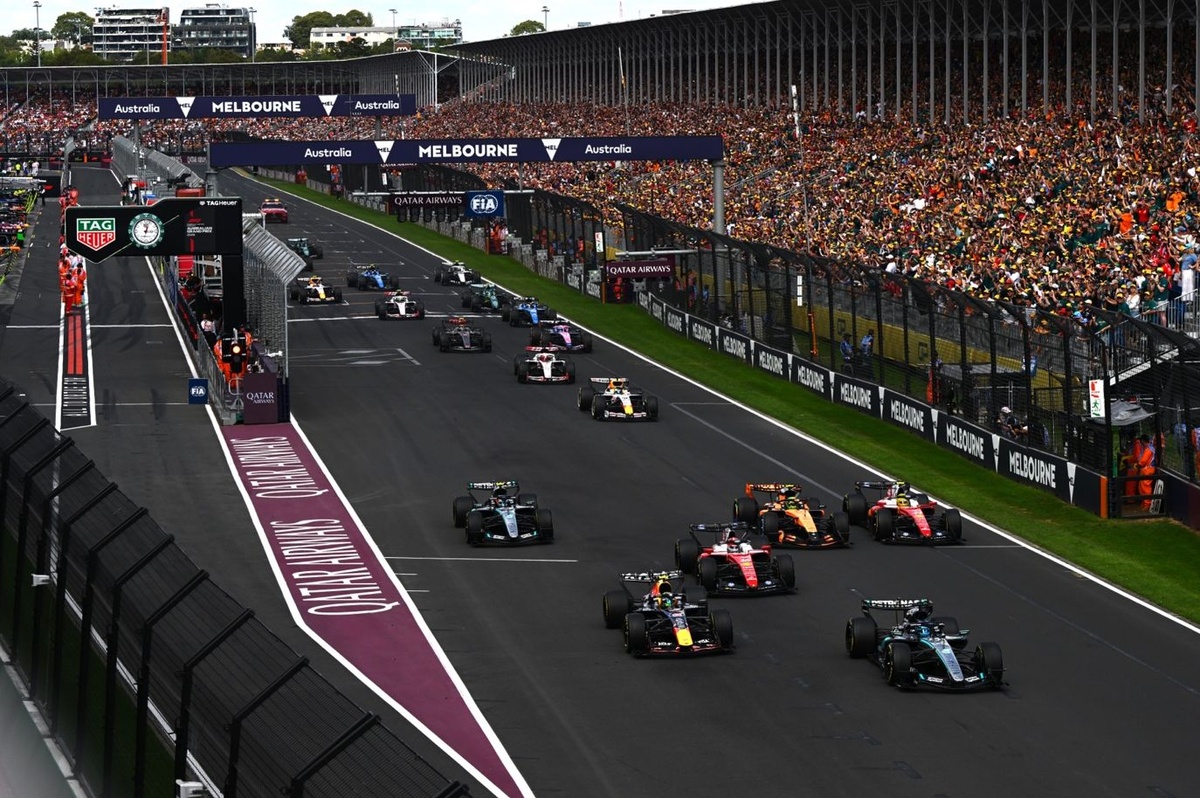
As the Formula 1 season kicks off under tumultuous circumstances, race starts have become a major issue. With driver criticisms and team hesitations, the absence of the MGU-H raises questions about safety and fairness on the grid. George Russell, a rising star in the paddock, doesn’t hold back and calls for a reevaluation of current practices.

A Chaotic Start: The MGU-H in Question
The removal of the MGU-H in the 2026 regulations has sent shockwaves through the paddock. This device, which helped mitigate turbo lag at the start, has been replaced by a longer procedure. Now, drivers must wait five seconds after the last car has stopped on the grid before they can launch. This change was tested in Bahrain and approved for the season, but it has sparked significant concern.
During the Australian Grand Prix, performance disparities at the start were glaring. Charles Leclerc launched off the line while George Russell was left behind. These gaps highlight the crucial importance of turbo settings and start strategies. Ferrari’s advantage, with a smaller turbo allowing for quicker revs, exacerbates the imbalance between teams. In short, the battle for the podium begins long before the first corner.
Deep-Rooted Opposition
Resistance to changing the start procedure primarily comes from teams worried about losing their competitive edge. Mercedes, represented by Russell, is leading the charge for change. The driver, also the GPDA director, expressed concerns about the selfishness of certain teams blocking any evolution. “You can probably guess which team is against it,” he remarked, highlighting the tense atmosphere in the paddock.
For Russell, this isn’t just about fairness; it’s also about safety. With several drivers starting with nearly empty batteries, the risk of accidents increases. The Australian GP nearly saw a major incident when Liam Lawson struggled to launch, requiring a quick reaction from Franco Colapinto to avoid disaster. This situation could become recurrent if nothing changes.
Max Verstappen: Solutions Within Reach

Max Verstappen, the reigning champion and race management expert, sees simple solutions to improve the situation. He advocates for better battery management at the start, claiming that a few adjustments could make launches safer and fairer. “There are some simple solutions, but they need to be allowed by the FIA regarding the battery,” he explained, emphasizing the paradox of underutilized technology.
The issue isn’t solely about battery usage but also the anti-stall systems in the cars. Speed differences at the start can create dangerous situations, as demonstrated in Australia. Verstappen thus calls for collective reflection between the FIA and teams to prevent such incidents from recurring.
The Will for Change Against Inertia
Discussions around race starts highlight a broader struggle within Formula 1: the tension between tradition and innovation. On one side, some teams want to preserve their competitive advantage, while on the other, drivers like Russell and Verstappen demand change for the greater good. “The FIA just wanted to make our lives easier and remove that recovery limit,” Russell stated, denouncing the selfishness that hinders progress.
This resistance to change could have long-term consequences for F1. If procedures don’t adapt to new technological realities, it could lead to a loss of interest in the sport, especially among younger generations increasingly sensitive to safety and fairness.
A Matter of Safety Above All
Driver safety must be at the heart of concerns. Starts are often crucial moments where tensions run high. Allowing drivers to start with more charged batteries could reduce accident risks and ensure more thrilling races. Indeed, a good start can determine the outcome of a race, and the stakes are enormous both sportingly and economically.
Teams must realize that change is inevitable. Formula 1 must evolve to remain relevant in a world where technology and safety are paramount. The stakes extend beyond on-track performance; they also encompass the sport’s image and its appeal to the public.
In Summary
- The removal of the MGU-H calls into question F1’s starting procedures.
- Drivers like Russell and Verstappen are calling for changes to ensure safety and fairness.
- Performance disparities at the start highlight an imbalance between teams.
- Rapid change is necessary to avoid dangerous incidents at the start.
- Resistance to change could harm the sport’s image and future.
In conclusion, the current situation surrounding Formula 1 starts reveals an urgent need for change. While some drivers and teams advocate for necessary evolution, others cling to their advantages. In the medium term, a reform of the rules could not only enhance safety but also reinvigorate interest in the competition. Who is it for? For the drivers risking their lives on the track and for an audience eager for quality spectacles. Alternatives exist, but it remains to be seen if the will to act will be strong enough to overcome individual selfishness.


