

The 2026 Formula 1 season, while dominated by intense regulatory debates, has so far seen stewards largely avoid controversy. The early Grands Prix were surprisingly calm, but the recent Canadian Grand Prix highlighted a worrying trend: the decreasing use of penalty points on Super Licenses.
A Season Opener Marked by Lenience
Following remarkably quiet disciplinary periods in the Australian, Chinese, and Japanese Grands Prix, the Canadian Grand Prix saw a return of stewards’ interventions. However, a consistent pattern has emerged: no penalty points have been issued on Super Licenses in 2026. This is a stark contrast to previous seasons, where sporting penalties were routinely accompanied by penalty points, sometimes repeatedly.
This shift aligns with a trend observed in recent years, following heated discussions around the cases of Pierre Gasly in late 2022 and Oliver Bearman in late 2024. The governing bodies appear to have adopted a more measured approach, aiming to avoid driver suspensions for infractions deemed minor, while still hoping to maintain the system’s core purpose: penalizing serious offenses and deterring repeat behavior.
Stewards Opting for Restraint
The Canadian Grand Prix provided several clear examples of this new doctrine. Red Bull driver Isack Hadjar received two penalties. His defense against Charles Leclerc, involving multiple changes of direction, resulted in a ten-second time penalty but no points on his license. This decision is consistent with the current trend for such potentially dangerous, yet seemingly unintentional, infractions.
In the same race, Oscar Piastri was handed a ten-second penalty for his collision with Alexander Albon, again without penalty points. In China, Esteban Ocon received the same penalty for his incident with Franco Colapinto, with no points being assigned. These cases, where responsibility is clear and the fault evident, raise questions about the actual severity of penalty point application.
Furthermore, one of the penalties issued to Hadjar in Montreal raises even more questions. The French driver was given a ten-second stop-and-go penalty, one of the most severe before disqualification, for failing to slow down “significantly” under double yellow flags. This is an infraction of a fundamental safety rule, yet, once again, it resulted in no penalty points.
2026: A Shift in Penalty Philosophy

Drivers have advocated for a more flexible approach to penalties. Information from Motorsport.com reveals that discussions took place this winter between the FIA and the drivers. The drivers expressed a desire for a more lenient application of the points system, aiming to penalize only behaviors deemed intentional or irresponsible.
This change in paradigm is reflected in the directives provided to stewards for 2026. The document now specifies that for certain infractions, the number of penalty points can be modulated, ranging from zero to the maximum limit. While this doesn’t radically alter past practices, the emphasis on the possibility of assigning no points is telling.
For double yellow flags, the sporting penalty remains a ten-second stop-and-go, with the possibility of assigning up to three penalty points. The same applies to multiple changes of direction. However, regarding collisions, the doctrine is evolving. It is now specified that points should be adjusted “relative to the severity of the incident caused.”
A minor “touch” or very light contact will no longer warrant a penalty, with a maximum of zero penalty points. Conversely, for collisions with an “apparently deliberate or irresponsible” intent, four points remain theoretically possible.
F1’s Penalty Points System: An Empty Shell?
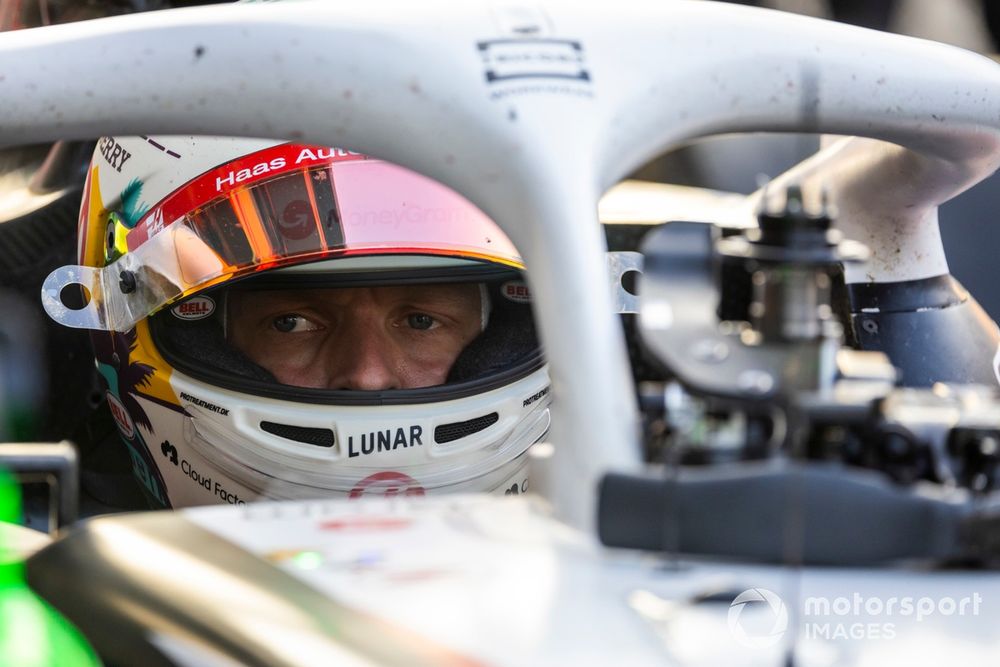
Kevin Magnussen remains the only driver suspended by the points system since 2014.
The intention to soften the application of penalty points is clear. Fewer sanctions to focus on the most serious ones, perhaps. But if failing to respect yellow flags is no longer considered a serious enough offense to warrant points, where is the line drawn?
Pushing this logic to the extreme, one might wonder if an incident like the one involving Max Verstappen and George Russell in Spain 2025, widely considered intentional or at least irresponsible, would have been penalized with points in 2026. If even infractions of fundamental safety rules no longer trigger points, the system seems to be losing its substance.
The penalty points system, conceived in 2014 to punish serious offenses and prevent repeat behavior, now appears to be stripped of its primary mission. It is applied only in extreme, almost non-existent cases, and no longer sufficiently considers the notion of recidivism. The question therefore arises: is it still relevant to maintain this system as it is? Doubt is certainly warranted.
[une collision]
Related articles : McLaren
Selection of articles, guides and advice : McLaren.

Red Bull, Verstappen Clash Over Car Setup Despite Canadian GP Podium
Max Verstappen's surprise podium in Montreal confirmed Red Bull's progress but also highlighted internal tensions over car setup.…

F1: Antonelli’s Canada Win Marred by Intense Teammate Duel
Mercedes prodigy Kimi Antonelli has written a new chapter in Formula 1 history by winning the Canadian Grand…

F1 2027 Engine Rules: McLaren and Alpine Face Timeline and Hardware Headaches
Formula 1 is gearing up for another technical evolution, but proposed hardware changes for engines starting in 2027…
Miami GP Exposes Shifting F1 Power Balance as Red Bull Gains Ground
The Miami Grand Prix data reveals a reshuffling of the Formula 1 pecking order. While Mercedes maintains its…

McLaren Senna Replica: A Functional Lego Marvel That Roars to Life
Lego enthusiasts have seen scale models before, but this takes it to another level—a full-size McLaren Senna replica…

McLaren Unveils Track-Only MCL-HY GTR: A Radical Hypercar for VIP Clients
McLaren is preparing a customer version of its upcoming Le Mans program: the MCL-HY GTR. With around 720…


