

MotoGP‘s new owner, Liberty Media, is keen to expand the sport’s footprint in the United States, with Miami emerging as a potential new venue. However, MotoGP officials are emphasizing that rider safety is paramount, a stance that could complicate ambitions for urban circuits.
Miami: A Logical Next Step for Liberty Media
Since acquiring MotoGP nearly a year ago, Liberty Media has made it clear that growing the sport’s popularity, especially in the American market, is a top priority. The U.S. once hosted as many as three Grand Prix races in 2013, but now only features one in Austin. The idea of adding more events on American soil, therefore, seems logical. In this context, the Miami circuit, which recently joined the Formula 1 calendar, has been cited as a “logical” destination by Derek Chang, Liberty Media’s CEO. The synergy between the two championships, now under the same ownership, strengthens this prospect.
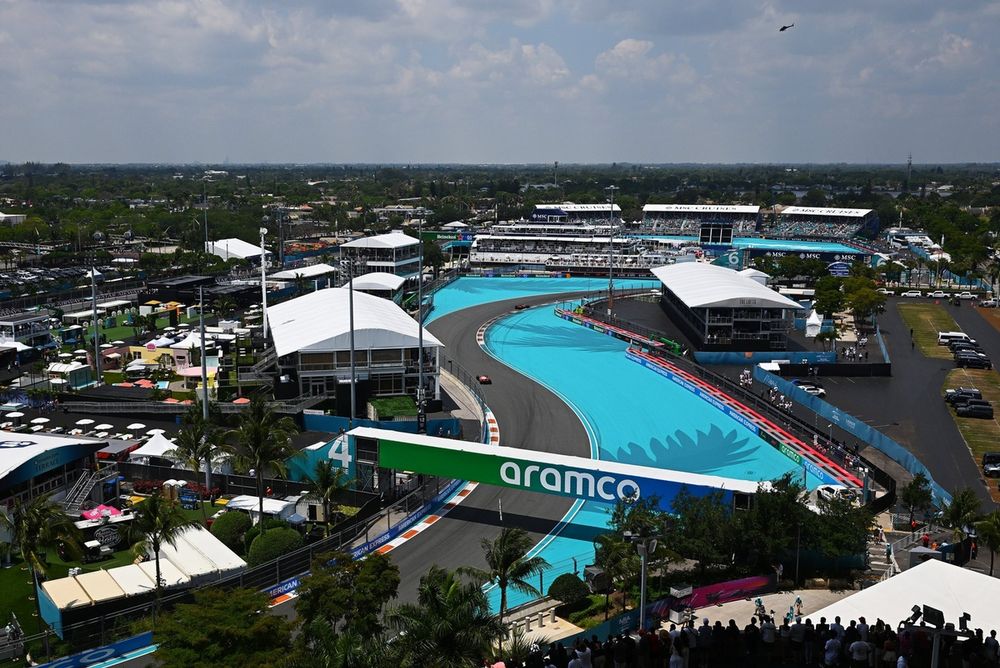
Could the Miami circuit, F1’s host since 2022, also welcome MotoGP?
A Growing American Market
Carlos Ezpeleta, MotoGP’s Sporting Director, confirmed the strong interest in the American market during his visit to Le Mans. While Miami is indeed part of the discussions, he tempered expectations. “I think Derek said it would be a logical step to consider Miami,” he told a select group of French media. “Since the deal with Liberty Media was announced, everyone is probably thinking we’re looking at that. Miami is part of our conversations.” However, he stressed that the immediate goal is to consolidate the current presence, particularly in Austin. “We feel that event has huge potential. We are obviously looking at new options, but it’s not an immediate subject.” The priority, therefore, remains capitalizing on the success of the Texas Grand Prix before considering new destinations.
Safety: An Uncrossable Red Line
The prospect of a Grand Prix in Miami, however, raises a crucial question: safety. Street circuits, often characterized by walls very close to the track, present considerable challenges for motorcycles, whose racing lines are less predictable than those of F1 cars. MotoGP is preparing to set up in Adelaide in 2027 on a street circuit that will require significant adaptations to ensure rider safety. It is precisely on this point that Carlos Ezpeleta remains firm: “What is clear for us is that there will never be a compromise on safety. The FIM has made huge progress in circuit safety over the last few decades, and there will only be progress.” This firm stance leaves little room for improvisation and imposes high standards for any new track.
Lessons from Adelaide and the Limits of Street Circuits
The Adelaide example is instructive. The Australian city, which hosted F1 in the 1980s, is set to host MotoGP in 2027, but with substantial modifications to the circuit to meet the safety requirements for two-wheeled racing. Carlos Ezpeleta explained: “The solution for Adelaide is very specific because there is space around the park, a desire on their part to have an incredible circuit in the city.” This particular configuration illustrates the difficulty of implementing motorcycle races on classic street circuits. Unlike Formula 1, which has multiplied urban circuits in recent years (Jeddah, Miami, Las Vegas), MotoGP adopts a more cautious approach. “We don’t see half the MotoGP calendar going to downtown circuits in the short term, or perhaps ever, because it’s a very specific solution for a city,” Ezpeleta concluded. While enthusiasm for new destinations is palpable, rider safety remains the watchword, a constraint that could redefine the contours of a future calendar.
- Safety First: The FIM and Dorna will not compromise on rider protection, even for attractive venues like Miami.
- Necessary Adaptations: The Adelaide experience shows that existing street circuits will need significant modifications to host MotoGP.
- Targeting the U.S.: Liberty Media aims to grow MotoGP’s presence in the United States, with Austin as the current anchor.
- Cautious Strategy: MotoGP isn’t planning to follow F1’s lead in rapidly increasing urban races, prioritizing safety and feasibility.
- No Rush for Miami: While discussed, a Miami race isn’t an immediate priority, with consolidation of the U.S. market taking precedence.
[du projet à Adélaïde]


