
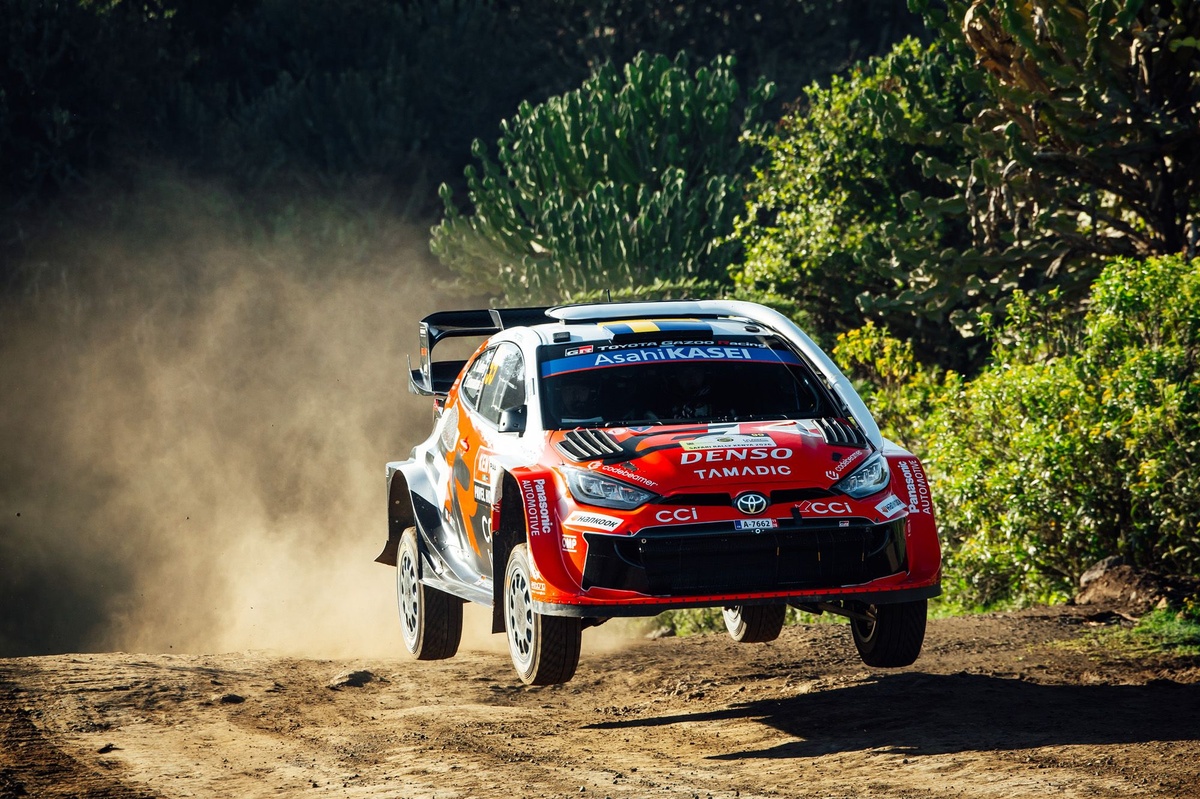
The Safari Rally, known for its extreme conditions, saw Oliver Solberg take the lead from the very first stages, solidifying his status as a frontrunner. This performance raises questions about Toyota’s dominance and the challenges faced by Hyundai in this iconic WRC event.
Conditions Fit for an Adventure
After a year marked by winter rallies, WRC drivers faced a completely different challenge in Kenya. The first two stages of the Safari Rally were characterized by particularly harsh conditions. The Camp Moran 1 stage, stretching 24.35 km, tested the drivers’ skills. Between torrential downpours and muddy sections, the road quickly turned into a true obstacle course.
Oliver Solberg, starting in second position, leveraged his experience and his car’s performance to clock the fastest time. With a 30-second gap over Elfyn Evans and more than a minute ahead of Sébastien Ogier, his lead is impressive. This feat not only highlights his talent but also reveals the importance of a strategy adapted to changing conditions. Other drivers, notably Takamoto Katsuta, struggled with communication issues with their co-drivers, adding another layer of complexity to an already demanding rally.
Toyota’s Dominance Against Hyundai
The second stage, Mzabibu 1, allowed Sébastien Ogier to demonstrate that Toyota remains the benchmark on this type of surface. Although conditions were slightly drier, Hyundai drivers suffered. Thierry Neuville, in particular, had to deal with technical issues that compromised his performance.
Interestingly, the results from this stage reinforce Toyota’s position in the market. While Hyundai struggles to regain its performance level, Toyota seems to have found the right balance between power and handling. In short, Toyota’s development strategy is proving effective, while Hyundai needs to reassess its approach to stay competitive.
Technical Challenges at Play
The issues faced by Hyundai drivers illustrate a crucial challenge: the reliability of cars in extreme conditions. Adrien Fourmaux and Esapekka Lappi also encountered mechanical problems, underscoring the importance of meticulous preparation. In a championship where every second counts, these failures can be costly.
This situation highlights an often-overlooked aspect of rallying: the impact of technology on performance. The technical advancements made by Toyota seem to provide an undeniable advantage. Other brands must therefore ramp up their efforts to avoid falling behind.
A Look to the Future
As the Safari Rally continues, the question arises regarding the long-term strategy for struggling teams. Hyundai, in particular, must urgently get back on track. Drivers need to rely not only on their skills but also on a perfectly tuned car to tackle the challenges of the WRC.
On the other hand, teams like Toyota and M-Sport Ford appear to have a head start. The growing gap between leading teams and others could influence future strategic decisions, particularly in terms of technological development and investments.
A Rally with Multiple Implications
Beyond individual performances, the Safari Rally has far-reaching implications for the entire WRC. The results from this edition could lead to changes in teams’ priorities regarding vehicle development. In essence, a strong result here can bolster a brand’s market position, while a failure could prompt strategic revisions.
The current dynamics suggest an intensification of competition among teams. For drivers, each stage is an opportunity to prove their worth, but also a crucial test for their machines. The pressure is palpable, and every mistake can have significant consequences on the overall standings.
In Summary
- Oliver Solberg emerges as a promising leader in extreme conditions.
- Toyota confirms its dominance against a struggling Hyundai team.
- Technical challenges are crucial for vehicle performance and reliability.
- The results of the Safari Rally could influence future strategies for teams.
- Competition is intensifying; every driver must rise to the occasion to stay in the race.
In conclusion, the Safari Rally is not just a simple showdown between drivers; it serves as a true revealer of the strengths at play in the WRC. For struggling teams like Hyundai, it is imperative to reassess their technical and strategic approach. Conversely, Toyota seems well-positioned to capitalize on its current successes. In an environment where every detail matters, rallying becomes a testing ground for experimentation and innovation, where only the most agile will succeed in making their mark.


