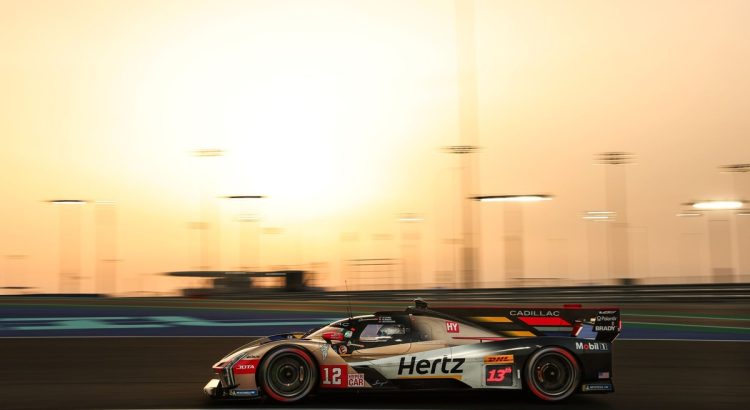
The postponement of the 2026 World Endurance Championship (WEC) season opener, originally set for Qatar, raises critical questions about the future of the series amid a tense geopolitical climate. This precautionary decision highlights the challenges the WEC faces in maintaining its credibility and appeal in an uncertain context.
Postponement Expected Amid Rising Tensions
The delay of the 1812 km Qatar race, intended to kick off the 2026 WEC season, comes as no surprise. In a world where security has become a major concern, the WEC’s decision reflects a prudent approach. Following recent military escalations involving the U.S., Israel, and Iran, the threat to sports infrastructure in the Gulf region prompted organizers to act swiftly.
The geopolitical situation in the Middle East, marked by targeted attacks on American bases, necessitated a thorough risk assessment. The U.S. naval base in Manama, located near the Sakhir circuit, exemplifies the fragility of the situation. In this context, the WEC had to respond decisively to ensure the safety of all participants, from competitors to spectators.
Economic Stakes Behind the Decision
Beyond security considerations, this postponement carries significant economic implications. The WEC, like other international competitions, heavily relies on the financial commitment of its partners and sponsors. Canceling or delaying a major event can lead to considerable financial losses and impact the organization’s budget.
Moreover, Qatar has invested heavily to become a key player in motorsport. Hosting the 1812 km race was supposed to bolster this position. This delay could tarnish the country’s image and its ambitions to host other large-scale events. In short, every missed event is a lost opportunity to strengthen Qatar’s brand on the international sports stage.
Measured Response from Motorsport Authorities
Statements from Mohammed Ben Sulayem, president of the FIA, and Pierre Fillon, president of the Automobile Club de l’Ouest (ACO), reflect a desire for transparency and empathy regarding the situation. These leaders emphasized that participant safety is paramount, but also that the sport must adapt to the realities of the current world.
This approach highlights a paradigm shift in motorsport: events can no longer proceed without considering geopolitical realities. This realization may prompt other competitions to reassess their schedules and venue choices.
New Schedule: Hope and Uncertainty
With the postponement of the 1812 km race, the WEC is forced to reorganize its calendar. The first race will now take place on April 19 with the 6 Hours of Imola. This rescheduling could provide teams with an opportunity to better prepare and optimize their performance, but it also raises questions about logistics and available resources.
However, this change could disrupt the preparation rhythm for teams, which must now adjust their training plans and budgets accordingly. This uncertainty may favor more flexible teams, while others could struggle to adapt to this new reality.
A Season in Search of Legitimacy
The WEC must skillfully navigate between safety and attractiveness to maintain fan and sponsor interest. The postponement of the 1812 km Qatar race could be seen as an admission of weakness, but it can also be interpreted as a commitment to the safety and well-being of all involved.
In this context, the WEC will need to work harder to win back its audience in upcoming races. The competition must prove it remains a benchmark in the motorsport world, despite external challenges. Communication around these issues will be crucial to restoring the trust of fans and partners.
In Summary
- The postponement of the 1812 km Qatar race occurs amid a tense geopolitical climate.
- Significant economic stakes are at play for the WEC and Qatar.
- Motorsport authorities are adopting a measured approach in the face of crises.
- The new schedule raises logistical and strategic questions for teams.
- The WEC must prove its legitimacy to maintain fan and sponsor interest.
Useful Conclusion: The postponement of the 1812 km Qatar race illustrates the growing challenges the WEC faces in an unstable world. Who is it for? For teams and fans hoping for a swift return to normalcy. What are the alternatives? Other circuits could be considered to compensate for this loss. Strengths: commitment to safety and strategic adaptation. Limitations: financial and reputational risks in the long term.