

Yamaha is pushing hard to reclaim its former glory in MotoGP, but its methods are raising eyebrows. While the Japanese manufacturer has embraced an ambitious V4 engine for its new M1, some of its riders seem to be finding their stride by returning to… familiar technical solutions. Is this a step back to leap forward?
MotoGP is a sport of cutting-edge engineering, where every millimeter counts and evolution is a constant race. Yet, Yamaha appears to be playing with fire, favoring choices that stand out. The new M1, powered by a promising V4, is still undergoing intense development. But the most surprising aspect is seeing riders like Fabio Quartararo regain positive sensations by… reverting to the front wing designs from last season. It’s a choice that sparks questions and highlights the challenges the manufacturer faces.
The V4: A Double-Edged Revolution
The shift from an inline-four to a V4 for the new Yamaha M1 is undoubtedly the most significant change this season. This architectural mutation, driven by the desire to align with current standards and prepare for the future, necessitated a complete overhaul of the bike. The machine’s overall behavior was altered, forcing engineers and riders into a substantial adaptation process. While this new engine configuration opens interesting possibilities, it still requires considerable development to unlock its full potential.
For now, the V4 engine serves more as an experimental platform than an absolute weapon. Yamaha has admitted as much: this M1, version 2026, is acting as a laboratory to gather experience for the 2027 regulations. A portion of resources is already allocated to this major project, partly explaining why updates on the current machine have been scarcer in recent weeks. The engine itself hasn’t seen major evolution this year.
Returning to Aerodynamic Roots to Regain Confidence
Where things get more peculiar is on the aerodynamic front. At the Jerez test, Fabio Quartararo rediscovered a tri-plane, wavy front wing, a component that had been replaced by a more discreet version earlier in the season. The result was immediate: the 2021 world champion found improved front-end feel, a crucial element for confidence and aggressive riding. This technical step backward allowed him to achieve a strong performance at the French Grand Prix.
In Barcelona, the French rider confirmed that this compromise involved returning to familiar elements. “The bottom part is more or less similar, between the old and the new,” he explained. “And the old
gives me more confidence.” This statement reveals a truth: sometimes, novelty doesn’t equate to immediate progress, and reverting to proven solutions can unlock complex situations. The rider then regains a connection with his machine, a feeling essential for chasing lap times.
Divergent Choices Among Yamaha Riders
While Quartararo seems to have found his groove with this wing configuration, its adoption isn’t universal within the Iwata team. Toprak Razgatlioglu followed his teammate’s lead, opting for the same setup. However, Jack Miller and Álex Rins preferred to stick with the version seen at the start of the season. This divergence highlights the subjectivity of rider feedback and the complexity of developing a motorcycle.
Álex Rins, who had perceived a positive evolution during the same Jerez tests, chose not to use this configuration at Le Mans or Barcelona. “Looking at the data, it seems that with the older wings, he can lean over a bit more and thanks to that, he can turn a bit better,” the Spaniard confided. A finding that, on paper, should push him to adopt this solution. But the reality on track is often more nuanced.
Barcelona Test: A Missed Opportunity?
The test organized in Barcelona, immediately after the Catalan Grand Prix, should have clarified the situation. Rins, in particular, wanted to get a clearer idea by testing this wing configuration himself. Yamaha had even brought a slight variation to try. Quartararo, meanwhile, found the wings “really, really similar,” noting that one was “halfway
but it’s a bit like the one I had
.”
For Rins, however, the day was frustrating. Rain arrived, preventing him from conducting a conclusive comparison. “I focused a bit on the fairing that Fabio is using, which I liked at Jerez,” he confirmed. “I didn’t like it much here, I feel like I don’t have the same potential, the same weight on the front in the final part of the corner, so I didn’t feel that great.” The lack of track time and changing conditions made any hasty conclusions impossible.
Top Speed: That Confirmed Achilles’ Heel
Jack Miller, for his part, had the opportunity to test different configurations, but the overall assessment remains mixed. While Quartararo’s preferred version offers better feel, it proves detrimental on the straights. Top speed is already one of the current Yamaha’s weak points. “We’ve found our way a bit, there are pros and cons with each of them,” the Australian explained. “Obviously, with the bigger wing, we have a bit more drag, which isn’t really ideal for us, but at the same time, I feel the bike handles a bit better, so we might have to live with it.”
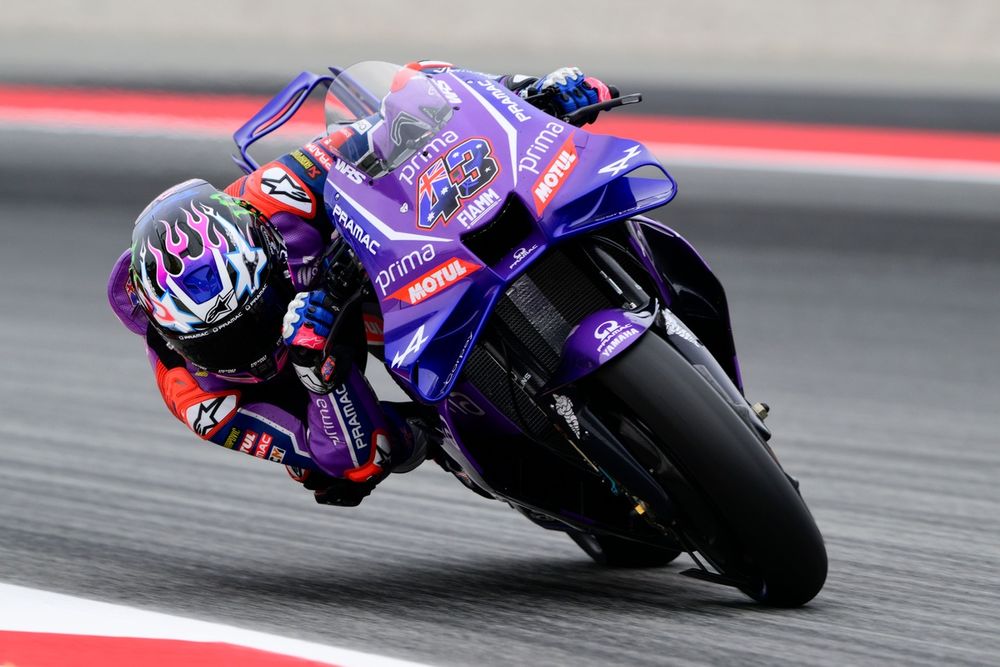
Jack Miller opted for the two-main-element wing during the Catalan GP.
Fabio Quartararo fully accepts this compromise. Although he laments the straight-line performance, he confirms that the configuration that suits him best costs him about 2 km/h in top speed. “The aero I’m using loses about 2 km/h,” he stated. This choice illustrates Yamaha’s difficulty in finding the right balance between aerodynamics, handling, and pure performance. The aerodynamic backtrack, while improving handling, accentuates an existing flaw, placing the M1 in a delicate position.
Yamaha M1 2026: Key Takeaways
- New V4 Engine: A promising architecture for the future, but still in the development phase.
- Controversial Aerodynamics: A return to older front wing designs improves feel but reduces top speed.
- Rider Divergence: Not all Yamaha riders are adopting the same technical solutions, indicating complex development.
- 2027 Goal: The current M1 serves as a laboratory to prepare for the future regulation bike.
- Straight-Line Performance: A persistent Achilles’ heel, exacerbated by certain aerodynamic choices.
- Ongoing Development: Yamaha continues to explore avenues to optimize its machine despite the challenges.
[pour le haut]
[entre deux versions]
[pour la course]


