Audi has just turned a decisive page by relinquishing control of Italdesign, a legendary design studio founded by the illustrious Giorgetto Giugiaro. As automotive design shifts towards a digital future, this pivot towards the technology company UST only underscores the evolving stakes in the industry.
A rich heritage and a new direction
Italdesign, created in 1968, is the brain behind some of the most beautiful lines in the European automotive landscape. Who could forget the Golf or the Scirocco, those cars that marked their era? This studio has not only sculpted iconic silhouettes for Volkswagen but also for Alfa Romeo with models like the Brera, a coupe that turned many heads. The story continues with projects for BMW, Hyundai, and Renault, illustrating the breadth of their expertise.

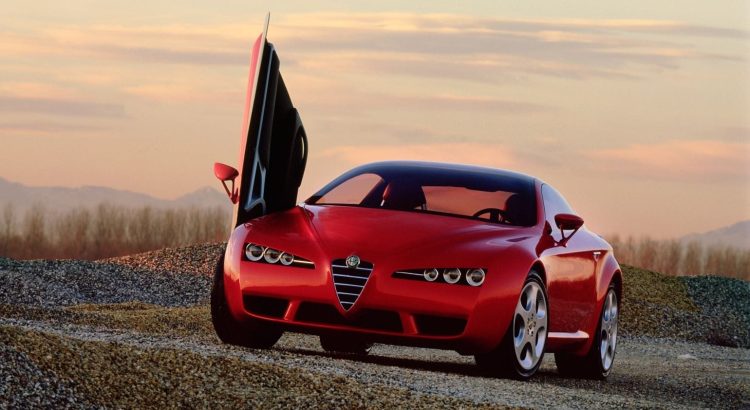
The 2002 Alfa Romeo Brera Concept, heralding the eponymous production coupe, is signed by the Italdesign studio. © Alfa Romeo
In 2015, Audi acquired Italdesign in a strategic maneuver to strengthen its design and engineering role within the Volkswagen group. But now, the tide has turned. The rings brand has recently decided to part with the majority of its stake in favor of UST, a California-based company specializing in cloud technologies and artificial intelligence. In practice, this means that Italdesign is leaving Audi’s fold to enter the ecosystem of a company that pushes vehicles to become ever more connected.
Towards increasingly digital design
UST is not yet a household name in the automotive world, but that could change. Founded in 1999, this company employs 30,000 people and positions itself at the intersection of artificial intelligence and software development. Its ambition? To combine its skills with Italdesign’s expertise to offer a complete solution that ranges from initial development to production, including hardware and software design. It’s as if an old family recipe is being revamped by a Michelin-starred chef: tradition meets innovation.
This evolution aligns with the current needs of automakers. At a time when cost reduction and outsourcing are becoming the norm, integrating players like UST into the creative process seems to be a wise choice. Software-defined vehicles (SDVs) are becoming the new standard, where perceived value lies as much in design as in the underlying digital architecture.
What future for Italdesign without Audi’s oversight?
With this transfer to UST, Italdesign could broaden its horizons well beyond Audi’s borders. However, the immediate future of the studio remains uncertain. Recently, they presented a concept in Munich that resembled more of a hologram than a physical car. A demonstration that illustrates a transition already underway towards a world where automotive design is no longer limited to the bodywork.

In 1974, Volkswagen presented the Golf 1, whose design is credited to Giorgetto Giugiaro, the founder of the Italdesign studio. © Volkswagen
It seems that integration within UST could propel Italdesign into a new hybrid era. For the automotive industry in general, this operation sends a strong signal: historic design studios must evolve if they want to survive. They need to find their place in a modern value chain that is now dominated by innovative tech companies. A major shift that could lead to other similar movements in the years to come.

At the Munich 2025 show, Volkswagen presented a digital demonstrator with lines signed by Italdesign to showcase the possibilities offered by the MEB+ platform, which the German brand wants to sell to other manufacturers. © Italdesign
Conclusion: A bright future ahead for Italdesign
This significant transition to UST could ultimately prove beneficial for Italdesign. By freeing itself from Audi’s constraints, the studio may potentially explore new creative avenues while benefiting from the technological resources of a forward-thinking company. This could well represent an exciting new chapter in Italdesign’s history, where the virtual meets the real and where every drawn curve tells a story.
In an ever-changing sector, this shift illustrates how automotive design is becoming increasingly intertwined with digital technologies. The road ahead will undoubtedly be filled with challenges, but also opportunities for bold creators who can adapt.