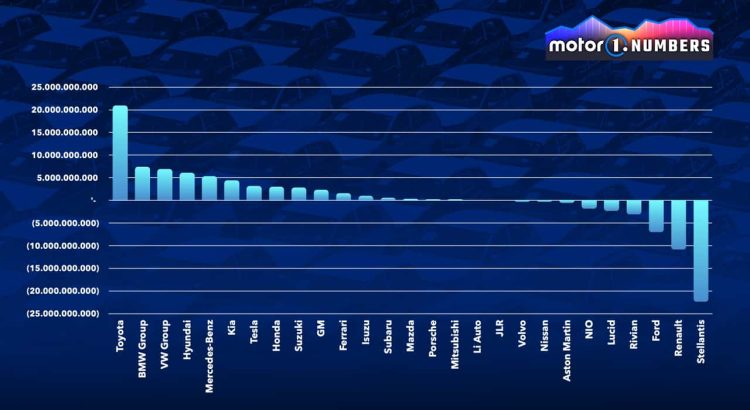
In 2025, the global automotive industry finds itself at a critical crossroads: sales volumes remain relatively steady, yet profit margins are plummeting. An analysis of financial data from major players reveals a troubling reality where rising costs and pricing pressures threaten profitability.
By closely examining the financial results of 23 traditional automakers, we paint a revealing picture of the challenges they face. This analysis includes American giants like GM and Ford, European stalwarts such as Volkswagen and Renault, as well as Japanese brands like Toyota and Honda. Notably, this study does not encompass Chinese manufacturers, but it provides a clear view of the mounting difficulties for historical players. For those interested in automotive news, this situation is one to watch closely.
A Dramatic Drop in Profits
The first observation is alarming: the cumulative net profit of the 27 companies analyzed has plummeted by 84% compared to 2024. In numbers, this translates to a total net profit of €18.68 billion in 2025, down from €119.47 billion the previous year. This drastic decline is not due to a collapse in sales, but rather a combination of soaring operating costs, particularly from the electrification of lineups and increased competition from Chinese brands.
Indeed, investments related to the transition to electric models weigh heavily on balance sheets. Automakers must juggle the need to comply with new environmental regulations while facing mounting pressure to maintain competitiveness in a saturated market. The real issue is profitability in a context where costs are skyrocketing.
Resilient Sales, But at What Cost?
Sales figures indicate that the 27 companies sold 66.45 million vehicles in 2025, reflecting a slight decrease of 1.1% compared to 2024. This number may seem reassuring at first glance, but it conceals a more complex reality. Overall revenue fell by 7%, settling at €2.08 trillion, while the average price per vehicle sold dropped by 6.1% to €31,359.
This phenomenon of stable sales at declining prices is symptomatic of a defensive strategy adopted by many manufacturers. By raising prices in certain segments to offset market share losses to Chinese vehicles, they have inadvertently accelerated the decline in margins. In practice, this means consumers may find fewer options in the premium segment as brands strive to maintain profitability.
Ferrari: The Exception That Proves the Rule
Amid this bleak landscape, Ferrari shines like a shooting star. For the sole Italian brand, net profit has actually increased compared to 2024. This achievement is primarily attributed to the success of the Purosangue model, which has captivated supercar enthusiasts while avoiding the turmoil of the Chinese market and trade tensions. This performance raises a crucial question: how does Ferrari manage to navigate these turbulent waters while other brands struggle to stay afloat?
This contrast with brands like BMW or Suzuki, which are experiencing more moderate profit declines, underscores the importance of a clear strategy and a strong brand image. Ferrari demonstrates that by focusing on exclusivity and innovation, it is possible to stand out in a challenging economic environment.
An Uncertain Future for the Industry
As major automakers strive to maintain their sales volumes, the future appears uncertain. The need for massive investments in electrification and vehicle automation could exacerbate profitability issues in the short term. Additionally, the rise of Chinese brands in the European and global markets presents an additional challenge.
In the medium term, we may witness a reconfiguration of players in the market. Brands that fail to adapt to the new realities of the sector risk losing ground to more agile competitors. The real challenge will be finding a balance between technological innovation and profitability.
In Summary
- Profits for major automakers have dropped by 84% in 2025.
- Sales remained stable, but at declining prices.
- Ferrari stands out with an increase in profits.
- The rise of Chinese brands complicates the situation for historical players.
- The future will depend on rapid adaptation to new market norms and expectations.
Who is this analysis relevant for? Investors looking to understand the dynamics of the automotive market, as well as car enthusiasts eager to anticipate future trends. Alternatives exist, but they require a clear strategic vision and an ability to innovate in the face of contemporary challenges. Strengths lie in a loyal customer base and iconic brands, while limitations are found in economic uncertainty and increasing competitive pressure.