

Google Maps, the go-to GPS application, is set to transform our navigation experience with a major update, the most significant in a decade. The integration of immersive 3D navigation and an AI-powered conversational assistant marks a pivotal shift in the evolution of this app, aiming to become much more than just a mapping tool.
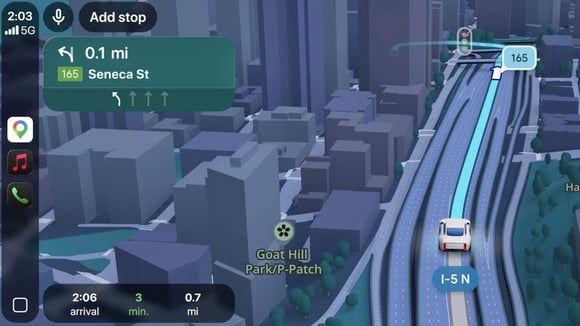
Immersive 3D Navigation: A New Perspective on the Road
This update ushers Google Maps into a new visual era. The promise of immersive navigation in 3D is enticing. The concept relies on a three-dimensional display that offers unprecedented realism. By utilizing data from Google Street View and aerial imagery, the map transforms into a living dashboard, where every building, terrain, and highway interchange is represented with impressive detail.
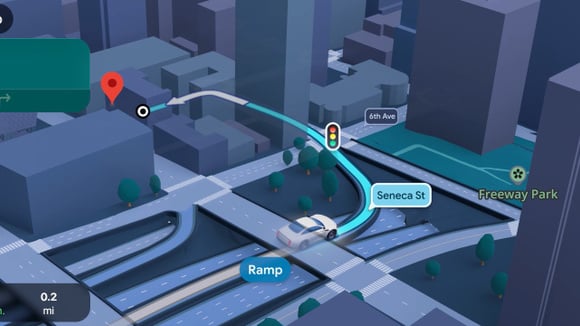
In practice, this approach aims to solve a recurring problem for many drivers: the difficulty in navigating complex junctions. By making elements like traffic lanes, traffic lights, and stop signs more visible, Google hopes to help drivers anticipate their maneuvers. Imagine never getting lost in a tricky intersection or confused by an off-ramp obscured by buildings!
Smart Routes: Make Informed Choices
But beyond the graphical aspect, Google has also rethought the navigation logic. With around 5 million traffic updates per second, the app becomes a true oracle of road traffic. Users will now benefit from alternative routes accompanied by clear explanations of their pros and cons. For instance, if an off-ramp allows you to avoid a jam but adds a few minutes to your trip, the app will flag it.
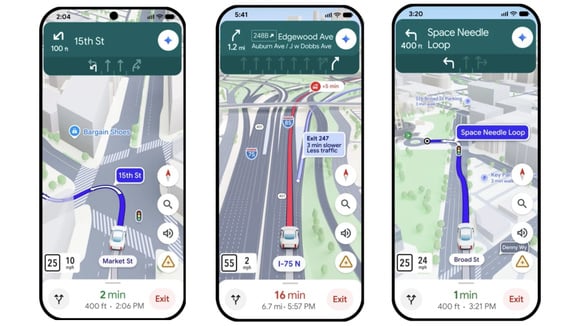
This feature is a real asset for the modern driver, who seeks to optimize their trips while minimizing stress. Additionally, the ability to preview arrival at the destination using Street View images, along with parking recommendations, adds an anticipatory dimension to navigation. In short, Google Maps is no longer just about getting you from point A to point B; it becomes your personal guide, capable of planning every detail of your journey.
Ask Maps: AI at the Service of Users
The other major innovation lies in the integration of artificial intelligence with Ask Maps. This conversational system allows users to ask questions in natural language. For example, asking “Where can I find a restaurant open in Bordeaux after 10 PM with nearby parking?” becomes as simple as chatting with a friend. The AI analyzes available data to provide relevant answers, taking into account the user’s personal preferences.
This advancement isn’t limited to restaurant recommendations. It also enables the planning of complete tourist itineraries, optimized to discover multiple destinations. Imagine being able to organize your vacation in just a few clicks, with suggested stops and practical tips to avoid tourist traps. This is a true industrial breakthrough that could revolutionize how we plan our travels.
Gradual Rollout: Towards Global Adoption
For now, these innovative features are beginning their rollout in the United States. Ask Maps is already accessible on Android and iOS smartphones, while the desktop version is expected soon. Immersive navigation will gradually extend to various platforms, including in-car systems compatible with Android Auto or Apple CarPlay.
However, no specific date has been announced for Europe. French users will need to be patient before they can enjoy these advancements. Still, this update raises questions about competition: how will other players in the sector, like Waze or Apple Maps, respond to Google’s bold move?
In Summary
- Google Maps launches its biggest redesign in 10 years with immersive 3D navigation.
- Routes are now explained with clear trade-offs for better decision-making.
- The introduction of Ask Maps transforms the app into an intelligent travel assistant.
- The rollout begins in the United States, leaving Europe waiting.
- This evolution raises questions about competition in the navigation app sector.
This radical overhaul of Google Maps is much more than just a technical update. It represents a genuine shift for the app, which aspires to become an indispensable travel companion. In the medium term, this strategy could strengthen Google’s position in the navigation app market and encourage other players to innovate further. In short, it will be interesting to see how this evolution influences not only our driving habits but also our relationship with technology in everyday life.

