

The technological revolution in the automotive industry sometimes seems to turn into a farce. After fervently embracing minimalist interiors dominated by touch screens, China is reversing course with a series of new regulations. Mandatory physical buttons, “yoke” steering wheels banned, and stricter requirements on automated driving, Beijing wants to regain control without giving up on innovation. A turning point that could influence the entire world.
A Return to Basics
China aims to impose physical buttons, ban “yoke” steering wheels, and tighten automation rules. A major regulatory turning point. © Tesla
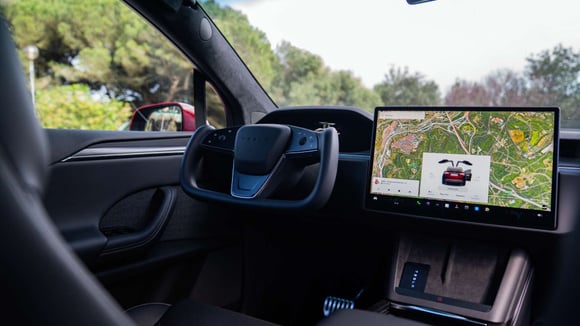
For a decade, China has supported a radical transformation of interiors, dominated by large central screens and a drastic reduction of physical controls. Heavily inspired by Tesla, giants like BYD and Xiaomi have popularized minimalist dashboards, where some essential driving or safety functions could be found in sub-menus. But after already launching a crusade against electric door handles, a hot topic in Europe, the Ministry of Industry and Information Technology (MIIT) is tackling new challenges. Notably, the issue of buttons. Or rather, their absence.
Real Buttons
Turn signals on the steering wheel, forward and reverse on the screen: on the latest Tesla Model 3 and Model Y, some systems have been widely criticized by users. © Alex Krassovsky
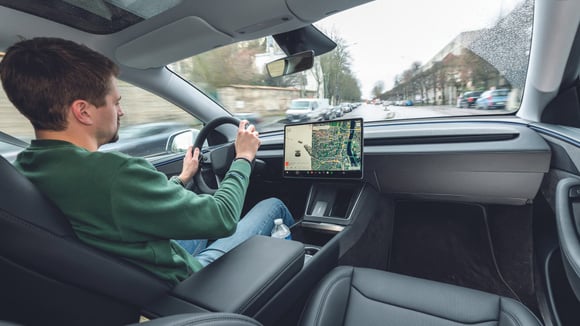
This is how the Chinese ministry is preparing a number of rules on functions deemed essential for safety, which must now be controlled by dedicated physical devices. Turn signals, hazard lights, gear selection, or emergency calls can no longer be relegated to a touch screen or hidden behind a secondary menu. Controls must take the form of buttons or fixed switches, with a minimum surface area of 10 mm by 10 mm. The goal is for drivers to be able to activate them without taking their eyes off the road or relying on the responsiveness of a screen. This framing explicitly targets the ultra-minimalist architectures that have dominated in recent years, where sleek aesthetics and the reduction of physical parts took precedence over ergonomics in dynamic situations. Moreover, real-world usage has already caught up with some manufacturers, who have already reversed their all-touch approach, even as Euro NCAP examines the issue.
“Yoke” Steering Wheels Incompatible with the New Standard
Furthermore, China is addressing other systems. The proposed mandatory standard GB 11557-202X, which will replace the standard in effect since 2011 starting January 1, 2027, significantly tightens the requirements for steering mechanisms. Beijing now aligns the maximum allowable force during a driver impact against the steering wheel to 11,110 newtons, or about 1.1 tons of pressure, in accordance with international regulation UN R12. Specifically, the steering wheel must not transmit excessive load to the chest in the event of a frontal impact. Stricter thresholds are also set for upward or backward movement of the steering column in the event of a collision. With this new testing methodology, the half-steering wheels seen in Tesla (the famous “Yoke”), Lexus, or in some concepts (Mercedes) are nearly condemned. At least in the crosshairs.
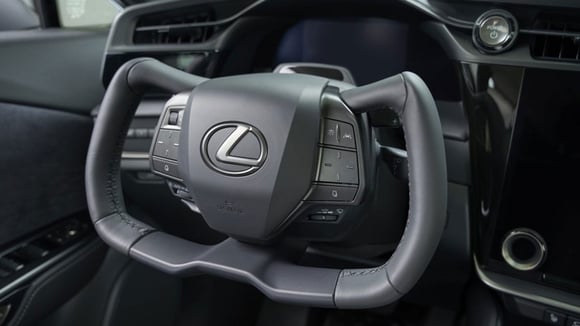
At Lexus, the One Motion Grip steering wheel is offered as an option on the electric Lexus RZ SUV. © DR
The new standard imposes impact tests at ten specific points around the circumference of the steering wheel. On a steering wheel devoid of a top part, these points simply do not exist. They are therefore technically non-compliant. The authorities rely on data indicating that 46% of driver injuries come from the steering mechanism. A circular steering wheel would provide a larger dissipation surface during a secondary impact. Additionally, there is the issue of airbag deployment: the standard now prohibits any hard projectile oriented towards the occupant. The atypical shapes and internal structures of “yoke” steering wheels create breakage patterns that are more difficult to validate during high-speed tests.
Automation: The Bar Raised
The regulatory revision does not stop at ergonomics. Level 3 and 4 driving systems must demonstrate a level of safety equivalent to that of an attentive and competent human driver. Manufacturers will need to present a formal safety dossier covering common scenarios as well as high-risk situations. In the event of a failure or lack of takeover, the vehicle must reach a “minimal risk condition,” in other words, stop safely in an autonomous manner. Remote supervision of fully automated vehicles is also regulated. By legislating on this point, China requires that automation be demonstrable, measurable, and legally defensible, without turning its back on it.
A Rebalancing that Exceeds Chinese Borders
This new series of measures desired by Beijing, pending official validation, aligns with the ban on hidden flush door handles, deemed problematic in certain accidents. In a country where manufacturers have pushed the integration of screens and futuristic interfaces to the limit, reality is catching up with technical limitations. These safeguards do not stifle innovation but ensure that it does not come at the expense of the driver and their safety. A repositioning that raises questions for other major markets. For reference, in Europe, regulation 2019/2144, known as General Safety Regulation 2 (GSR2), has mandated a number of mandatory driving aids since July 2024. Brussels acts on the expected functions and performances without explicitly regulating the form of controls or the architecture of interiors. Unconventional steering wheels remain homologable as long as they meet existing testing protocols, and all-touch is not formally prohibited. A different approach with a continent that adds layer upon layer of mandatory safety devices while China modifies its protocols to account for new designs. It remains to be seen whether this forthcoming Chinese tightening will remain specific to its market or eventually influence international standards.


