

As Europe and other regions struggle to fully embrace 100% electric vehicles, China is taking the lead with a vast array of extended-range electric vehicles (EREVs). This strategic shift could redefine the global automotive landscape.
Only 7 of the 81 extended-range vehicles currently available come from legacy brands. This statistic highlights how the EREV segment is now dominated by Chinese manufacturers—and how quickly this technology is gaining traction. Countries like China and Norway continue their transition from combustion engines to fully electric models, but elsewhere, the adoption of new technologies is progressing more slowly. Ambitious regulations in regions like Europe still face a complex reality: 100% electric cars remain expensive, and charging infrastructure is not yet fully deployed. In this context, any new solution that can facilitate the transition deserves attention.
The Rise of Chinese EREVs
China’s dominance isn’t limited to pure electric vehicles. Over the past three years, the country has also made significant strides in plug-in hybrids and full hybrids, categorized under NEVs (New Energy Vehicles). EREVs—electric vehicles with extended range—represent the latest bet for continued growth, both domestically and for export. These are battery-powered cars equipped with a gasoline engine that serves solely as a generator. Even with an internal combustion engine on board, it never delivers power to the wheels: traction is provided exclusively by the electric motor, while the gasoline unit kicks in to recharge the battery when the charge level drops.

Number of new EREVs introduced in China Photo: Motor1 Italy
This solution is gaining popularity in China and could soon make a more pronounced impact on international markets. According to data from the CAAM (China Association of Automobile Manufacturers), in the first six months of 2025, 40 new EREV models were launched in the Chinese market, surpassing the 35 launched throughout 2024. This growth has led these vehicles to account for nearly 5% of total new car registrations in China in the first half of last year.
81 Models Available, Few Legacy Brands
As of March 2026, the market features 81 different models (excluding commercial vehicles) equipped with this technology. Changan Auto leads the pack: through four of its brands, the group offers 16 EREV models. Chery and Dongfeng follow with 8 models each.

Chinese EREV models Photo: Motor1 Italy
The offering is overwhelmingly Chinese: only 7 of the 81 available models are from legacy manufacturers. Specifically, Mazda offers 3, while Nissan, GM, Volkswagen, and Ford each have one model. This raises a crucial question: where are the major European and American brands? While China innovates and adapts to new market expectations, other players seem to struggle to keep pace.
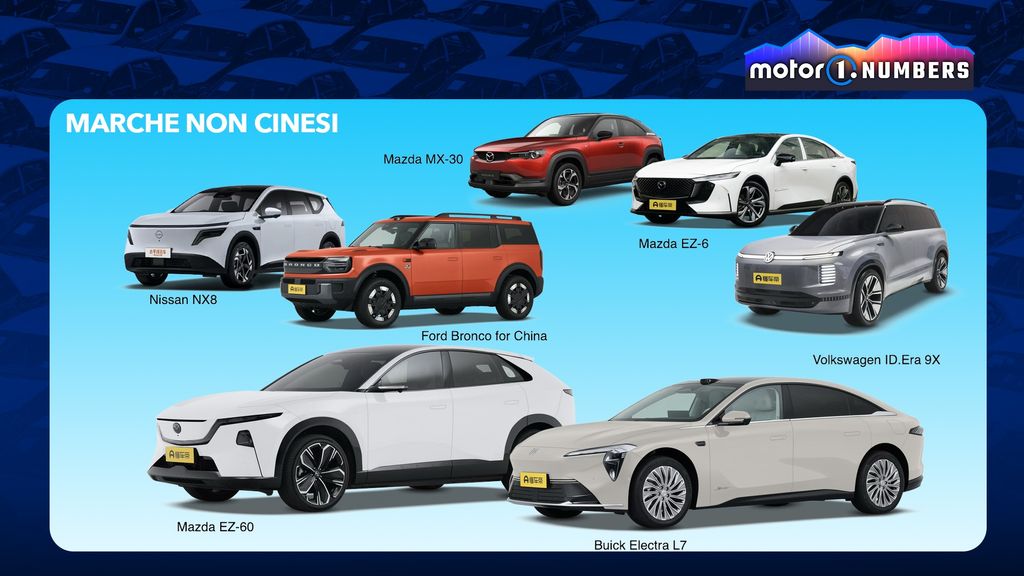
Non-Chinese EREV models Photo: Motor1 Italy
However, the landscape is expected to broaden. Nissan’s e-POWER technology is anticipated in new models, BMW has previously experimented with this solution in the i3, and Jeep is set to introduce an EREV version of the Grand Wagoneer. These initiatives indicate that major industry names are beginning to respond to the rising power of Chinese brands.
This technology offers several advantages: it is simpler and less costly to develop than a pure electric vehicle, does not require heavy infrastructure investments, and provides a concrete answer to range anxiety. Additionally, the gasoline engine used as a generator does not need to be of large displacement. In short, EREVs could be the key to attracting a customer base still hesitant about fully electric vehicles.
Implications for the Global Market
The rise of EREVs could redefine automakers’ priorities. With a predominantly Chinese offering, legacy brands risk being sidelined if they do not react quickly. Product development strategies will need to evolve: it is no longer enough to simply add an electric version to the lineup. Manufacturers must reassess the relevance of their investments and their ability to innovate in the face of a competitor as dynamic as China.
In practice, EREVs could appeal to a wide range of buyers: from urban drivers to families seeking a practical solution for daily commutes. The relatively lower acquisition cost compared to fully electric vehicles could also work in their favor. However, the main challenge remains consumer acceptance: range anxiety is still deeply rooted, and the presence of an internal combustion engine, even as a generator, could reassure some buyers.
In Summary
- China dominates the EREV market with 81 models available.
- Only 7 cars come from legacy brands.
- The EREV technology could attract hesitant customers towards fully electric vehicles.
- Major manufacturers must quickly adapt their strategies to avoid being left behind.
- EREVs represent a concrete response to range anxiety.
In conclusion, the extended-range electric vehicle segment could become a major issue in the coming years. For legacy brands, this is a last stand to avoid being outpaced by the Chinese. Alternatives exist, but they must be relevant and well thought out. EREVs could also play a key role in accelerating the transition to more sustainable mobility while offering a pragmatic solution to consumers still attached to combustion engines.


