


Geely, a Chinese automaker long viewed as an outsider, is reorganizing its development in Europe to prepare for an ambitious commercial offensive. With billions invested and research centers redeployed, the automaker aims to attract European consumers. France, a key market, is in focus with the imminent arrival of new models.

Revamped Development Strategy
Geely has decided to take the bull by the horns by reorganizing its European R&D centers. Gone are the days when Chinese brands faced a technical gap against the expectations of the Old Continent. The creation of Geely Technology Europe represents this desire to accelerate and better adapt to local specifics. Research and development activities are now consolidated under a single entity, with two strategic hubs: Gothenburg, Sweden, and Frankfurt, Germany.

The Swedish site, historically linked to Volvo, focuses on safety and overall engineering, while the German center, the Lotus Tech Innovation Centre, handles European industrial standards. This structuring aims to reduce the adaptation time for models designed for the Chinese market to less than six months.

Geely is reorganizing its development to prepare for its offensive in several markets, including France. © Geely
Europe at the Heart of Innovation
What’s particularly interesting about this new approach is that Geely no longer sees Europe merely as a market to conquer, but as a true technological development hub. This shift comes at a time when a vehicle’s value is no longer based solely on its mechanics but also on its software. Embedded operating systems and over-the-air (OTA) updates are becoming increasingly important in vehicle design.

The CMA (Compact Modular Architecture) and SEA (Sustainable Experience Architecture) platforms developed by Geely are already designed to integrate these software advancements. They provide flexibility to cover various segments from compact to premium while reducing development costs.
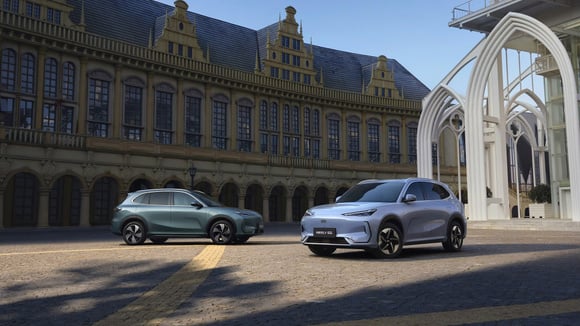
The new electric E5 and hybrid Starray EM-i models will hit the European market this year. © Geely
Well-Structured Commercial Offensive
Alongside this technical reorganization, Geely is preparing its commercial offensive. After solidly establishing its presence with brands like Volvo and Polestar, it’s time for Geely to step into the spotlight with its own lineup. Two new models are already in the works: a 100% electric SUV, the E5, and a plug-in hybrid model, the Starray EM-i.

These vehicles target mid-range segments and will face increased competition. The E5 may struggle to penetrate a market where local models benefit from significant government incentives. In contrast, the Starray EM-i seems to have more advantages to attract consumers.

Geely has high ambitions with its new models in a highly competitive market. © Geely
Launch Planned Across Multiple European Countries
The rollout of the new models will be gradual, starting from key markets like Germany, Spain, and the Benelux countries before reaching France, expected by the end of April 2026. To support this expansion, Geely is establishing a dedicated local structure with the appointment of Jenny Jin as general manager.

However, the challenge remains colossal: the European market is one of the most demanding in the world, both in terms of regulations and consumer expectations. Well-established players like BYD and MG further complicate the task for this newcomer.
In Summary
- Geely restructures its European R&D to improve efficiency.
- The brand becomes an influential technological development center.
- Imminent launch of new models: electric E5 and Starray EM-i plug-in hybrid.
- Launch expected by the end of April 2026 in France after several European markets.
- Competition will be tough in an already saturated market.


