The 1.2 Puretech belt engine, a motor that has generated so much ink, takes its bow in the European Union. Anticipated, but not for the reasons one might think. Instead of bowing to its sometimes notorious reputation, it is the Euro 6 e-bis standard that brings its journey to an end. Between disillusionment and hope for renewal, let’s take stock of this decision by the Stellantis group.
An engine at the end of its life
The 1.2 Puretech belt engine has become as rare as snow in July. Disappeared from the catalogs of the Peugeot 208 and 2008, it is nothing more than a memory for fans of Stellantis vehicles. Its last breath is expected by the end of 2025, but don’t expect a flamboyant tribute. This three-cylinder gasoline engine is fading away primarily because it cannot meet the Euro 6 e-bis anti-pollution standards, which are set to precede the arrival of Euro 7. In short, this engine has not stood up to the increasing ecological demands.

The 1.2 Puretech belt engine ends its career in the European Union by the end of 2025. © Stellantis
A pragmatic and strategic decision
Stellantis does not hide the fact that this decision is primarily environmental. The group wants to reposition itself in the hearts of buyers by proving that it takes ecological issues seriously. While the United Kingdom, escaping these European constraints since Brexit, will still maintain the 1.2 Puretech belt engine for some time, Europe must move forward. It’s almost as if we see a football team changing tactics mid-match: one must adapt to win.
The belt version of the 1.2 Puretech is easily distinguished from the chain variant by its engine cover that does not integrate the oil filler cap. © Johann Leblanc
Here photographed in a Citroën C3 Aircross 1.2 Hybrid 136, the third generation of the 1.2 PureTech differs significantly from previous versions despite its identical displacement. © Johann Leblanc
double_chevron_horizontal
Stellantis’s attempts to restore the reputation of the 1.2 Puretech, such as the introduction of a reinforced belt or a new oil viscosity for oil changes, have hardly been enough to overshadow its reliability issues. The promise of a ten-year or 180,000 km warranty only underscores customers’ concerns: “Better to prevent than to cure,” as a good doctor would say.
A gap to fill for the Peugeot 208 and 2008
This disappearance leaves a gap in the range of the Peugeot 208 and 2008, which lose their entry-level version with a manual gearbox. Access prices are likely to rise, like a raised shield in a retreating army. The 110 hp hybrid version now becomes the cheapest offering, with an electric motor coupled to the latest generation of the chain engine.
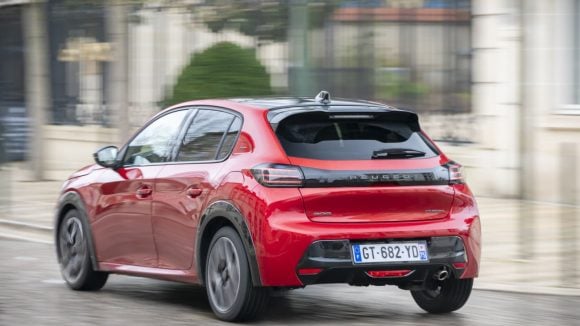
The Peugeot 208 and 2008 temporarily find themselves without an entry-level version with a manual gearbox. © Alex Krassovsky
But rest assured, it will be necessary to wait until early 2026 to see a manual version without electrification return to these models. In the meantime, the belt still holds on the Opel Corsa, but its time is also numbered. Like a secondary character in an action movie, its fate is sealed.
Reliability: an uncertain future for its replacement
New generations of engines are often met with a certain skepticism, especially when one has experienced past troubles. The fourth-generation Citroën C3 and the Fiat Grande Panda have already opted for the new 1.2 turbo chain engine from their launch, leaving behind the issues related to the belt. But as in any good suspense story, defects can arise at any moment.
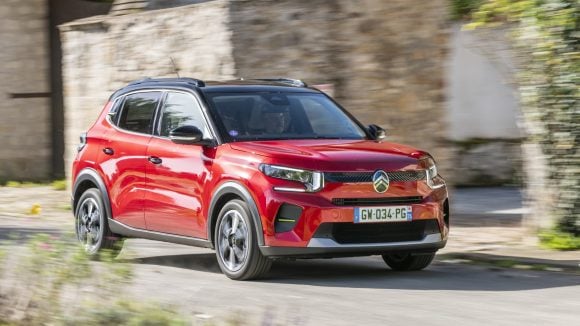
The fourth-generation Citroën C3 benefited from the new 1.2 turbo chain engine from the start, with or without hybridization. © Alex Krassovsky
For now, no alarming reports have been received regarding this recently revised mechanic on our reliability form, but caution is the mother of safety. A significant recall was recently carried out to correct fuel leaks on over 200,000 vehicles, a small hiccup that reminds us that even stars can have their moments of weakness.
Conclusion: a necessary but delicate change
Ultimately, the cessation of the 1.2 Puretech belt engine fits into a necessary transition logic for Stellantis. While responding to increasing environmental standards, the group also hopes to regain consumer trust. It remains to be seen whether this strategy will bear fruit in an ever-evolving automotive market.