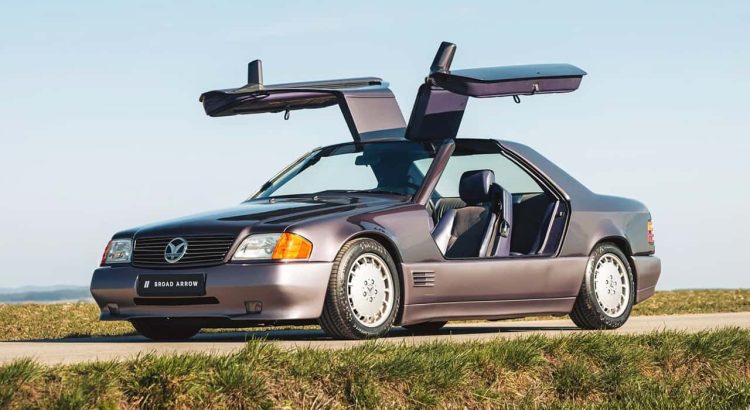
You can’t file this one under any easy label. This 1989 Boschert B300 Biturbo Gullwing starts with a Mercedes 300 CE, adds gullwing doors, and is now headed to Villa d’Este 2026. The appeal goes well beyond the looks: its one-off status, tuned mechanical package, and backstory make it a collector car that’s fascinating—and tough to price with any cold logic.
In the steady stream of car news, this one deserves more than a nostalgic glance. The real story is the rare overlap between 1980s coachbuilt ambition, Mercedes mythology, and an auction market that loves cars nobody can duplicate.
Villa d’Este spotlights the Mercedes Stuttgart never built
Among the more unusual entries announced for the Concorso d’Eleganza Villa d’Este 2026, the Boschert B300 Biturbo Gullwing stands out right away. Broad Arrow Auctions will offer it with an estimate of 475,000 to 525,000 euros, which tells you plenty before the bidding even starts. This is not just another modified Mercedes coupe. It’s a category of one.
At its core, the car is a one-off built in 1989 on a Mercedes-Benz 300 CE base. It clearly nods to the 300 SL “Gullwing,” one of Mercedes’ defining icons from the 1950s, but it doesn’t read like a tribute act. It’s more of an unapologetically 1980s reinterpretation, with all the flair, excess, and confidence that implies.
The Boschert project turned the 300 CE into a design statement
Behind the car was German engineer Hartmut Boschert. His idea was straightforward: take a contemporary Mercedes and turn it into something more exclusive, more dramatic, and far more theatrical than the donor car. The 300 CE was the foundation, not the limit.
Shown at the Frankfurt Motor Show in 1989, the B300 Gullwing wore a heavily revised body. The front end came from the Mercedes-Benz SL R129, while the roof and rear were shortened to visually lower the car’s stance. The result feels like a concept car that somehow slipped onto public roads—recognizably Mercedes, but free of the usual committee-approved restraint.
The biggest talking point, of course, is the set of electrohydraulically operated gullwing doors. That one feature pushes the car from high-end tuner special into genuine automotive oddity. It also separates this example from most other Boschert B300s, which were fitted with conventional doors. That distinction matters, because it’s a big part of why this car may command such a premium.
Its twin-turbo inline-six comes from a more direct, analog era
Under the hood, this Boschert uses a 3.0-liter inline-six derived from Mercedes-Benz’s M103 family. The source material points to a sequential twin-turbo setup and an output of 283 hp. That was serious power for the period, especially in a car conceived as an exclusive grand touring coupe rather than a styling exercise alone.
One point does need clarification. An image caption in the original draft mentioned a “twin-turbo V8,” but that conflicts with the fuller description of the M103 inline-six. Without additional sourcing, the only consistent specification in the file is the 3.0-liter inline-six rated at 283 hp.

Boschert B300 Biturbo Gullwing (1989), the cabin with the manual transmission

The modified powertrain is central to the car’s identity

A closer look at the gullwing door hardware
Power goes to the rear wheels through a five-speed manual. In today’s market, that may be part of the car’s biggest draw. The layout is easy to understand, the engine has real period tuning credibility, and there’s no mention of modern electronic filtering. It’s an analog performance car in the best sense—something you drive, not something you swipe.
Its value comes less from the spec sheet than from total uniqueness
You could stop at the styling or the engine, but that would miss the bigger point. What really drives this Boschert’s value is how singular it is. Even when new, its price reportedly sat above the most expensive Mercedes models in the catalog. That alone says plenty about the ambition behind the project: Boschert wasn’t trying to build a sensible alternative. He was building a statement piece.
That changes the math in today’s collector market. A rare production car can still be measured against a few comparable examples. A one-off doesn’t play by the same rules. That’s both the strength and the limitation here. Its value can climb because nothing else is quite like it, but it also depends heavily on how much confidence bidders have in its history, preservation, and documentation.
Its history adds appeal, even if the usual one-off questions remain
The car reportedly began life in Germany, then spent more than two decades with an enthusiast who first saw it as a child in a magazine. That kind of ownership story matters. In the collector world, long-term care driven by passion rather than quick profit usually carries weight. It’s not a guarantee, but it is a meaningful signal.
Sold again in 2023, the car now shows a little over 39,000 km, presented as original. That low figure helps, but mileage alone is not what defines the car. The real story is the combination of extreme rarity—just one built—an unusual spec, and long-term preservation. That trio can move bidders more than any badge on the hood.

Boschert B300 Biturbo Gullwing (1989): a very 1980s cabin
The 2026 sale will show how far buyers will chase the truly unusual
The auction is scheduled for Saturday, May 16, 2026 in Cernobbio during the Concorso d’Eleganza Villa d’Este. The setting fits perfectly: elegant, highly visible, and full of buyers who respond to cars with a strong story. In that environment, the Boschert won’t look outlandish. It will look like it belongs.
Still, the central question is familiar with cars like this: how much will bidders pay for exceptionality rather than factory-backed historical legitimacy? A rare official Mercedes follows one set of market cues. An independent coachbuilt creation based on a Mercedes follows another. One feels safe. The other feels irresistible to the right buyer. Sometimes that second category brings the bigger number.
In summary
- The Boschert B300 Biturbo Gullwing is a one-off 1989 car based on the Mercedes-Benz 300 CE.
- Broad Arrow Auctions will offer it at Villa d’Este 2026 with an estimate of 475,000 to 525,000 euros.
- Its standout feature is its electrohydraulically operated gullwing doors.
- The consistent mechanical specification in the file is a 3.0-liter twin-turbo inline-six making 283 hp, paired with a five-speed manual.
- With a little over 39,000 km indicated, it combines extreme rarity, an unusual history, and real symbolic weight.
- Its value will depend largely on how strongly the market responds to unofficial but virtually irreplaceable Mercedes-based cars.
At heart, this Boschert is for the collector who wants something other than a conventional classic Mercedes. It suits someone chasing a very specific slice of German car culture—something to drive differently, display differently, or simply own knowing nobody else will pull up next to it in the same machine. That’s the strength, and the risk. Buyers who want easier provenance and simpler resale will still lean toward more familiar vintage Mercedes models. But over the next 3 to 5 years, if the market keeps rewarding one-offs with strong stories, cars like this could carve out an even firmer niche of their own.