

Formula 1 rarely ceases to surprise, and not always with on-track performance. At the 2026 Canadian Grand Prix, one team found itself in the spotlight, not for an exploit, but for a technical failure with very real consequences. Racing Bulls received a hefty fine following a safety system malfunction that led to an unexpected red flag.
The Canadian weekend took an unexpected turn during Free Practice 1 for Liam Lawson and his Racing Bulls team. The young New Zealand driver was forced to stop his car on track due to a hydraulic issue. But the incident didn’t end there: extracting the car proved more complicated than anticipated, leading to a session interruption that annoyed more than a few competitors.
In Formula 1, every detail counts, and the safety of drivers and marshals is paramount. It was within this context that race control quickly placed the team under investigation. Article C9.3 of the F1 regulations, concerning the operation of the ‘Clutch Disengagement System’ (CDS), was at the heart of the concerns.
A Safety System That Fails to Perform
The much-discussed CDS, which can be translated as the clutch disengagement system, is a crucial button. Strategically placed on the chassis, it allows marshals to release the clutch of a stopped car. The goal? To unlock the rear axle and thus facilitate its removal, minimizing intervention time and the need for a red flag. However, in Racing Bulls’ case, the button remained inoperative. The car, despite attempts, wouldn’t budge, forcing the intervention of a heavier recovery vehicle.
A Dual Function Causing Problems
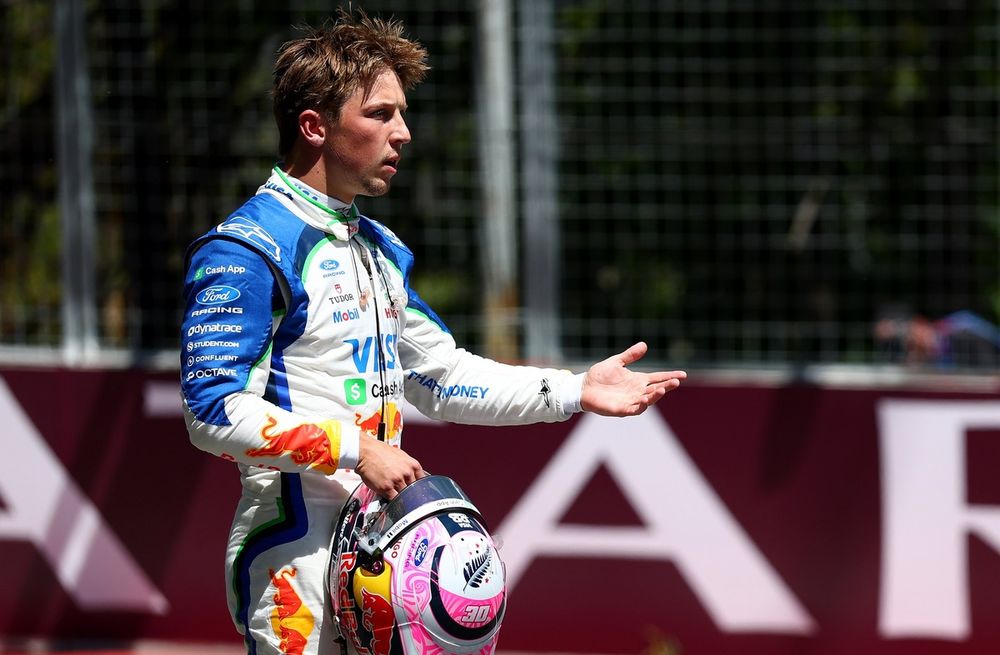
Liam Lawson, visibly surprised by the marshals’ intervention on his single-seater.
During the technical hearing, a team engineer attempted to explain the CDS operation. It was revealed that the system implemented by Racing Bulls served a dual purpose. Firstly, it disengaged the clutch when the car was stopped with the engine off, its primary role. Secondly, it was linked to the anti-stall system. A seal rupture, causing a hydraulic leak, led to the immobilization. But when the marshal activated the CDS, the system failed to release the clutch, making it impossible to move the car.
A Financial Penalty, But an Old Warning
The stewards did not mince words, calling the incident “serious.” The system’s inability to function correctly directly led to the session being stopped by a red flag, whereas a simple Virtual Safety Car would have sufficed had the recovery been swift. The penalty was handed down: a fine of €30,000, with €20,000 suspended. But more concerning is that Racing Bulls had already been alerted to this particular design of its CDS the previous year. The FIA, through its technical delegate, had already raised this concern in 2025.
Marshals Lacking Practical Training?
While the fine targets Racing Bulls, the stewards’ remarks, including input from former driver Pedro Lamy, extend beyond the team. The track marshals also seem to need a helping hand. Liam Lawson highlighted troubling points: marshals attempted to push the car while it was stopped, and one even mistook the CDS button for the onboard camera control.
These observations suggest that additional practical training might be necessary, beyond the official documents distributed by the FIA.
Lessons Learned from This Incident
- Financial Penalty: Racing Bulls was fined €30,000 (with €20,000 suspended) for the faulty CDS.
- Direct Consequence: Liam Lawson’s car immobilization resulted in a red flag during Free Practice 1 of the 2026 Canadian GP.
- Design Flaw: Racing Bulls’ CDS had a dual function and failed to operate as intended, preventing easy car removal.
- Prior Warning: The team had already been cautioned by the FIA about the system’s design in 2025.
- Marshal Training: The incident highlighted a potential need for practical training for track marshals on intervention procedures and control identification.
[sportifs]


