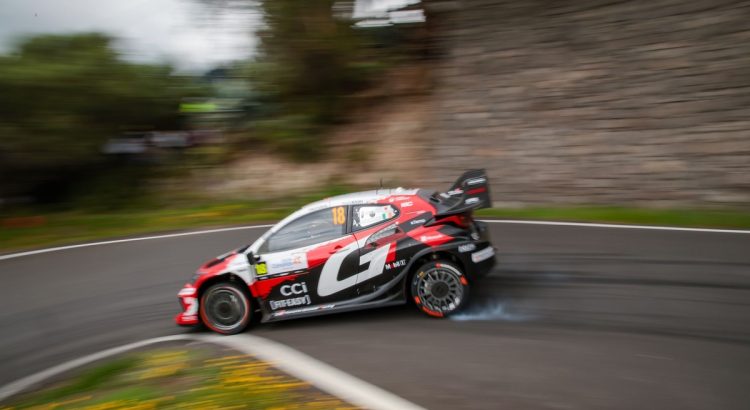
Takamoto Katsuta set the pace in the opening super special at Rally Islas Canarias, grabbing the early lead before the event gets into its real rhythm. It matters, but only to a point: on a stage measuring less than two kilometers, the clock counts, yet it still says very little about a weekend that will be shaped far more by Friday’s proper asphalt tests.
The stage is set in the World Rally Championship: after Croatia, the asphalt portion of the season rolls straight into a Canary Islands round with a very different kind of opener. This first pecking order was drawn inside a stadium, between concrete blocks, side-by-side runs, and an artificial jump. In other words, it was built for spectacle, not for a clean read on who really has the measure of this rally.
Katsuta leads early, but SS1 only tells part of the story
Thursday night, Katsuta came away with the win on SS1. The Japanese driver beat Sami Pajari by four-tenths and moves to the top of the overall standings, with Roberto Daprà right behind in one of the night’s biggest surprises from the WRC2 field. Sébastien Ogier sits sixth at 1.4 seconds, tied with Adrien Fourmaux. At this stage, the margins are tiny.
What that really rewards is the ability to switch on instantly on a very unusual course. That helps confidence, no question. But in rallying, an opening super special can feel a lot like a movie trailer: it sets the tone without giving away the plot.
A fan-friendly super special, not a true sorting session
The format of SS1 made its purpose obvious. Less than two kilometers in Las Palmas, head-to-head action, a course laid out inside a Gran Canaria stadium, and a string of artificial obstacles to thread through. The goal was clear enough: put the cars close to the crowd and give the rally a high-energy launch.
The trade-off is that a stage like this can distort the sporting picture. It does not test tire management over distance, consistency, or a driver’s ability to read a road surface that changes pass after pass. It’s more about placement, launch, and instant precision. Fun to watch, absolutely, but not yet the Canary Islands asphalt in its true form.
The artificial jump shows how the show can blur the read
Several drivers also pointed to the harsh landing from the artificial jump built into this super special. That detail matters. When drivers are talking about what the landing does to their backs on Thursday night, it’s a reminder that the entertainment piece has taken up a noticeable share of the equation.
That tension is nothing new in WRC. Organizers want TV-friendly formats that are short, easy to follow, and easier to sell to a broader audience. The bigger issue is balance. If the opener becomes too manufactured, it starts giving a fuzzy picture of the actual competitive order, and in a series decided by tiny margins, that fuzziness is never fully harmless.
[[AUTONOME_IMG_X]]
Friday changes everything with seven stages on deck
The first real read on this rally arrives Friday, when the event gets much denser with seven stages scheduled. That is where the field should start to separate, where the best setups begin to show, and where small weaknesses start to cost real time. On an asphalt rally, pace is built stage by stage, not in a made-for-show lap inside a stadium.
Katsuta will head out as the leader and open the road on the first loop at 9:25 a.m. French time. That is worth watching, even if the source material does not provide more detail on road conditions or the likely impact of that starting spot. Either way, Friday morning should tell us whether his recent momentum is carrying over, or whether this lead was simply an early green light before the real fight began.
Ogier and Fourmaux stay close, while Daprà delivers the surprise
Behind the provisional leader, the gaps remain far too tight for any hard conclusions. Ogier, sixth at 1.4 seconds, has no reason to panic. The same goes for Fourmaux, who sits on exactly the same time. Once this round moves onto full-length stages, that deficit is basically cosmetic.
Daprà’s presence near the top, though, adds the first unexpected twist of the weekend. Seeing a WRC2 driver mix it up near the front, even on a highly unusual super special, is a good reminder of how this format can produce surprising time sheets. That is the beauty of a sprint. It is also the limitation.
What matters before the Canary Islands rally truly begins
So after SS1, the smart move is to avoid overreading the result. Katsuta did exactly what he needed to do, cleanly and quickly. But Rally Islas Canarias has not yet shown its hand. The order remains light, almost suspended, as if the championship has pressed the throttle once without really getting into top gear.
- Takamoto Katsuta is the rally’s first leader after SS1.
- He leads Sami Pajari by four-tenths.
- Roberto Daprà is the early surprise after beating several established names.
- Sébastien Ogier is sixth at 1.4 seconds, tied with Adrien Fourmaux.
- The super special was extremely short and highly artificial, making it a poor benchmark.
- The real sporting test starts Friday with seven stages on the schedule.
The useful takeaway is simple: treat this opener as an entertaining prologue, not a final word on the rally. Katsuta’s run deserves credit, but it still needs backing up over a full day of real stages. For anyone following this round closely, Friday’s first loop should offer the first meaningful split between genuine win contenders and those who simply nailed the launch sequence. Over the next few years, that balance between made-for-TV spectacle and pure competitive value will remain one of WRC’s more interesting tensions.