

The Miami Grand Prix will not start when originally scheduled. The FIA has moved the race up by three hours to avoid the highest-risk weather window, with thunderstorms forecast for late afternoon in Florida.

The move may look small on paper, but in Formula 1 it can change everything. A few hours can be the difference between a clean race and a long stretch under caution, with strategy, safety, and the show all taking the hit.
For readers following the rest of the weekend, our Formula 1 coverage helps put the decision in context. In Miami, weather is not background noise. It is part of the race.
Three hours earlier to protect the race
The Grand Prix was originally set for 4:00 p.m. local time, or 10:00 p.m. in France. It will now begin at 1:00 p.m. in Miami, which works out to 7:00 p.m. in France. The FIA made the call with Formula One Management and the local promoter after weather forecasts put the original slot squarely in the danger zone.
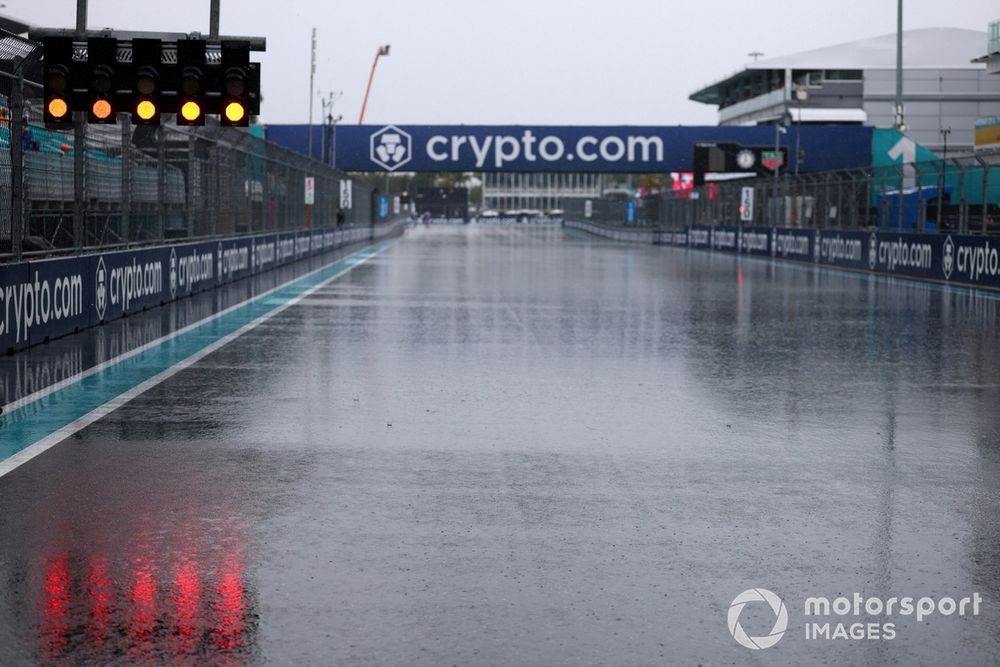
The real issue is not whether fans in Europe get a slightly different TV slot. It is whether the race can actually go distance. In Florida, a thunderstorm is not just a heavy shower. If lightning is detected nearby, U.S. rules require the event to stop and everyone outdoors to move to shelter.
Formula 1 chose the safer option before the clock became the enemy. Losing three hours on the schedule beats losing a race to a safety stop or a full weather shutdown once the storm hits.
Miami’s layout leaves little margin when the weather turns
The Miami circuit, built around Hard Rock Stadium, does not offer the same flexibility as a more traditional permanent track. Water has to clear quickly, visibility can disappear in seconds, and lightning protocols leave no room for improvisation.
The problem is not only sustained rain. It is the sequence that can follow: a delayed start, a shelter order, then a messy restart. On a circuit already sensitive to strategy swings, even a brief interruption can wreck a team’s plan.
That is why the FIA and F1 went with the simplest answer available: move the start and open up more of the race window before the storms arrive. It is a straightforward call, but it shows how modern Grands Prix are now shaped as much by weather models as by tire simulations.
Rain also changes how teams set up the cars
The calendar shift is only part of the story. Rain also changes how teams prepare the cars, because F1 does not leave much to chance once grip starts to fall away.
If rain and thunderstorm risk is officially declared, teams get two extra exceptions to parc fermé rules: ride height can be adjusted and the front wing flap opening angle on the straight can be changed. Those allowances give engineers a little more room to tune the car for a slick surface.
This is not just engineer talk. On a wet track, a few millimeters or a few degrees can change braking, cornering balance, and throttle pickup. That improves safety, but it also matters for performance, because a badly set-up car can become nearly impossible to drive cleanly.
Wet-weather rules are already tighter before lights out
The FIA has also built in a separate set of limits for wet conditions. MGU-K deployment is capped at 250 kW, and boost mode is not allowed when grip is low.
Active aero is controlled more tightly too. The rear wing is locked, and the front wing can only open partially and within limited zones. Tire blankets for intermediate tires are also run at a higher temperature to help get the tires into their operating window.
Those rules are meant to keep the racing fair and manageable. On track, they also make one thing clear: when the rain comes down, technology can help, but it cannot fully tame the elements.
The race could still become a survival test
Even with the earlier start, the weekend still looks vulnerable. Rain is expected to affect the Grand Prix, and Miami is not the kind of circuit that forgives mistakes. A driver who is not comfortable in low-grip conditions can turn a simple switch to intermediates into a survival run.
The tricky part is that the current generation of cars has not often spent long stretches running hard in heavy rain under these conditions. With setup changes, poor visibility, and the threat of another stoppage, the race can change shape fast.
The early call from the FIA at least gives the event a better shot at going the distance before the storm takes over. Formula 1 cannot always outrun the weather. In Miami, it is trying to get ahead of it.
Miami’s race window may decide more than the lap chart
The Miami Grand Prix is now about more than a schedule change. The decision shows how modern F1 has to balance safety, local rules, and weather that can become a sporting factor on its own.
- The start has been moved up three hours, to 1:00 p.m. local time, to avoid storms forecast for late afternoon.
- The FIA says the priority is clear: protect the race, the drivers, the teams, and the crowd.
- If rain arrives, teams still get limited setup changes despite parc fermé.
- Wet-weather regulations remain strict, with limits on MGU-K deployment and active aero.
- Miami remains a vulnerable circuit, where even a short shower can complicate drainage and race management.
- For the teams, the outcome may be decided as much on the pit wall as under Florida lightning.


