A loss of power in a Peugeot 205 rarely points to a single, obvious culprit. The engine might feel sluggish, struggle to rev, hesitate during acceleration, or seem to be working hard without making real progress. For this classic model, a power deficit can stem from numerous issues: weak ignition, compromised air intake, insufficient fuel delivery, incorrect air-fuel mixture, a clogged exhaust, misfires, or engine control problems. It’s therefore unwise to immediately suspect a specific component; instead, understanding the conditions under which power is lost is key to a step-by-step diagnosis.
When diagnosing a Peugeot 205, this symptom must always be considered within the context of the vehicle’s age. An older car can accumulate several minor weaknesses: aging ignition wiring, worn spark plugs, brittle vacuum hoses, less-than-perfect intake sealing, or an inconsistent fuel supply. A power loss isn’t always tied to a dramatic failure; it can be gradual, intermittent, or only appear under specific temperatures, loads, or RPMs. This is precisely what makes diagnosing a 205 so interesting: you need to observe the engine’s behavior before jumping to conclusions.
What Exactly Does “Loss of Power” Mean in a Peugeot 205?
A loss of power isn’t just about the car feeling “less sprightly.” For a Peugeot 205, it typically means the engine isn’t producing its usual output. The car accelerates poorly, struggles to get moving from a standstill, has trouble revving freely, or seems to tire when pushed. Drivers often notice this when accelerating, merging into traffic, climbing hills, or trying to gain speed in the mid-range gears.
The symptom can range from distinct to vague. Some cars might still respond adequately at low RPMs but then fall flat. Others feel sluggish across the board. Sometimes, the power loss is accompanied by stumbling, an engine that hesitates, or an irregular idle. In other situations, the engine might seem to run relatively smoothly, but the car simply lacks its former pep.
This distinction is important because the nature of the power loss already guides the diagnosis. A 205 that feels weak at higher RPMs doesn’t necessarily point to the same issue as one that hesitates primarily at low revs, or one that only becomes sluggish when hot. Before discussing specific parts, it’s crucial to accurately describe the symptom.
When is the Peugeot 205 Lacking Power?
The first question to ask is simple: When does the power disappear? Is it constant, or does it only happen at certain times? A Peugeot 205 that loses power only during hard acceleration sends a different signal than a car that feels sluggish at all RPMs. If the problem is more pronounced in hot weather, temperature should be a factor in your thinking. If the loss is more evident in the cold, certain hypotheses become more credible.
Pay attention to whether the car struggles to rev up, hesitates off the line, stumbles, or seems to “choke.” A power loss related to ignition doesn’t always manifest the same way as one stemming from an exhaust or fuel supply issue. Observing the engine’s actual behavior remains the most critical step.
In a Peugeot 205, this context is often more revealing than a general feeling. A car can lose power because it’s burning fuel poorly, breathing inefficiently, not getting enough fuel, or because a control unit is disrupting the whole system. The conditions under which the power loss occurs help narrow down these possibilities.
Is the Ignition System the Problem?
Yes, the ignition system is very often among the first areas to check when a Peugeot 205 experiences a power loss. A spark that’s too weak, poorly distributed, or irregular can be enough to degrade combustion without preventing the engine from running. The result felt at the wheel is a car that’s less responsive, less smooth, sometimes hesitant, and occasionally noticeably sluggish.
For a 205, this hypothesis is all the more logical given that ignition components naturally age over time. Worn spark plugs, an exhausted spark plug wire set, a tired distributor cap, a damaged rotor, or a less potent ignition coil can all lead to incomplete combustion. The engine still runs, but it’s not delivering its normal power. This is especially noticeable during acceleration and under load.
If the power loss is accompanied by slight misfires, an engine that stumbles, an irregular idle, or poorer performance in damp weather, the ignition hypothesis gains significant weight. It should always be among the first logical checks for a Peugeot 205.
Could a Compromised Intake or Vacuum Leak Explain the Issue?
Yes, and this is actually a common cause in older vehicles. If the engine is ingesting too much unmetered air or if the intake system isn’t functioning correctly, the air-fuel mixture gets thrown off balance. A Peugeot 205 can then feel hollow, hesitant, and lose acceleration. This type of fault is often more gradual than a severe ignition failure, which can sometimes make it harder to pinpoint.
A vacuum leak doesn’t always just cause an unstable idle. It can also degrade acceleration, make the engine feel less full, and disrupt the mixture across various RPMs. A cracked hose, a worn intake boot, a loose clamp, or a poorly sealing gasket can be enough to significantly alter the engine’s behavior.
On a Peugeot 205, if the car hesitates, loses flexibility, or responds erratically to throttle input, the intake system should be thoroughly inspected. This is often less dramatic than a clear-cut failure but is very consistent with a diffuse power loss.
When Do Fuel or Injection Issues Restrict Power?
An inconsistent or insufficient fuel supply can significantly rob a Peugeot 205 of power. If the engine isn’t getting enough gasoline when it demands it, it simply cannot produce its full output. The symptom often appears under load, during acceleration, or when climbing hills.
The car might feel like it’s suffocating, hesitate before picking up again, or struggle to rev. In some cases, the engine might run almost normally at a steady speed but collapse as soon as more power is requested. This strongly suggests a fuel or injection hypothesis. Insufficient fuel flow, a clogged injector, or erratic fuel system operation can cause exactly this behavior.
For a Peugeot 205, if the power loss becomes particularly noticeable under load, this cause truly deserves attention. It doesn’t exclude others but becomes one of the most plausible issues to investigate.
Could the Exhaust or Catalytic Converter Be Restricting the Engine?
Yes. A Peugeot 205 can also lose power because it’s not expelling its exhaust gases efficiently. If the flow is obstructed, disrupted, or blocked, the engine struggles to breathe, and its performance suffers. The driver might sometimes get the impression the car is straining, not revving normally, or feels “held back.”
This hypothesis becomes even more credible if the power loss is accompanied by an exhaust fault, a gradually worsening engine performance, or a history of irregular combustion. An engine that has been running poorly for a long time can stress the exhaust system or emissions control components, leading to a new symptom: power loss.
This shouldn’t be your first thought, but it should exist in the diagnostic hierarchy, especially if ignition, intake, and fuel supply issues don’t clearly explain the problem.
What Fault Codes Might Accompany a Power Loss?
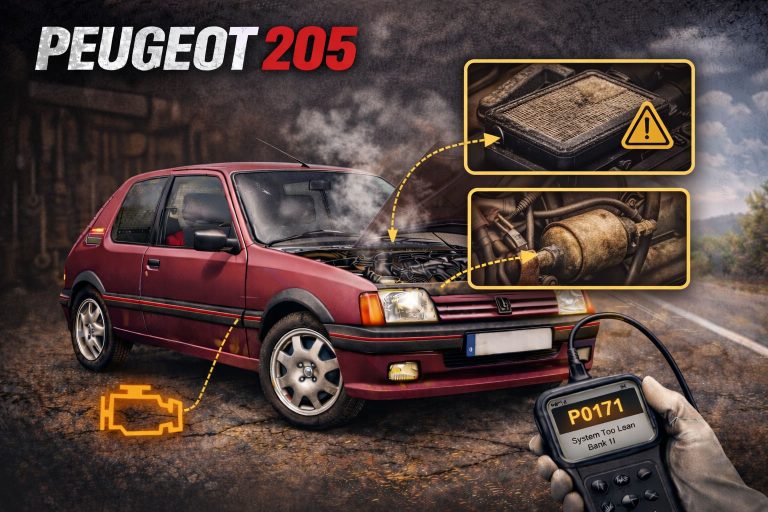
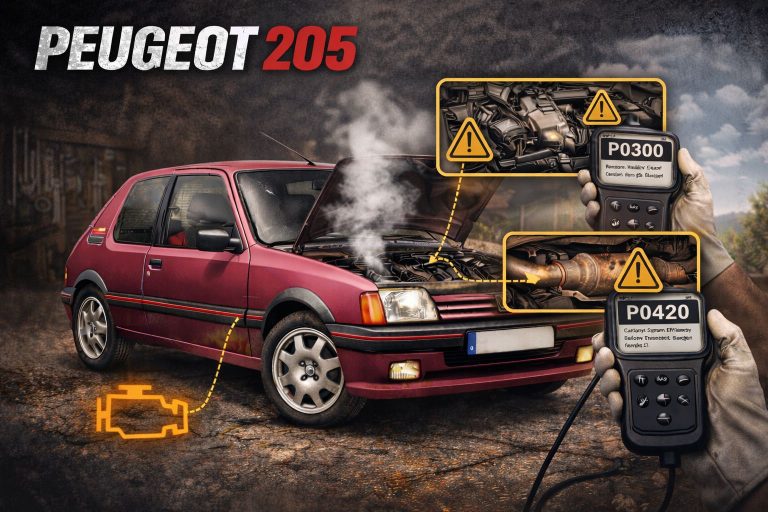
If fault code reading is possible, certain codes can help guide the diagnosis. Codes related to misfires, a lean condition, exhaust anomalies, or irregular combustion can appear alongside a power loss. For example, a P0300 might indicate random misfires. A P0171 could point to a lean fuel mixture. A P0420 might suggest catalytic converter efficiency issues or indicate combustion has been poor for some time.
However, caution is advised. A fault code helps prioritize the search but doesn’t replace diagnosis. A Peugeot 205 can lose power without any readable codes, or conversely, show a code that’s merely a consequence rather than the primary cause. As always with this model, the actual engine behavior remains the most useful basis for diagnosis.
Can You Keep Driving a Peugeot 205 That’s Losing Power?
It depends on the severity of the issue. If the power loss is slight and stable, some owners might continue driving for a while, monitoring its progression. But this isn’t necessarily a good practice. A car losing power signals an imbalance, and that imbalance can worsen or have other consequences if ignored for too long.
If the Peugeot 205 becomes dangerous to merge with, stumbles, misfires, refuses to rev properly, or if the behavior rapidly deteriorates, it’s best to limit driving. The problem isn’t just about comfort; it’s about the vehicle’s ability to react correctly in normal situations.
The right reflex, therefore, is not to ignore this symptom. A power loss isn’t necessarily a catastrophic failure, but it should be treated as a genuine warning sign.
In What Order Should You Investigate the Cause?
The correct method begins with carefully observing the symptom: at what RPM, under what conditions, with what other visible signs? Then, work through the hypotheses logically. First, check the ignition, as it’s a very frequent culprit on an older Peugeot 205. Next, inspect the intake and vacuum systems. Then, examine the fuel supply, especially if the problem worsens under load. Finally, if nothing is clear, consider the exhaust, emissions system, and finer engine control elements.
This approach avoids immediately jumping to expensive or complex hypotheses. It also allows you to link the power loss to other potential symptoms: stumbling engine, unstable idle, hesitation on acceleration, occasional no-starts, excessive fuel consumption, or recorded fault codes.
For a Peugeot 205, this step-by-step logic is often far more cost-effective than impulsively replacing parts. The correct diagnosis isn’t necessarily the fastest on paper, but the one that respects the mechanical coherence of the problem.
Common Mistakes to Avoid
The first mistake is to immediately assume a “major engine problem” without precisely describing the power loss. The second is to ignore other accompanying symptoms. A 205 losing power and stumbling doesn’t point to the same issue as a 205 that only loses acceleration. The third is to disregard the vehicle’s age: ignition wires, hoses, the ignition system, intake leaks, and minor vacuum issues are often more realistic causes than a very rare failure.
Another common error: replacing multiple parts without a clear logic. This happens quickly on an old vehicle. You change the spark plugs, then something else, then something else again, without truly following a coherent diagnostic sequence. Finally, avoid believing that an emissions system fault necessarily only affects the exhaust. On a Peugeot 205, many power issues actually stem from poorly controlled combustion or an incorrect mixture.
What to Keep in Mind
A Peugeot 205 losing power could be suffering from an issue with its ignition, intake, vacuum system, fuel supply, exhaust, or engine management. The key to diagnosis lies in precisely describing the symptom: when the car lacks power, with what other signs, under what conditions, and how it has evolved over time.
For this model, the first hypotheses to check are typically ignition, intake, and fuel supply before moving on to the exhaust or more intricate causes. As is often the case with the Peugeot 205, method counts more than intuition. It’s the cross-referencing of symptoms, the logical sequence of checks, and any fault codes found that will lead to the correct cause.