

A Peugeot 205 experiencing power loss rarely offers a single, obvious clue. The engine might feel sluggish, struggle to rev, lack responsiveness, hesitate during acceleration, or seem to labor without its usual pep. For this classic model, power loss can originate from a variety of sources: worn ignition components, disrupted intake airflow, air leaks, insufficient fuel delivery, improper air-fuel mixture, a clogged exhaust, or engine management glitches. The most effective approach isn’t to immediately suspect a specific part, but rather to understand the exact conditions under which power is lacking, then methodically work through the diagnosis.
In a Peugeot 205, this symptom must always be considered within the vehicle’s overall condition. An older car can accumulate several minor weaknesses: aging ignition wires, worn spark plugs, porous hoses, a less-than-perfect intake seal, or an unstable fuel supply. Power loss isn’t always tied to a dramatic failure; it can be gradual, intermittent, or only appear when the engine is hot, cold, under load, or at specific RPMs. This complexity makes diagnosis an interesting puzzle, requiring careful observation of the engine’s behavior before jumping to conclusions.
What Does “Power Loss” Mean in a Peugeot 205?
Power loss isn’t just a car that feels “less peppy” than before. In a Peugeot 205, it generally refers to an engine that’s no longer delivering its expected output. The car accelerates less effectively, struggles to regain speed, climbs through the rev range less eagerly, or seems to run out of steam when pushed. Drivers often notice this during overtaking, merging onto highways, climbing hills, or accelerating through intermediate gears.
The symptom can be pronounced or more subtle. In some cases, the car might respond well at low RPMs but falter significantly afterward. In others, it feels sluggish across the entire rev range. Sometimes, power loss is accompanied by stuttering, a rough-running engine, or irregular revs. In other situations, the engine might run relatively smoothly, but the car simply lacks its usual vigor.
This distinction is important, as the type of power loss already guides the diagnosis. A 205 that feels weak at high RPMs doesn’t point to the same issues as one that hesitates primarily at low RPMs or one that becomes sluggish only when the engine is hot. Before discussing specific parts, accurately describing the symptom is crucial.
When Does the Peugeot 205 Experience Power Loss?
The first question to ask is simple: when does the power disappear? Is it constant, or only at certain times? A Peugeot 205 that lacks power only during hard acceleration sends a different signal than a car that feels sluggish at all RPMs. If the issue arises mainly when the engine is hot, temperature must be factored into the reasoning. If the loss is more pronounced when cold, certain diagnostic leads become more credible.
It’s also essential to observe whether the car struggles to rev, hesitates before accelerating, stutters, or seems “choked.” Power loss related to the ignition system doesn’t always manifest the same way as loss due to exhaust or fuel supply issues. Observing the engine’s actual behavior remains the most critical step before anything else.
In a Peugeot 205, this context of occurrence is often more useful than a general feeling of weakness. A car can lack power because it’s burning fuel poorly, breathing inadequately, not receiving the correct fuel supply, or because a management component is disrupting the system. The conditions under which the issue appears help classify these hypotheses.
Is the Ignition System to Blame?
Yes, the ignition system is often one of the first areas to explore when a Peugeot 205 lacks power. A weak, poorly distributed, or irregular spark can degrade combustion without necessarily preventing the engine from running. The result felt at the wheel is a car that is less lively, less smooth, sometimes hesitant, or even distinctly sluggish.
On a 205, this diagnostic path is particularly logical as ignition components age over time. Worn spark plugs, tired spark plug wires, a distributor cap with carbon tracking, a damaged rotor, or a less effective ignition coil can all create incomplete combustion. The engine may still run, but it no longer delivers its normal output. This is especially noticeable during acceleration and under heavy demands.
If power loss is accompanied by slight misfires, rough running, irregular revs, or worse performance in humid conditions, the ignition system becomes an even more significant lead. On a Peugeot 205, it should always be among the first logical checks.
Could a Disrupted Intake or Air Leak Explain the Problem?
Yes, and this is a common cause in older vehicles. If the engine receives too much unwanted air (a vacuum leak) or if the intake system is malfunctioning, the air-fuel mixture becomes unbalanced. A Peugeot 205 can then feel hollow, hesitant, and lack power during acceleration. This type of failure is often more gradual than a significant ignition issue, making it sometimes less obvious to identify.
An air leak doesn’t always just cause an unstable idle. It can also degrade acceleration, make the engine feel less robust, and disrupt the air-fuel mixture at various RPMs. A porous hose, a worn connector, a loose clamp, or a less-than-airtight gasket can significantly alter the engine’s behavior.
On a Peugeot 205, if the car seems hesitant, lacks smoothness, or reacts irregularly to the accelerator pedal, the intake system deserves a thorough check. This diagnostic path is often less dramatic than a clear component failure but very consistent with diffuse power loss.
When Fuel or Injection Limits Performance
An irregular or insufficient fuel supply can clearly cause power loss in a Peugeot 205. If the engine doesn’t receive enough fuel when asked to perform, it simply cannot deliver its full capacity. The symptom often appears under load, during acceleration, or when climbing hills.
The car may feel like it’s choking, hesitate before accelerating, or struggle to rev up. In some cases, the engine seems almost normal at a steady speed but collapses as soon as more is demanded. This points quite clearly toward fuel or injection issues. Insufficient fuel delivery, a clogged injector, or irregular operation of the fuel pump can produce exactly this type of behavior.
On a Peugeot 205, if power loss is especially noticeable under load, it’s crucial to pay attention to this family of causes. It doesn’t exclude others, but it becomes one of the most coherent areas to check.
Can the Exhaust or Catalytic Converter Restrict the Engine?
Yes. A Peugeot 205 can also lack power because it’s expelling exhaust gases poorly. If the flow is hindered, disrupted, or blocked, the engine breathes less effectively, and its performance suffers. The driver may sometimes feel that the car is straining, not revving normally, or is “held back.”
This hypothesis becomes even more credible if power loss is accompanied by an emissions fault, a progressively degraded engine behavior, or a history of irregular combustion. An engine that has long run poorly can eventually wear out the exhaust or emissions components, creating a new symptom: power loss.
This diagnostic path shouldn’t be the first reflex, but it should exist in the diagnostic hierarchy, especially if ignition, intake, and fuel supply don’t clearly explain the failure.
What Defects Can Accompany Power Loss?
When reading fault codes is possible, certain codes can help guide the diagnosis. Codes related to misfires, a mixture that is too lean, an emissions anomaly, or irregular combustion may appear alongside power loss. A P0300, for example, can indicate random misfires. A P0171 may point to a mixture that is too lean. A P0420 can draw attention to the catalytic converter’s efficiency or to combustion that has already degraded over time.
But caution is necessary. A fault code helps prioritize the search; it doesn’t replace the diagnosis. A Peugeot 205 can very well lack power without any readable codes, or conversely, display a fault that only describes a consequence and not the main cause. As always with this model, the engine’s actual behavior remains the most useful basis.
Can You Continue Driving a Peugeot 205 That Lacks Power?
It depends on the severity of the issue. If the power loss is mild and stable, some drivers continue to drive for a while while monitoring the situation. However, this isn’t necessarily a good habit. A car that lacks power signals that an imbalance exists, and this imbalance can worsen or have other consequences if pushed too long.
If the Peugeot 205 becomes genuinely dangerous during merging, stutters, hesitates, fails to rev properly, or its behavior deteriorates rapidly, it’s better to limit trips. The issue isn’t just about driving comfort; it’s also about the vehicle’s ability to respond correctly in normal situations.
The best reflex is not to ignore this symptom. Power loss isn’t necessarily a dramatic failure, but it should be treated as a genuine warning sign.
In What Order Should You Search for the Cause?
The right method starts with precisely observing the symptom: at what RPM, under what conditions, with what other visible signs. Then, one should open diagnostic paths in a logical order. First, check the ignition system, as it is often the culprit in older Peugeot 205s. Then, the intake and air leaks. Next, the fuel supply, especially if the problem worsens under load. Finally, if nothing appears clearly, check the exhaust, emissions system, and finer engine management components.
This progression avoids jumping straight to costly or complicated hypotheses. It also helps connect power loss to any other potential symptoms: rough running, unstable idle, stuttering during acceleration, occasional no-starts, excessive fuel consumption, or recorded faults.
On a Peugeot 205, this step-by-step logic is often much more cost-effective than impulsively replacing parts. The best diagnosis isn’t the quickest on paper, but the one that respects the mechanical coherence of the problem.
Common Mistakes to Avoid
The first mistake is to immediately conclude a “major engine problem” without having precisely described the power loss. The second is to ignore other associated symptoms. A 205 that lacks power and stutters doesn’t point to the same issues as one that only lacks acceleration. The third is to neglect the vehicle’s age: ignition wires, hoses, spark plugs, intake components, and minor leaks are often more realistic causes than a very rare failure.
Another frequent error is replacing multiple parts without a clear diagnostic logic. On an older car, this can happen quickly. One changes the spark plugs, then something else, then yet another part, without genuinely following a coherent order of checks. Finally, one should avoid believing that an emissions-related fault solely indicates the exhaust. On a Peugeot 205, many power issues actually stem from poor combustion or a poorly managed air-fuel mixture.
Key Takeaways
A Peugeot 205 that loses power may suffer from ignition, intake, air leak, fuel supply, exhaust, or engine management issues. The key to diagnosis is to describe the symptom precisely: when does the car lack power, with what other signs, under what conditions, and how does it evolve over time.
For this model, the first diagnostic paths to check are generally ignition, intake, and fuel supply, before expanding to exhaust or finer causes. As is often the case with the Peugeot 205, method matters more than intuition. By cross-referencing symptoms, following a logical order of checks, and noting any recorded faults, one can find the correct cause.
If you want to dive deeper, you can also check our articles on the Peugeot 205 that stutters, the Peugeot 205 that won’t start, as well as our detailed guides on the most common fault codes. Together, these resources help build a coherent and more reliable diagnosis.
Related articles about Peugeot 205
Selection of articles, guides and advice about Peugeot 205.
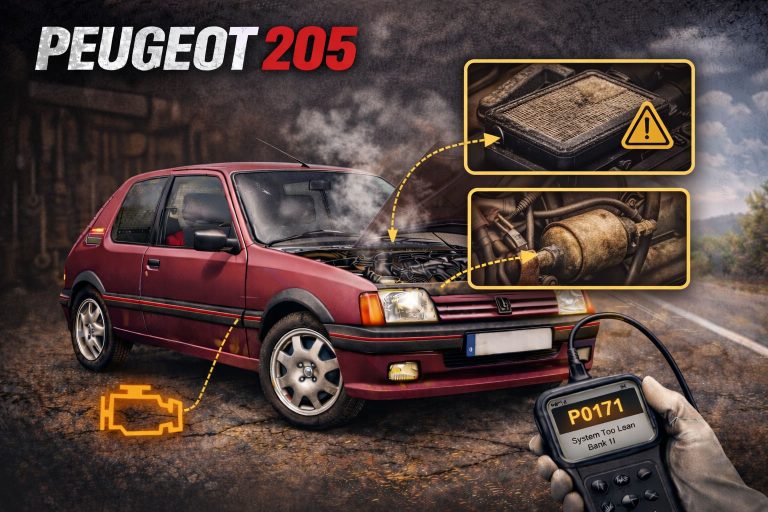
Peugeot 205 Losing Power? Here’s How to Diagnose the Common Causes
Ein Leistungsverlust bei einer Peugeot 205 gibt selten einen klaren Hinweis. Der Motor kann sich schwach anfühlen, langsamer…

Can You Read OBD Codes on a Peugeot 205?
Can You Read OBD Codes on a Peugeot 205? The short answer is: not always in the way…
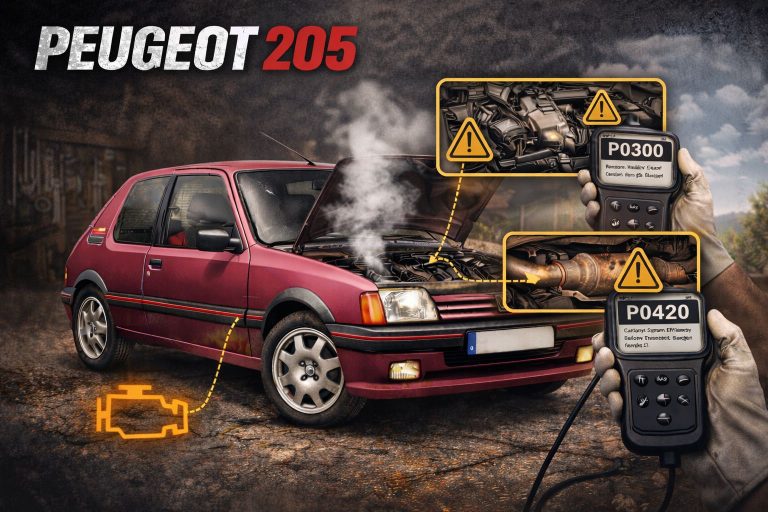
Diagnosing a Peugeot 205’s Rough Running Issues
A rough-running Peugeot 205 is a symptom that should never be taken lightly. This behavior often indicates an…
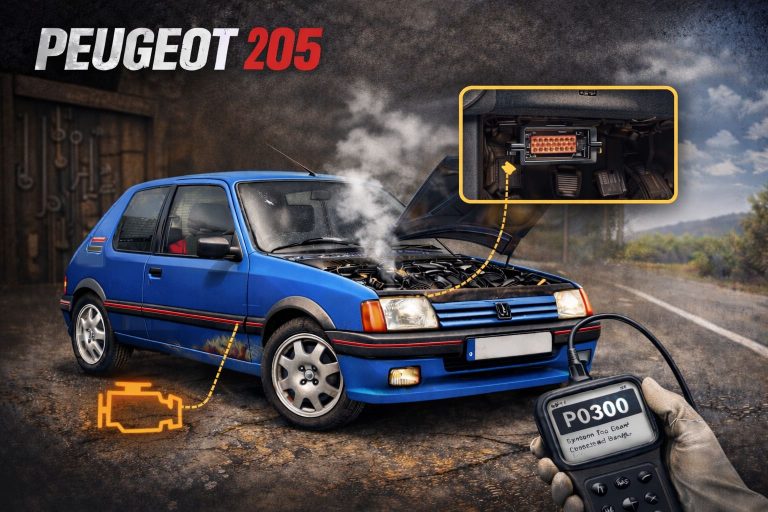
Locating the Diagnostic Port on a Peugeot 205
Finding the diagnostic port on a Peugeot 205 isn’t as straightforward as it is on modern cars. Many…
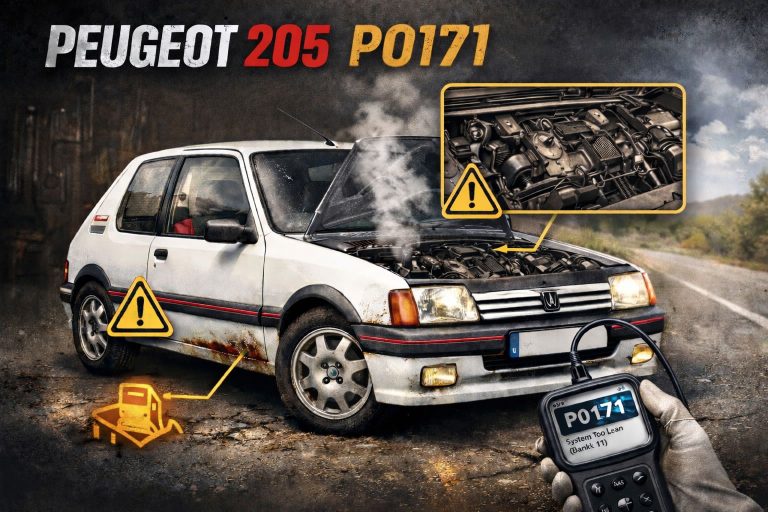
Understanding the P0171 Code on Peugeot 205
The P0171 code on the Peugeot 205 typically indicates a lean air-fuel mixture, meaning the engine is running…