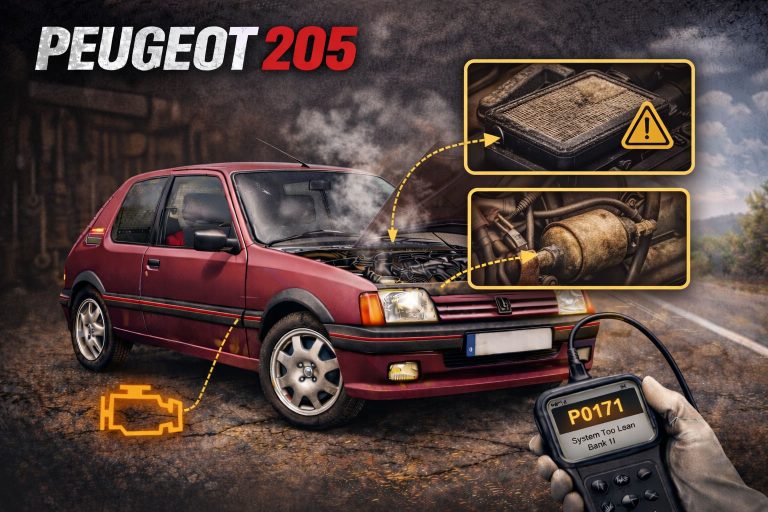
The P0171 code on the Peugeot 205 typically indicates a lean air-fuel mixture, meaning the engine is running with too much air or not enough fuel compared to what the engine management system expects. If your diagnostic tool shows this code, don’t jump to conclusions about a single faulty part. On a Peugeot 205, a P0171 can be triggered by an air leak, an intake issue, insufficient fuel delivery, a faulty sensor, or an injection anomaly. This code provides a clear direction but doesn’t replace thorough diagnostic reasoning.
In practice, P0171 is often associated with symptoms like unstable idle, engine stuttering, hesitation during acceleration, loss of smoothness, or an irregular running feel. Depending on the situation, the fault may be more pronounced when cold, at idle, or during acceleration. On a Peugeot 205, the vehicle’s context is crucial: age, condition of hoses, maintenance of the intake system, fuel quality, and the state of the spark plugs and ignition circuit all play a role. To fully understand this fault, one must consider the whole system rather than isolated parts.
What Does the P0171 Code Mean on a Peugeot 205?
The P0171 code means the engine control unit (ECU) detects a lean mixture. Simply put, this indicates that combustion is occurring with a higher proportion of air compared to the amount of fuel injected, or the engine behaves as if that were the case. The ECU continuously adjusts the mixture based on the information it receives, but when it reaches a certain level of correction or detects a persistent anomaly, it can log this fault.
On a Peugeot 205, this doesn’t automatically mean the engine is always starving for fuel. There are two main categories of causes to consider. Either the engine is receiving too much unwanted air where it shouldn’t, or it isn’t getting enough fuel, or a measurement element is misleading the engine management. This is why a P0171 must be analyzed methodically. The code indicates a “lean mixture,” but it’s essential to understand why the engine has reached this state.
This fault is particularly tricky because it can be confused with other behaviors. An air leak can produce the same symptoms as a clogged injector. Irregular fuel delivery can mimic an ignition problem. A sensor sending inconsistent information can mislead the ECU. The best reflex is to cross-reference the code, symptoms, and context of occurrence.
What Symptoms Can Accompany a P0171 on a Peugeot 205?
The symptoms of a P0171 code on a Peugeot 205 aren’t always dramatic at first. The engine may simply feel less smooth, a bit hollow, or exhibit slight stutters under low load. In other cases, the idle becomes unstable, especially when cold or during the first few minutes of operation. Hesitation during acceleration, decreased smoothness, or even stalling under certain conditions can also be observed.
When the fault is more pronounced, the car may stutter, respond sluggishly to the accelerator, or lack power during acceleration. Increased fuel consumption is also possible in some scenarios, not because the engine is genuinely “lean” at every moment, but because the management system tries to compensate or the driver has to push the engine harder to achieve the same result. An unusual smell, irregular exhaust, or engine behavior that changes with temperature can also provide useful clues.
It’s crucial to observe when the problem occurs. A P0171 that manifests primarily at idle doesn’t point to the same issues as a fault that primarily appears under load or during a cold start. If the Peugeot 205 runs fine on stable roads but hesitates in the city or at idle, the possibility of an air leak or a richness imbalance at low air flow becomes more credible. Conversely, if the fault worsens under load, the fuel delivery should be examined more closely.
Common Causes of a P0171 Code on a Peugeot 205
On a Peugeot 205, the most common causes of a P0171 revolve around the intake, fuel system, and elements influencing the mixture. The first major avenue, very frequent on older vehicles, is unwanted air ingress. A cracked hose, a worn connector, a loose clamp, a failing intake gasket, or a porous peripheral element can disrupt the mixture.
The second major avenue concerns fuel delivery. If the engine isn’t receiving the expected amount of fuel, the ECU may eventually detect a lean mixture situation. This can stem from insufficient pressure, a partially clogged injector, irregular fuel delivery, or imperfect operation of the fuel system. On a Peugeot 205, depending on the engine type and overall vehicle condition, this hypothesis should never be overlooked.
The third major avenue involves measurement and management elements. A worn sensor, inconsistent information, erroneous readings of the incoming air, or a disturbed interpretation of the mixture can lead to excessive corrections and the logging of a P0171. Finally, ignition issues shouldn’t be entirely ruled out. Poor combustion can sometimes create engine behavior that obscures the fault reading and makes it seem like a mixture problem when another weakness is exacerbating the situation.
Air Leaks: One of the First Hypotheses to Check
When an engine runs too lean, checking for air leaks is one of the first reflexes. On a Peugeot 205, the vehicle’s age makes this hypothesis particularly credible. Hoses age, connections dry out, some gaskets lose effectiveness, and the intake can allow unwanted air to enter without it being immediately obvious.
A small air leak can be enough to disrupt the mixture, especially at idle or under low load. It’s often under these conditions that the engine becomes irregular, the idle fluctuates, or the car hesitates slightly. An unwanted air ingress doesn’t necessarily cause a clear breakdown, but it disrupts operation to the point where the ECU ends up making constant corrections and eventually logs a P0171 fault.
The inspection should be both visual and logical. Check hoses, connectors, the intake area, the throttle body, clamps, and the area around the manifold based on the engine configuration. Even a seemingly minor defect can explain a lean mixture. This is why it’s essential to avoid immediately replacing expensive components without first ruling out this possibility.
Fuel and Injection: When the Engine Doesn’t Receive Enough Gas
If no obvious air leaks are found, it’s time to seriously consider the fuel delivery angle. An engine that receives too little fuel relative to its needs can logically trigger a P0171. On the Peugeot 205, this can stem from irregular fuel delivery, a clogged injector, insufficient flow, or pressure that isn’t properly maintained under operating conditions.
The symptoms can be very similar to those of an air leak: lack of smoothness, hesitation, engine stuttering, and less responsive acceleration. The difference is that fuel delivery often becomes more sensitive when the engine is under load. If problems worsen during acceleration or under load, this angle should be prioritized. Conversely, if the issue is mainly pronounced at idle, the intake often remains the first area to examine, even if both hypotheses can coexist.
It’s also important to remember that a partially clogged injector doesn’t always produce a dramatic fault. It can simply unbalance combustion during certain cycles and push the engine management to compensate until a P0171 is logged. Again, the key is not to replace blindly but to progressively check the entire relevant circuit.
Can a Sensor or Incorrect Information Cause a P0171?
Yes, absolutely. A P0171 doesn’t always mean the fault lies directly in the air or fuel. It can also arise from a misreading by the ECU. If a sensor sends inconsistent information, or if a critical value for managing the mixture is skewed, the applied correction can become excessive and lead to a lean mixture fault.
On a Peugeot 205, it’s essential to keep this hypothesis in mind, especially if basic checks don’t reveal anything clear. An erroneous signal can lead the engine management to incorrectly lean out or enrich the mixture or to believe that a richness imbalance exists. This is why a P0171 should never be interpreted as an absolute diagnosis. It’s an entry point, not a certainty.
In a thorough diagnostic process, one first checks the simplest, most probable, and most common causes. But if the fault logic doesn’t fit, one must know to look into the quality of the information used by the engine to manage combustion. This rigor helps avoid unnecessary replacements and dead ends.
Can You Drive with a P0171 Code on a Peugeot 205?
It depends on the severity of the symptoms. If the Peugeot 205 still runs correctly, without significant hesitation during acceleration or abnormal behavior, some drivers may continue to drive cautiously for a short period before addressing the cause. However, this doesn’t mean the problem should be ignored. An engine running too lean can, over time, perform worse, run hotter under certain conditions, and lead to other imbalances.
If the idle is very unstable, if the car stutters significantly, if it lacks power, or if it stalls, it’s better to limit trips and address the issue promptly. Driving for an extended period with poorly managed mixture isn’t a good habit. Even if the vehicle seems operable, the fault indicates that an imbalance exists and needs correction.
The best reflex is not to panic but also not to trivialize the situation. A P0171 on a Peugeot 205 should be taken seriously, especially if symptoms become repetitive. It’s not necessarily a severe fault, but it’s not a code to clear without understanding.
What Order Should You Diagnose a P0171 on a Peugeot 205?
The most effective method is to start with simple checks that align with the symptoms. First step: observe the engine behavior. Does the problem occur when cold, hot, at idle, during acceleration, in the city, under load? Second step: inspect the entire intake and any potential air leaks. On a Peugeot 205, this is often one of the most productive checks.
Third step: check the fuel delivery and the overall condition of the injection system. If the engine seems to lack fuel in certain situations, this angle should be prioritized. Fourth step: if nothing clear appears, broaden the reasoning to sensors, the information sent to the ECU, and other elements that could disrupt mixture management.
This step-by-step logic is essential. A P0171 doesn’t call for immediate replacement of parts “on intuition.” It requires a prioritization of possible causes. This approach distinguishes intelligent diagnostics from a series of costly and random trials.
Common Mistakes to Avoid with a P0171 Code
The first mistake is to believe that a P0171 automatically points to a single guilty part. This isn’t the case. The code refers to a result observed by the ECU, not a component that is definitely faulty. The second mistake is to immediately jump to an expensive replacement without inspecting the overall condition of the intake and hoses. On a Peugeot 205, the simplest causes are often the most realistic.
Another classic error is neglecting the context of occurrence. A fault when cold, at idle, or under load doesn’t lead to the same checks. Finally, don’t confuse clearing a code with repairing the issue. Deleting the code from the diagnostic tool may temporarily remove the alert, but if the cause still exists, the P0171 will generally return.
Key Takeaways on the P0171 Code for Peugeot 205
The P0171 code on the Peugeot 205 signals a lean mixture. In practice, this means combustion is unbalanced, with too much air or not enough fuel, or the engine management interprets the situation as such. The most common causes involve air leaks, intake issues, fuel delivery, injection problems, and certain management or measurement elements.
The most common symptoms include unstable idle, engine stuttering, hesitation during acceleration, and lack of smoothness. The right method is to observe the conditions under which the fault occurs, starting with the intake, then progressively expanding to fuel and engine management. On a Peugeot 205, this methodical approach is essential to avoid false leads.
If you want to delve deeper into the topic, it’s useful to also consult our dedicated guides on reading fault codes for the Peugeot 205, diagnostic taking, and other common symptoms like power loss, engine stuttering, or ignition misfires. By connecting codes, symptoms, and checks, you can achieve the most relevant diagnosis.