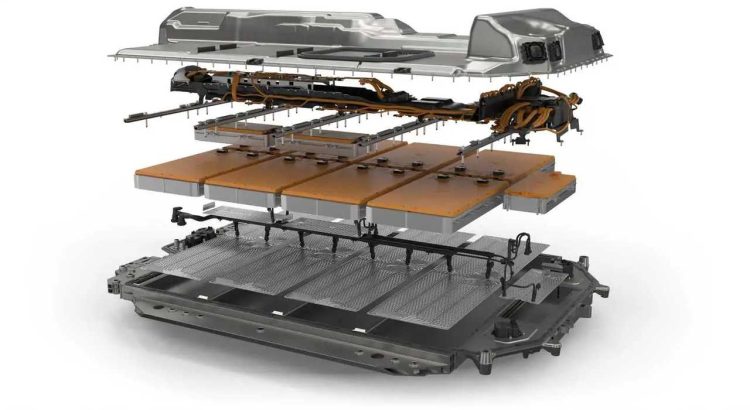
Advancements in battery technology are becoming more fascinating every day. Manufactured in China, a new liquid-solid electrolyte battery manages to retain 85% of its capacity even at -34 °C. A feat that could revolutionize not only electric drones but also the automotive sector.
A Step Towards the Future of Batteries
While waiting for a true solid-state battery to arrive, hybrid technologies are making great strides. Among them are liquid-solid electrolyte batteries, which present themselves as a promising solution. Chinese researchers from the Dalian Institute of Chemical Physics, under the leadership of Professor Zhang Meng, have developed a battery capable of withstanding extremely low temperatures without excessively losing its charge and discharge performance. After being exposed to -34 °C for 8 hours, this battery retains 85% of its effective capacity. An achievement worthy of the best science fiction films.
How Liquid-Solid Technology Works
To understand the innovation, let’s revisit the principle of a liquid-solid battery. In this type of battery, small amounts of liquid are added to a solid electrolyte, thereby optimizing contact with the electrodes and facilitating the passage of ions. This system differs from the semi-solid state battery, which uses a paste-like electrolyte, and the solid battery, where the “contact” liquid is completely absent.
Initially developed for industrial applications, liquid-solid technology proves particularly effective in conditions where traditional lithium-ion batteries show their limits. For example, some packs installed on electric vehicles can lose up to 50% of their capacity as soon as the temperature drops below -20 °C. With this new technology, electric vehicles could finally venture into areas where the cold reigns supreme.
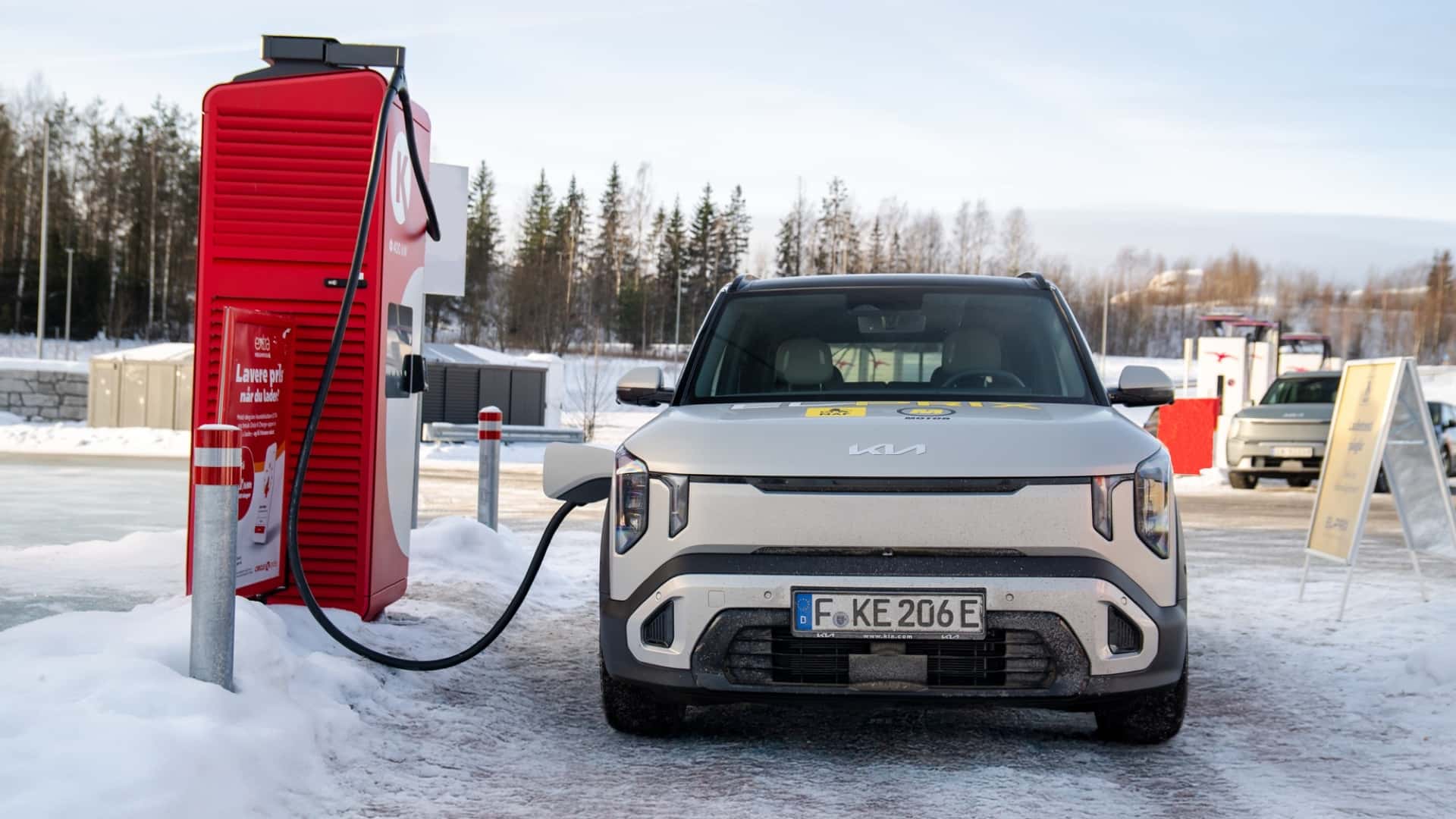
Kia EV2 during the El Prix Winter Test
No Need for Thermal Insulation
The tests conducted by the Chinese researchers were carried out on drones, capable of flying in extreme cold conditions thanks to this innovative battery. The results show that in addition to maintaining good overall capacity, energy is delivered consistently, without notable fluctuations. It’s as if these drones have found a way to warm themselves without adding a gram to their weight.
To manage discharge flows, Professor Meng integrated AI-based software, along with a series of specific components in the cells. This approach improves the stability of the power supplied while avoiding the often heavy and bulky thermal insulation solutions. Researchers are now tackling the crucial step of transitioning this technology from the experimental phase to an industrial and commercial phase.
An Alternative for Electric Vehicles
The prospect of using this technology in electric cars is exciting. Indeed, while lithium-ion batteries have been the queens of the road for several years, they are now facing fierce competition. Extreme weather conditions represent a major challenge for their range and efficiency. With a liquid-solid battery, electric cars could finally offer optimal performance even in hostile environments. Imagine an SUV capable of climbing snowy peaks without fearing that its range will melt away like snow in the sun.
Towards a Promising Future
As the world moves towards massive electrification of transport, advancements like these are crucial. Electromobility must become synonymous with efficiency and reliability, regardless of the conditions. If this liquid-solid technology manages to transition from the lab to the automotive industry, it could mark a turning point in the history of batteries. And who knows? Perhaps one day we will see electric vehicles facing winter storms without flinching.
It is clear that innovation knows no borders and that researchers continue to push the limits of the possible. In the meantime, let’s stay tuned for upcoming announcements that could well disrupt the global automotive landscape.