As the shift to electric vehicles accelerates, Europe is racing against time to establish its battery independence. The recently released Battery Atlas 2026 highlights an unprecedented industrial expansion, but the pressing question remains: can Europe truly compete with Asia in this critical arena?
A Thriving Industry on the Continent
The Battery Atlas 2026 report recently unveiled an impressive mapping of the battery value chain in Europe. It encompasses not just cell manufacturing, but also module production sites, material suppliers, and even recycling infrastructures. Nearly 120 companies are now engaged in this venture, a stark contrast to just a handful of sites in France and Germany fifteen years ago. An industrial renaissance is unfolding across the continent.
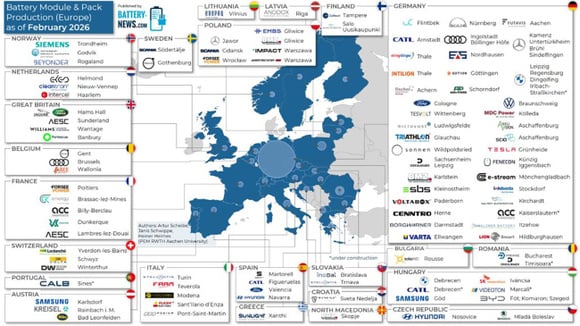
This momentum is particularly evident in Germany, which remains the nerve center of the ecosystem. The country hosts emblematic projects like Tesla’s Grünheide factory and CATL’s facilities in Arnstadt. These initiatives not only reflect the historical weight of the German automotive industry but also its commitment to leading the transition to electric mobility.
Shifting Production East: Poland Takes the Lead
While Germany stays at the forefront, much of the growth is shifting towards Central and Eastern Europe. Poland is emerging as a true production hub, with cities like Gliwice and Warsaw witnessing a surge in industrial projects. This trend is driven by lower production costs and public policies that favor investment. Hungary is also set to achieve impressive industrial capacity, attracting Asian giants like CATL and Samsung.
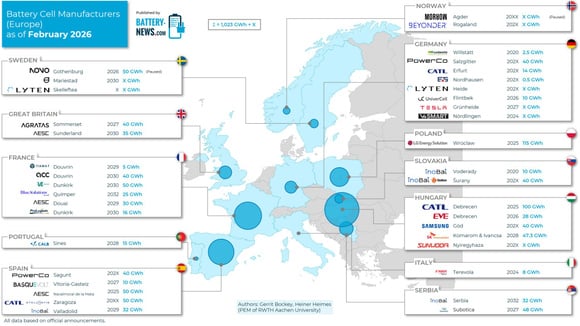
This geographical redistribution is significant. It underscores a major strategic challenge: industrializing battery production is becoming imperative not just for local economies but also for the continent’s energy sovereignty. In essence, Europe must bolster its capabilities to avoid becoming reliant on Asian imports.
France, Spain, and Portugal: Ambitions to Fulfill
Amid this dynamic, France is working to rebuild its battery industry. Projects are emerging in Dunkirk and Poitiers, with companies like ACC investing in these initiatives. The goal is clear: secure European production and reduce dependence on Asia. Spain is also positioning itself with several initiatives, particularly around SEAT and Volkswagen. Portugal is beginning to emerge with projects in the Sines region.
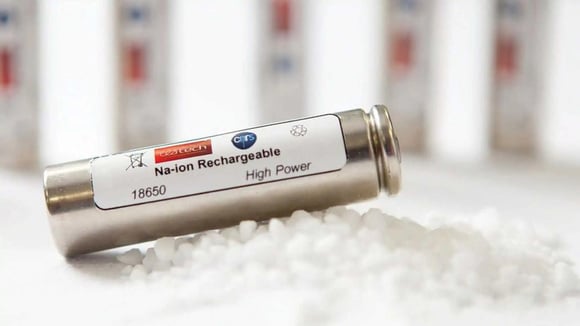
This drive for diversification is crucial. European countries are seeking to integrate into the battery value chain to secure their place in the global market. However, the road ahead is fraught with challenges, as these projects face significant financial and technical hurdles.
Unequal Competition: Asia Still in the Lead
Despite this buzz, Europe is still far from catching up. Over half of the planned production capacity, around 673 gigawatt-hours, is controlled by Asian companies. This dominance raises questions: how can Europe compete with players who have decades of experience in lithium-ion battery manufacturing? Moreover, many European projects are already suffering from delays and financial uncertainties, with some even facing bankruptcy.
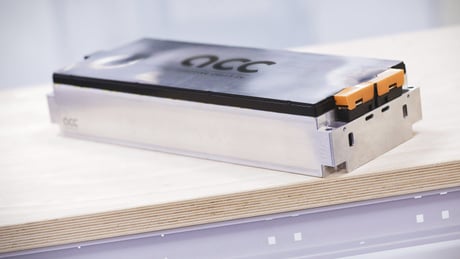
The outlook is grim: for now, Europe struggles to close the gap. The stated ambitions must be backed by genuine political and economic support to turn this momentum into tangible success.
A New Strategy: Betting on Disruptive Technologies
In light of this delicate situation, Europe could choose a different path. Instead of trying to mimic Asian leaders in lithium-ion batteries, it could invest in emerging technologies. Solid-state, lithium-sulfur, or sodium-ion batteries represent promising alternatives. These innovations could offer superior energy density and reduced environmental impact.
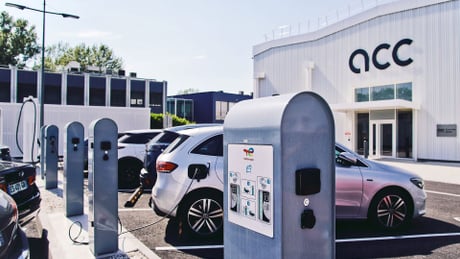
If these technologies can be industrialized, they could redefine global competition in the battery sector. The stakes are high: it’s not just about producing batteries, but doing so sustainably and innovatively. In short, Europe must take the risk to innovate to avoid falling behind.
In Summary
- Europe is heavily investing in electric vehicle battery production.
- Poland and Eastern Europe are becoming key industrial hubs.
- France, Spain, and Portugal are striving to catch up.
- Despite this, Asia remains dominant in the global battery market.
- Disruptive technologies could provide a chance to close this gap.
In conclusion, the future of the battery industry in Europe hinges on its ability to innovate and diversify production. The challenges are many, but so are the opportunities. In the medium term, the success or failure of this strategy will determine not only Europe’s position in the global market but also its energy independence against Asian giants.