


Mick Doohan isn’t reaching for the lazy “it was better back then” take. The Australian looks at modern MotoGP with real respect, but he does put his finger on one specific issue: aerodynamics that make passing harder and, at times, make the pecking order tougher to read. That matters because this isn’t nostalgia talking or PR spin. It’s the view of a former ruler of the championship.
Doohan isn’t looking for “the next Doohan,” and that’s exactly why his read lands
Right from the start, this isn’t about longing for another era. It’s about how Doohan sees the current generation. The five-time world champion, with 54 Grand Prix wins according to the source draft, makes it clear he has no interest in trying to label anyone “the new Doohan.” More than a polished quote, that stance gives his argument credibility. He’s not measuring today’s riders with an old yardstick.
That separates him from the retired champion who hands out verdicts from the couch. Doohan acknowledges that every era creates its own front-runners, benchmark bikes, and rulebook arguments. The bigger point, then, isn’t old versus new. It’s how today’s technical direction shapes the racing itself. That’s where his comments get interesting, because he moves away from legacy and back toward the riding.
For readers tracking the bigger championship picture, there’s more discussion over in the MotoGP category. Here, Doohan’s line is pretty clear: you can admire today’s riders without endorsing every byproduct of the rules.
Aerodynamics, in his view, remain the real pressure point in modern MotoGP
Doohan isn’t tearing the whole thing down. He’s not saying the current riders are less talented, and he’s not arguing that electronics have turned the series into an assisted exercise. But he does isolate one area: aerodynamics. That’s the piece he openly questions, with a simple idea behind it — do these bikes really need this much aero at this level?
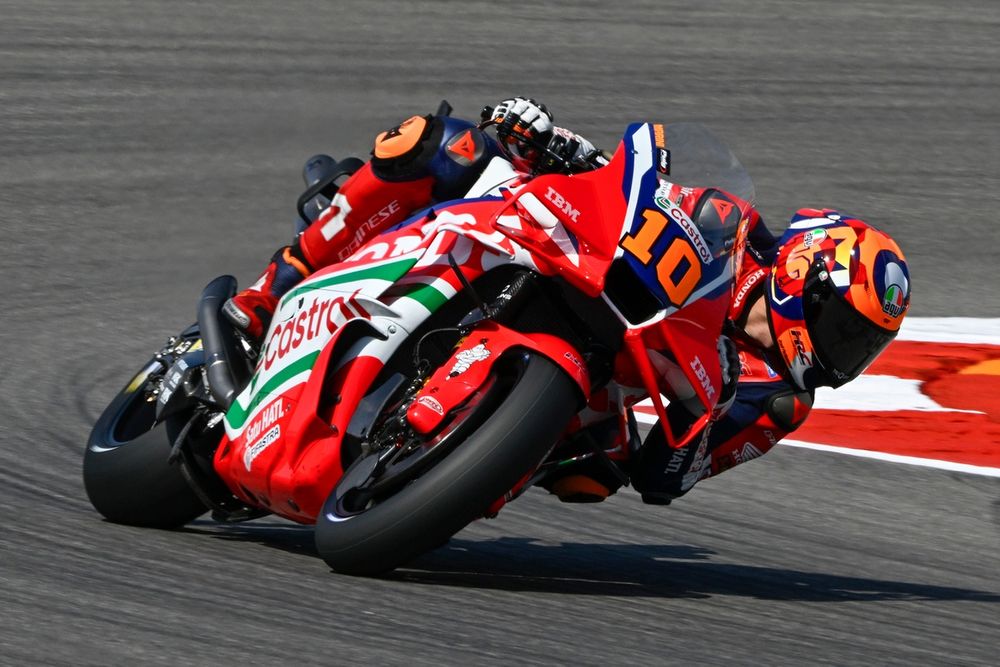
That criticism isn’t some side note. For several seasons now, aero has sat at the center of MotoGP’s biggest debates because it affects stability, behavior under braking, and the ability to follow another bike closely. In plain terms, it changes how riders attack. The flair is still there, but now it has to work around bikes that are more sensitive to dirty air, machines that need clean space to really breathe.
Doohan’s point is that charging back through the field or erasing a mistake looks harder than it did in the peak years of Marc Márquez or Valentino Rossi. He’s not saying those rides are gone for good. He’s saying they feel less natural now. That distinction matters. The issue isn’t speed. It’s racing freedom.
His argument goes beyond the tech: qualifying matters even more when passing gets tricky
Doohan also brings up a truth that tends to get lost in the noise: qualifying has always mattered. But it carries even more weight when aero and bike characteristics make life harder in traffic. On the grid, a few tenths are no longer just the difference between rows. They can be the difference between racing forward on Sunday and spending the afternoon stuck in someone else’s exhaust.
His reading stays balanced. He admits there are usually two or three riders capable of winning, just like in the past. So that part isn’t new. What does seem different is how hard it is to overturn the established order once the race gets going. When outright pace is paired with a strong bike and a good starting spot, the race can close up fast.
That has a direct effect on the show, but also on how riders are judged. A bad Saturday now comes with a steeper Sunday bill. Over time, that naturally favors the most complete bikes and the rider-bike pairings with the most confidence, while giving less room to the pure improvisers who used to rescue weekends in the middle of chaos.
Aprilia up front, Ducati harder to read: Doohan asks the right question without forcing an answer
Another reason his comments stand out is that he isn’t trying to play prophet after a handful of races. The draft refers to the first three Grands Prix being won by Aprilia, and Doohan’s response is to ask a question rather than deliver a verdict: has Aprilia really taken a step, or has Ducati lost a little of its margin? That’s a smart way to read an early season, especially in a series where development can shift the balance quickly.
His uncertainty around Ducati gets more specific than that. He questions the perceived level of the VR46 bikes compared with the factory Ducatis and, behind that, the direction of the development path. In MotoGP, that’s a major point. The order isn’t determined only by the raw value of an engine or chassis, but by how coherent the whole package is and which technical choices get locked in as the season unfolds.
Without more evidence, there’s only so far you can push that argument. But the question itself carries weight. When a former champion of Doohan’s caliber says he doesn’t fully understand what he’s seeing from Ducati, it tells you something important: the hierarchy may be less fixed than it used to be. For the championship, that’s a healthy place to be.
Bezzecchi, Martín, Marini, Bagnaia: Doohan hands out respect, not shortcuts
What jumps out in his comments is the lack of snap judgment. Marco Bezzecchi gets praise for the work he’s doing with Aprilia. Jorge Martín is described as spectacular despite his injuries, while Luca Marini is framed as a convincing surprise at Honda after a difficult exit from his previous situation. Again, Doohan isn’t just reading down the results sheet. He ties performance to context, which is rarer than it should be.
His tone shifts slightly with Bagnaia, but without drifting into easy suspicion. Doohan says he doesn’t know what has happened to him, while also reminding everyone of his talent and his dominance across two championships. In other words, he refuses to reduce an apparent dip in form to one neat explanation, whether technical or mental. MotoGP loves instant verdicts. Doohan doesn’t.
There’s also a very direct kind of respect in the way he talks about Martín. He sees a rider who is fast, mentally strong, and capable of bouncing back after a rough stretch. That’s more than a compliment. It’s a reminder that in MotoGP, outright speed only carries you so far if the situation around you isn’t stable.
Pedro Acosta points to what’s next, but Doohan also states a brutal paddock truth
Pedro Acosta naturally gets Doohan’s attention. He praises the young rider’s talent and what he has been able to extract from a KTM he views as highly competitive in Acosta’s hands. The draft mentions a future move to Ducati, but without official confirmation in the source text, that remains projection rather than fact. Even so, the projection says plenty on its own: Acosta is already being viewed as a rider who could soon operate on a bigger stage.
From there, Doohan imagines a showdown with Marc Márquez. It’s an appealing picture, maybe a little too perfect: the veteran still hunting and the young star arriving without asking permission. But his point goes further than the matchup itself. For Doohan, a teammate is never the excuse and never the central problem. If you want the title, you have to beat everyone, starting with the rider in the other side of your own garage. It’s blunt, but it’s true to how the paddock works.
His comparison with F1 serves less to blur the categories than to underline a top-level rule that applies everywhere. The established star doesn’t get to choose his rival; he has to absorb the challenge. And the newcomer has to prove it, not promise it. On that, Doohan is completely consistent.
What to take away from Doohan’s view of today’s MotoGP
Mick Doohan’s argument comes down to one clean line: modern MotoGP deserves respect, but it shouldn’t be beyond criticism. His admiration for today’s riders feels genuine precisely because it doesn’t cancel out what bothers him about the series’ technical direction. The obvious limit to his view is that it raises more questions than answers about the true balance between Aprilia and Ducati right now.
- Doohan refuses to compare the new generation to his own.
- His main criticism is aimed at aerodynamics, not rider talent.
- He believes passing and charging through the field have become harder.
- He sees the current balance between Aprilia and Ducati as still unclear.
- He stresses the performance context around Bezzecchi, Martín, Marini, and Bagnaia.
- On Acosta and Márquez alike, he argues that any title contender has to beat his own teammate first.
The takeaway is straightforward. If you want a final verdict on the season, this isn’t it. If you want a sharp framework for understanding the push and pull between regulations, racing quality, and the championship order, Doohan is pointing to the right place. That’s more useful than a paddock prophecy. And over the next few years, as MotoGP keeps wrestling with aero and how much it should shape the show, this debate is only going to get louder for riders, teams, and fans alike.


